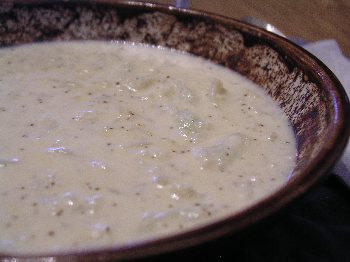
Delicious! I make this frequently in cooler weather.
- Carbohydrate 13.7248390625 g
- Cholesterol 75.5546875 mg
- Fat 25.4275675 g
- Fiber 3.07870313224196 g
- Protein 11.0307790625 g
- Saturated Fat 15.27498125 g
- Serving Size 1 1 Serving (215g)
- Sodium 279.0295 mg
- Sugar 10.646135930258 g
- Trans Fat 1.956968 g
- Calories 317 calories
Step-by-step
- In Dutch oven combine cauliflower and a small amount of lightly salted water.
- Bring to a boil; reduce heat.
- Simmer, covered, for 8 to 10 minutes or until tender.
- Drain cauliflower; set aside in medium bowl.
- In the same Dutch oven melt butter.
- Stir in flour, celery seed and pepper.
- Add half and half and broth all at once.
- Cook and stir until slightly thickened and bubbly.
- Cook and stir for 1 minute more.
- Add cooked cauliflower.
- Using a potato masher, mash some of the cauliflower to slightly thicken the soup.
- Add cream cheese and velveeta.
- Cook over very low heat for 5 minutes or until cheeses are melted, stirring occasionally.
- Season to taste with salt if desired.
The Starch Foundation
Butter and flour cooked together form a roux that prevents dairy proteins from separating under heat. Whisking half-and-half and broth into this cooked paste all at once prevents lump formation by hydrating the starch granules uniformly. Celery seed provides an aromatic background note without introducing visible specks that might distract from the smooth visual aesthetic. Raw flour requires cooking for at least one minute after bubbling begins to eliminate any lingering raw taste.Texture and Processing
Mashing cooked cauliflower directly in the pot releases endogenous starches into the liquid, acting as a natural body-builder alongside the roux. Over-blending or using a high-speed immersion blender can push cauliflower past a velvety threshold into a gluey texture by shearing the cell walls too aggressively. Retaining some whole florets offers textural contrast against the homogenous background of the melted cheese base. Cream cheese and processed cheese products introduce emulsifying salts that maintain a stable suspension when melted over low heat.Reheating and Storage
Dairy-heavy soups split easily when subjected to aggressive boiling due to protein coagulation. Store this soup in an airtight container in the refrigerator for up to four days. Reheat portions gently over medium-low heat, stirring continuously to prevent scorching at the bottom of the pan. Freezing is generally discouraged because the emulsion in the half-and-half and processed cheeses will break upon thawing, resulting in a grainy texture and separated fats.


