Swedish Meatballs
Swedish meatballs are probably one of the best-known Swedish dishes. IKEA made Swedish meatballs popular in the USA and I have them every time I go! There are so many different varieties of Swedish meatballs, depending on the region, family, and of course personal tastes. I've perused hundreds of recipes both in books and online for years before deciding on this particular combination of ingredients. If you haven't tried this kind of meatball before, you're in for a treat! Swedish meatballs might taste completely different than other meatballs, but just like my other meatballs, these were very well received. Give them a whirl and see what people say!
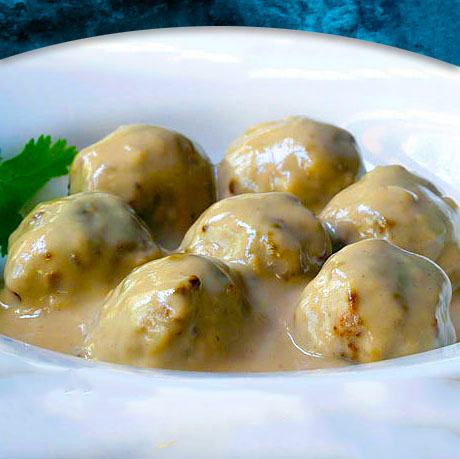
Swedish meatballs are probably one of the best-known Swedish dishes. IKEA made Swedish meatballs popular in the USA and I have them every time I go! There are so many different varieties of Swedish meatballs, depending on the region, family, and of course personal tastes. I've perused hundreds of recipes both in books and online for years before deciding on this particular combination of ingredients. If you haven't tried this kind of meatball before, you're in for a treat! Swedish meatballs might taste completely different than other meatballs, but just like my other meatballs, these were very well received. Give them a whirl and see what people say!
- 1/4 cup all-purpose flour
- 1 egg
- 1 pound ground beef
- 1/4 cup milk
- 1/2 cup sour cream
- 1/2 teaspoon ground allspice
- 3 tablespoons butter
- 3 tablespoons olive oil
- 1/2 cup heavy cream
- 3 cups beef broth
- 1 pound ground pork
- 1/2 teaspoon nutmeg
- 1/2 cup finely chopped onion
- 1 slice wheat bread
- salt & ground black pepper
- 1/2 cup flour for rolling the meatballs
- ==== sauce ====
- salt & ground black pepper
- 2 tablespoons minced fresh dill weed
- Carbohydrate 128.7355175372 g
- Cholesterol 707.224686776616 mg
- Fat 154.051189308652 g
- Fiber 3.64575002265198 g
- Protein 107.158822845894 g
- Saturated Fat 73.5108984584256 g
- Serving Size 1 1 Recipe (1787g)
- Sodium 2718.83246588201 mg
- Sugar 125.089767514548 g
- Trans Fat 15.4796769373007 g
- Calories 2331 calories
Step-by-step
- Preheat a large skillet on medium heat. Add oil.
- Place the slice of bread in a deep dish and pour the milk over it. Set aside
- In a large mixing bowl, combine ground beef, ground pork, chopped onion, egg, nutmeg, allspice, salt and pepper. Squeeze most of the milk out of the bread and crumble it into the meat. Mix very well until completely combined
- Dust your hands with flour, scoop out the meat with a soup spoon and roll the meatballs (about 1" size meatballs). Keep lightly dusting with flour while rolling the meat into a ball.
- Add the meatballs into the hot skillet. Cook covered on medium heat until completely cooked, flipping halfway through.
- Take out the meatballs and save the meat juice. The juice from the meatballs is used in the sauce.
- Heat butter in the same skillet over medium heat, whisk in flour to form a roux.
- Add the meatball meat juice slowly while stirring constantly. Slowly add the beef stock, keep stirring constantly. Whisk until smooth.
- Add the salt, pepper, heavy cream and sour cream. Whisk until combined. Bring to boil, still on medium and add the minced dill weed.
- Add the meatballs to the sauce. Cook together for about 5-7 minutes.
- Serve with pasta, roasted potatoes or mashed potatoes.
Historical Context
Traditional versions of this Nordic staple rely on a distinct spice profile featuring ground allspice and nutmeg. These warm aromatics separate the regional preparation from Italian or American meatballs, bridging medieval spice trading routes with comforting home cooking. Local interpretations often adjust the pork-to-beef ratio, but the foundational inclusion of pan-softened bread soaked in milk remains constant to keep the protein tender.
Pan Mechanics and Roux Building
Cook the meatballs in a wide skillet over medium heat to ensure proper browning without scorching the exterior before the center reaches safety. Reserve the rendered meat juices completely. Whisking those drippings directly into a butter-and-flour roux creates the structural base for the gravy. Slow incorporation of three cups of beef broth prevents lumping, while heavy cream and sour cream added at the end deliver richness without curdling.
Batch Scaling Dynamics
Doubling this formulation requires careful management of pan surface area. Overcrowding the skillet traps moisture, steaming the meat instead of searing it. Maintain batch cooking in single layers to preserve the essential fond needed for the sauce.


