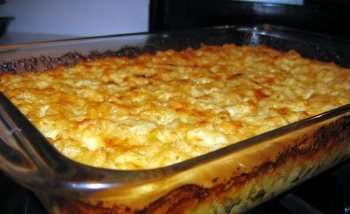
World's Best Macaroni and Cheese!
- 1/2 teaspoon black pepper
- 2 egg yolks
- 1 tablespoon olive oil
- 1/4 teaspoon nutmeg
- 2 teaspoons worcestershire sauce
- 1 cup half-and-half cream
- 1 cup heavy cream/whipping cream
- 8 ounces extra sharp cheddar cheese grated
- 8 ounces fontina cheese grated
- 8 ounces gruyere grated
- 8 ounces parmesan cheese grated
- 16 ounces pasta pasta shape of your own choosing, i prefer medium/large shells
- Carbohydrate 35.6851011194338 g
- Cholesterol 264.477305524383 mg
- Fat 52.8392889688274 g
- Fiber 0.0209249994754791 g
- Protein 42.2620682118407 g
- Saturated Fat 31.3555937853383 g
- Serving Size 1 1 Serving (236g)
- Sodium 985.865851921735 mg
- Sugar 35.6641761199584 g
- Trans Fat 3.14473054044354 g
- Calories 787 calories
Step-by-step
- Heat oven to 400 degrees F.
- Grease a large casserole dish (3 to 4 quarts or roughly 9"X13" pan).
- Cook pasta according to instruction for your chosen shape al-dente (you can skip forward and start #4 while this is cooking). Toss pasta in olive oil when finished to prevent sticking.
- Combine cream, half-and-half, egg yolks and nutmeg in a good-sized sauce pan over medium heat. Add 1.5 cups of each of the cheeses. Stir frequently until all cheese is melted (about 10 minutes), being sure not to let it boil (boiling causes the cheese to "break" and gives it a distinct broken-down rubbery feel). Add Worcestershire sauce and pepper.
- Place pasta in the casserole dish, and coat with melted cheese mixture. Stir to make sure everything is well-coated.
- Sprinkle remaining uncooked cheese on top.
- Bake for 15 minutes.
- When the edges have turned golden brown, crank the oven up to broil for about a minute and keep cooking until the top is golden brown, 2 or 3 minutes.
- Pig out!!!
Swapping fontina for low-moisture mozzarella shifts this bake from a sharp, complex profile toward a stretchy, mild pull. Traditional American comfort food relies entirely on how dairy interacts with heat. Four distinct cheeses—cheddar, fontina, gruyere, and parmesan—bring varying levels of moisture and fat to the dish. Grating these blocks from scratch rather than buying pre-shredded bags prevents anti-caking agents like cellulose from altering the final sauce consistency.
The Mechanics of Melting Cheese
Proteins in dairy tighten rapidly when exposed to excessive heat, squeezing out fat and creating a gritty, separated sauce. Keeping the saucepan at a true medium heat protects the emulsion. Egg yolks act as an essential binder, introducing lecithin to stabilize the heavy cream and half-and-half mixture. Boiling the sauce will break the cheese instantly, turning a smooth matrix into a rubbery curd.
- Maintain a gentle medium heat during sauce preparation to prevent protein separation.
- Toss boiled pasta in olive oil immediately after draining to block starch from absorbing excess fat.
- Watch the oven closely during the final two to three minutes of broiling to achieve a golden brown crust without burning.



