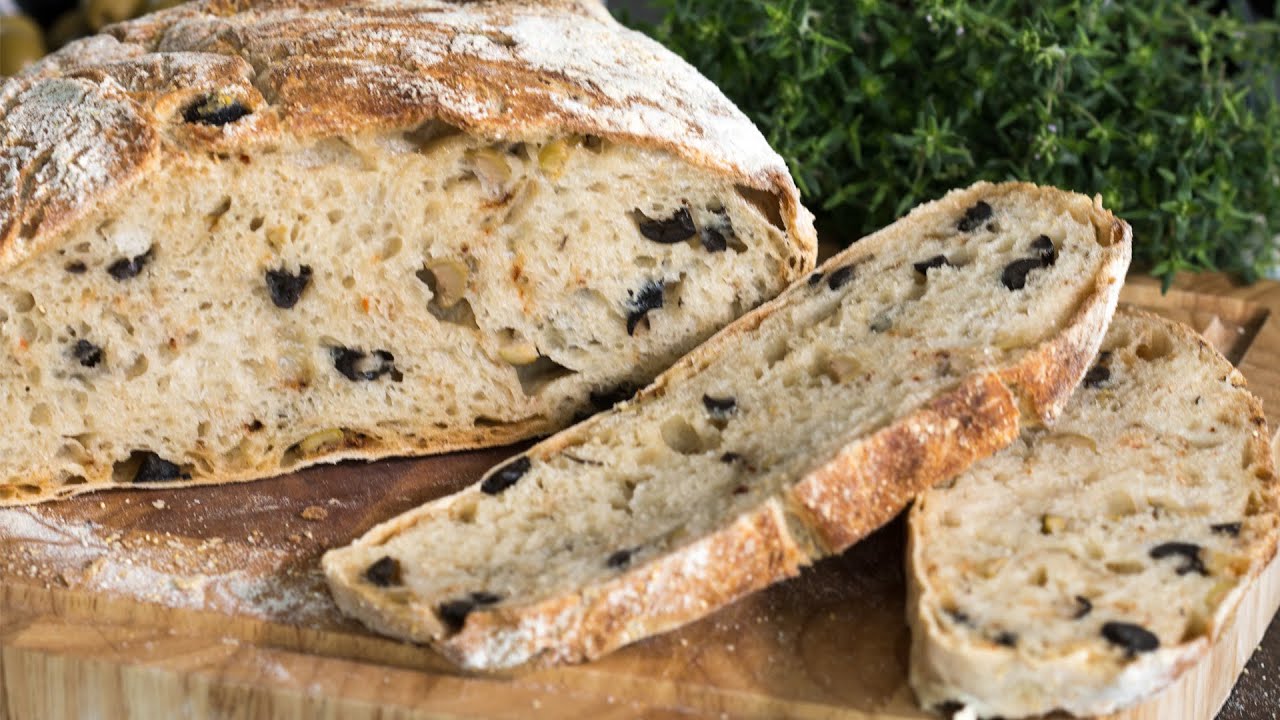
Try this Olive Bread recipe
- 2 ts salt
- 2 tb sugar
- fresh basil leaves
- 1 c warm milk; (about 110
- 2 tb yellow cornmeal
- 5 c flour -; (to 5 1/2 cups)
- 3 oz thinly-sliced proscuitto
- 1/2 c yellow cornmeal; plus
- 1 c tapenade i; see * note
- 1 c warm water; (about 110
- 1 pk active dry yeast
- 2 oz parmigiano-reggiano cheese;
- 1 bottle extra-virgin olive
- Carbohydrate 51.76774688786 g
- Cholesterol 24.947580328 mg
- Fat 8.65327980891 g
- Fiber 2.74250000029802 g
- Protein 13.66057033426 g
- Saturated Fat 5.004167241531 g
- Serving Size 1 1 Serving (129g)
- Sodium 438.599833199 mg
- Sugar 49.025246887562 g
- Trans Fat 0.610493226791001 g
- Calories 330 calories
Step-by-step
- Preheat the oven to 350 degrees.
- In the bowl of a standing electric mixer, whisk the yeast with the water and milk. Let the mixture stand for about 5 minutes, or until the yeast has dissolved. Whisk in the sugar, 1/2 cup of cornmeal and the Tapenade. Add the flour. Using a dough hook and the machine on low, mix until the dough starts to come together. Increase the speed and continue mixing until the dough comes away from the sides and crawls up the dough hook. Turn the dough out into a greased bowl and cover. Let the dough rise until double in size.
- Turn the dough out onto a floured surface, punch down and divide the dough in half. Shape each half into individual loaves. Sprinkle the baking sheet with the remaining cornmeal. Place the loaves on the baking sheet. Cover the loaves and let the dough rise until double in size.
- Using a sharp knife, make several slits across the top of the loaves. Bake the loaves for about 35 to 40 minutes, or until the bread is golden brown. Remove from the oven and cool on a wire rack.
- Serve the hot bread with olive oil, Proscuitto, cheese and basil.
Hydration and Yeast Activation
Working with enriched doughs requires careful temperature management to ensure proper yeast activity. Water and milk should be maintained between 105 and 110 degrees Fahrenheit; exceeding 120 degrees will kill the active dry yeast, while temperatures below 90 degrees significantly delay fermentation. When incorporating the tapenade directly into the liquid base, the high salt content of the olives will naturally slow down yeast reproduction. Compensate for this by allowing the initial bulk fermentation to proceed until the dough has cleanly doubled in volume, which typically takes between 45 and 60 minutes in a draft-free environment.Mixing and Gluten Development
The incorporation of cornmeal and dense olive paste creates mechanical drag that inhibits standard gluten formation. Using a standing electric mixer fitted with a dough hook is strongly recommended, though hand-kneading is possible if you increase the rest periods between folds. Run the mixer on low until the flour hydrates fully, then increase the speed to medium-high. Watch for the dough to completely clear the sides of the bowl and climb the hook, indicating that the protein strands have achieved sufficient elasticity to trap the expanding gas.Crust Formation and Scoring
Baking at 350 degrees Fahrenheit allows the interior starches to gelatinize before the exterior browns excessively. Sprinkling yellow cornmeal on the baking sheet acts as a physical barrier preventing the bottom crust from scorching while promoting a crisp texture. Before loading the pans into the oven, slash the top of each loaf deeply with a sharp blade to direct the final oven spring. Cool the finished loaves entirely on an open wire rack to prevent moisture condensation from softening the crust.


