Chicken-Fried Steak with Cream Gravy
In Texas, no other comfort food reigns supreme more than chicken-fried steak, or as Texans affectionately call it CFS. Traditionally, this Texan delicacy is a cutlet of top-round beef that has been tenderized, pounded thin, battered and fried in a cast-iron skillet (much like fried chicken, hence the name), and served with cream gravy. In this recipe, to seal in the meat juices, I use a wet-dry-wet method of preparation. That is, the steak goes into a wet mix, then a dry mix, then back into the wet mix (method adapted from a recipe in The Threadgills Cookbook). The use of baking soda and baking powder with the buttermilk will make for a lightly crunchy exterior. This same basic method of preparation works equally well for frying chicken cutlets or center-cut, boneless pork chops.
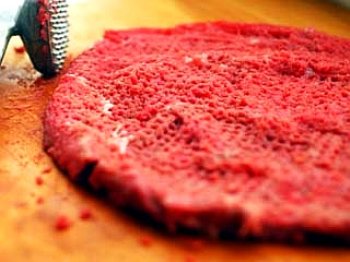
In Texas, no other comfort food reigns supreme more than chicken-fried steak, or as Texans affectionately call it CFS. Traditionally, this Texan delicacy is a cutlet of top-round beef that has been tenderized, pounded thin, battered and fried in a cast-iron skillet (much like fried chicken, hence the name), and served with cream gravy. In this recipe, to seal in the meat juices, I use a wet-dry-wet method of preparation. That is, the steak goes into a wet mix, then a dry mix, then back into the wet mix (method adapted from a recipe in The Threadgills Cookbook). The use of baking soda and baking powder with the buttermilk will make for a lightly crunchy exterior. This same basic method of preparation works equally well for frying chicken cutlets or center-cut, boneless pork chops.
- 1 teaspoon baking soda
- 1 1/2 teaspoons ground cumin
- 2 teaspoons baking powder
- 2 large eggs
- 3 cups unbleached all-purpose flour
- 1 teaspoon salt or to taste
- -- steak --
- 6 6-oz beef top-round steaks tenderized and at room temperature, (see *)
- 2 1/2 teaspoons meat seasoning (recipe below)
- 2 cups buttermilk at room temperature
- 4 cups peanut or canola oil (up to 5 cups)
- -- cream gravy --
- 1/4 cup leftover seasoned flour (up to 1/3 cup)
- 4 cups milk at room temperature
- 1/2 teaspoon bblack pepper or to taste
- 2 teaspoons worcestershire sauce or to taste
- 1/4 teaspoon tabasco sauce (or your favorite pepper sauce), or to taste
- -- meat seasoning --
- 1/2 cup kosher salt
- 4 tablespoons granulated garlic or powdered
- 2 tablespoons granulated onion or powdered
- 4 tablespoons black pepper
- 2 tablespoons white pepper
- 2 tablespoons paprika
- 1 1/2 teaspoons ground cayenne pepper
- Carbohydrate 63.7260561140153 g
- Cholesterol 370.6435 mg
- Fat 158.153725416703 g
- Fiber 7.73442716130853 g
- Protein 29.9753765633069 g
- Saturated Fat 29.1480866458398 g
- Serving Size 1 1 Serving (472g)
- Sodium 5249.22651733274 mg
- Sugar 55.9916289527067 g
- Trans Fat 9.16141825001098 g
- Calories 1760 calories
Step-by-step
- Prepare the Meat Seasoning by combining all ingredients together and mixing until well blended. Place mixture in a tightly sealed glass or plastic container, and store in a dark place for future use. Shake before each use to remix ingredients. Makes about 1 1/3 cups seasoning.
- For the Steaks: Have your butcher twice-tenderize the steak if possible. Cut the steak into equal portions and, if needed, lightly pound steaks with a meat mallet until they are about 1/4- to 1/3-inch thick, set aside to come to room temperature.
- Adjust an oven rack to the middle position, set a wire rack over a rimmed baking sheet, and place the sheet on the oven rack; heat the oven to 200 degrees F. Line a large plate with a double layer of paper towels. Heat 1 inch of oil in a deep 11- to 12-inch diameter cast-iron skillet or Dutch oven, over medium-high heat, to 375 degrees F (oil should pop loudly when a drop of egg mixture is dropped in).
- Combine flour and meat seasoning in a large shallow dish. In a second large shallow dish, beat the eggs, baking powder, and baking soda; stir in the buttermilk (the mixture will bubble and foam).
- Pat the steaks dry with paper towels and lightly sprinkle each side with meat seasoning to taste. Working with three steaks at a time, dip each steak into the egg mixture then dredge in the flour mixture. Shake off any excess flour, and dip again in the egg mixture. Using a long-handled meat fork or long metal tongs, very gently place the wet steaks into the hot oil (be extremely careful...there will be regular "explosions" of very hot oil as steaks cook). Fry for 3 to 5 minutes or until breading is set and deep golden brown. Gently turn steaks and fry for another 3 minutes (oil temperature will drop to around 335 degrees). Transfer the steaks to the paper-towel-lined plate to drain, then transfer them to the wire rack in the oven. Bring the oil back to 375 degrees and repeat the breading, cooking and draining process (use fresh paper towels) with the three remaining steaks.
- For the Pan Drippings Cream Gravy: After the chicken fried steaks are removed from the pan, pour off the oil through a strainer. Leave about 1/3 to 1/2 cup of pan drippings in the bottom of the skillet along with as many of the browned bits and cracklings (from the seasoned coating) as possible. Return any browned cracklings from the strainer to the skillet before starting the gravy.
- Heat the oil over medium heat until hot. Sprinkle with enough leftover seasoned flour to absorb most of the oil, approximately 1/4 cup. Blend with a wooden spoon or whisk, scraping loose browned bits from the bottom and sides of skillet, until mixture becomes bubbly, smooth and golden brown. Gradually whisk in the milk, stirring constantly and mashing out any lumps, until the gravy begins to boil. Lower heat and whisk mixture continuously until it is smooth and reaches desired consistency (gravy should have a loose consistency--it will thicken as it cools). Check seasoning, add salt and pepper to taste. Add the Worcestershire and Tabasco sauces, whisking until smooth.
- Transfer the chicken-fried steaks to individual plates. Spoon a generous amount of gravy over each steak. Serve immediately, placing any remaining gravy in a small bowl. Accompany with mashed potatoes, greens, black-eye peas, and cornbread, or biscuits.
Temperature control dictates the outcome of this dish before the beef even touches the pan. Bringing the cooking oil to a precise 375 degrees F ensures the coating sets instantly on contact, preventing the crust from absorbing excess fat or sliding off the meat. Maintaining that heat requires patience between batches, as dropping cold cutlets into cast iron causes an immediate thermal dip down to roughly 335 degrees F. Allowing the oil to recover its initial heat before adding the next batch prevents soggy results.
The Science of the Double-Dip
Chemical reactions drive the exterior texture through a wet-dry-wet staging process. Combining baking powder and baking soda with buttermilk generates immediate carbon dioxide bubbles, creating an aerated batter that puffs slightly upon hitting the hot oil. Double-dipping locks this porous layer around top-round cutlets, sealing natural juices inside while building a thick, rigid crust capable of supporting a heavy pour of pan gravy.
- Oil smoking excessively? The heat is too high; reduce the burner output slightly and let the thermometer stabilize at 375 degrees F.
- Gravy turning lumpy? Whisk continuously while pouring milk in a slow, steady stream to prevent flour proteins from clumping together.
- Breading detaching from the beef? Ensure cutlets are thoroughly patted dry with paper towels before seasoning and dredging.


