Blender Pancakes
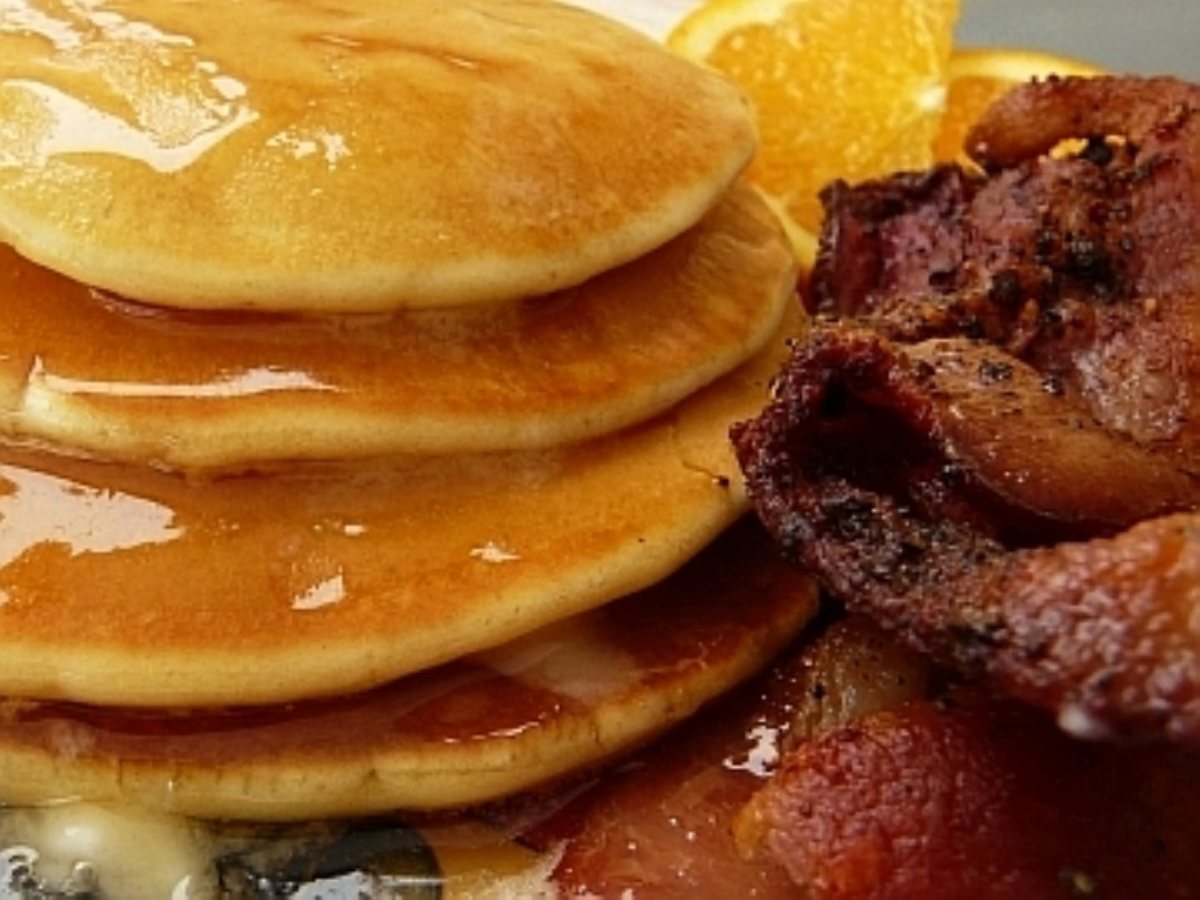
Aunt Virginia's Blender Pancakes are a time-honored family favorite. As a young boy, I spent a lot of time at my paternal grandmother's house. For breakfast, my grandma would always make Nalesniki (a.k.a. Polish crepes) for us kids. But when my father's third oldest sister was there, she would make a big breakfast consisting of her delicious blender pancakes accompanied by thick strips of bacon. These blender pancakes are very easy to make; just place all the ingredients in a blender, mix everything together for the shortest time, then pour...it's that simple, and actually turns out perfect pancakes every time.
Aunt Virginia's Blender Pancakes are a time-honored family favorite. As a young boy, I spent a lot of time at my paternal grandmother's house. For breakfast, my grandma would always make Nalesniki (a.k.a. Polish crepes) for us kids. But when my father's third oldest sister was there, she would make a big breakfast consisting of her delicious blender pancakes accompanied by thick strips of bacon. These blender pancakes are very easy to make; just place all the ingredients in a blender, mix everything together for the shortest time, then pour...it's that simple, and actually turns out perfect pancakes every time.
- 1/2 teaspoon salt
- 2 teaspoons baking soda
- 1 1/2 cups all-purpose flour
- 1/4 teaspoon baking powder
- 2 tablespoons sugar
- 2 large eggs - at room temperature
- 2 tablespoons lemon juice (her recipe calls for the juice of 1/2 large lemon)
- 1 7/8 cups whole milk - at room temperature
- 6 tablespoons unsalted butter - melted
- maple or fruit syrup - warmed, for serving
- Carbohydrate 57.6996675021057 g
- Cholesterol 574.545 mg
- Fat 30.1805675 g
- Fiber 1.58695002427585 g
- Protein 20.7403000000927 g
- Saturated Fat 14.8946715 g
- Serving Size 1 1 Serving (345g)
- Sodium 1425.26287500024 mg
- Sugar 56.1127174778299 g
- Trans Fat 3.444214 g
- Calories 580 calories
Step-by-step
- Place lemon juice in a large liquid measuring cup and add enough milk to make two cups. Mix well, then let stand for five minutes.
- Place eggs in a blender and process on medium speed for a few seconds. Add lemon-milk mixture and melted butter to the beaten eggs and process until well mixed, about 5 seconds. In a medium bowl, wisk together the flour, sugar, salt, baking soda and baking powder. Add dry ingredients to wet ingredients in the blender and pulse a few times in short burst on medium speed, stop and scrape down sides of blender as necessary, then continue to process on medium speed until just blended and no lumps of flour remain, another 10 to 15 seconds (blend everything together for only the shortest time necessary).
- Heat a heavy skillet or griddle over medium-high heat, or if using an electric griddle, heat to 375 degrees F. Skillet is ready when a few drops of water flicked onto the hot surface forms beads and dances across it. When hot, lightly grease the skillet with bacon grease, vegetable oil, or spray with nonstick cooking spray, and adjust heat to maintain temperature.
- Pour batter from blender, in about 1/4 to 1/3 cup amounts, onto hot skillet to form 5-inch pancakes, making sure to leave space between them. Cook until batter has set, tops have bubbled, and bottoms are golden brown, about 1 1/2 to 2 minutes. Flip pancakes and cook until golden brown on second side, about 30 seconds to 1 minutes more. Repeat with remaining batter, adding more grease or oil to skillet as necessary. Serve immediately, or to keep warm until all pancakes are cooked; place pancakes side-by-side, uncovered, on a wire rack (sprayed with nonstick cooking spray) set over a baking pan in a 200-degree F oven.
- Serve topped with butter and drizzled with either a warm maple or fruit syrup.
The Acid-Base Reaction
Combining fresh lemon juice with whole milk creates an immediate sour-milk substitute mimicking traditional buttermilk. Baking soda reacts instantly with this acid, generating carbon dioxide micro-bubbles that aerate the batter before cooking begins. Letting this dairy mixture rest for precisely five minutes ensures complete acid activation prior to blending.
Gluten Management
Over-blending transforms a light batter into a chewy, tough product due to excessive gluten strand formation. Pulse the dry ingredients into the wet mixture in short bursts, stopping completely within fifteen seconds once no flour lumps remain. Keeping dairy and eggs at room temperature further prevents melted butter from solidifying into hard globules during processing.
Thermal Control
Heat transfer dictates the final crust color and interior rise. Test skillet readiness by flicking water droplets across the surface; bouncing beads indicate a proper 375 degrees Fahrenheit operating threshold. Adjust burner output immediately if the bottom darkens before surface bubbles rupture, maintaining uniform heat distribution.



