BKT Salad
As in bacon, kale, and tomato. For those unfamiliar with kale, it's a tough leafy green more healthy for you than you probably care to think about. Some dislike its chewy texture and if so this is a good recipe for you because marinating the kale by itself in the dressing for a while before serving serves to soften the kale a bit. Regular lettuce would be a soggy mess if you left it in the dressing, so if you use it instead wait to toss the dressing in the salad until just before serving. You may also destem the kale if you prefer, pulling the leaf away from the thick stalk. I leave about half the stem in mine. The dressing recipe covered a good sized salad that two of us wolfed down in one sitting, the dressing again would've made the lettuce wilty if we hadn't eaten it all that night anyway, so try to prepare only as much as you'll eat in one night, or reserve the dressing separate from the salad. This can be made with any kind of kale, lettuce, or baby spinach!
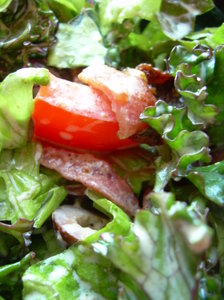
As in bacon, kale, and tomato. For those unfamiliar with kale, it's a tough leafy green more healthy for you than you probably care to think about. Some dislike its chewy texture and if so this is a good recipe for you because marinating the kale by itself in the dressing for a while before serving serves to soften the kale a bit. Regular lettuce would be a soggy mess if you left it in the dressing, so if you use it instead wait to toss the dressing in the salad until just before serving. You may also destem the kale if you prefer, pulling the leaf away from the thick stalk. I leave about half the stem in mine. The dressing recipe covered a good sized salad that two of us wolfed down in one sitting, the dressing again would've made the lettuce wilty if we hadn't eaten it all that night anyway, so try to prepare only as much as you'll eat in one night, or reserve the dressing separate from the salad. This can be made with any kind of kale, lettuce, or baby spinach!
- 1 teaspoon dijon mustard
- 1 teaspoon lemon juice
- freshly ground black pepper to taste
- dressing:
- 1/2 head kale destemmed if desired and chopped into bite sized pieces
- 1 1/2 cups lettuce chopped into bite sized pieces
- 1 cup tomatoes chopped into bite sized pieces
- 1/2 cup olives sliced
- 1/2 rasher bacon
- 1/4 cup mayonnaise
- 1/4 teaspoon salt
- 1 teaspoon agave nectar
- Carbohydrate 43.4137509793934 g
- Cholesterol 36.2915 mg
- Fat 47.5676124004134 g
- Fiber 4.08135977182338 g
- Protein 6.05535182737334 g
- Saturated Fat 7.50232200186501 g
- Serving Size 1 1 Serving (498g)
- Sodium 1736.35467515937 mg
- Sugar 39.33239120757 g
- Trans Fat 2.54495969431267 g
- Calories 600 calories
Step-by-step
- Place the cut kale into a large bowl. Whisk the dressing together and toss with the kale until evenly coated. If you are using regular lettuce, keep the dressing separate until just before serving. Cover with plastic wrap and refrigerate for at least 30 minutes.
- Store lettuce or baby spinach and olives if using in fridge until ready to toss with salad just before serving.
- Fry bacon in batches until crunchy, chop into bite sizes pieces and set aside to drain on paper plate. Drain a bit of the bacon grease off, reserving some in pan.
- Cook the tomatoes for 3 minutes over high heat in bacon grease, or until beginning to soften and the juices are starting to come out. Remove to a bowl, with juices.
- Once you are ready to serve the salad, toss lettuce or spinach and olives with the kale, making sure everything is now covered in dressing. Add 3/4 of the bacon and the tomatoes and toss again. Serve with the rest of the bacon and some freshly cracked black pepper.
The Anchoring Force of Kale
Kale serves as the structural backbone of this composition, requiring mechanical intervention to make its fibrous cellular walls palatable. Massaging or marinating the greens in an acidic medium like lemon juice and Dijon mustard breaks down the tough cellulose over a mandatory thirty-minute resting window without destroying the structural integrity of the leaf. While tenderizing tough brassicas usually demands heavy mechanical force by hand, chemical resting achieves a comparable softening effect efficiently.
Strategic Accompaniments
Serving this robust, fat-forward dish requires side elements that can cut through the richness imparted by mayonnaise and bacon grease. Simple grilled sourdough rubbed with raw garlic provides a dry, starchy counterweight that absorbs runaway dressing pooling at the base of the bowl. Alternatively, pairing the dish with a bitter chicory salad dressed simply in plain red wine vinegar balances the savory weight of cooked tomatoes and cured pork.
Managing Kitchen Sequencing
Kitchen timing requires deliberate staging because warm components will wilt fragile greens if combined prematurely. Fry the bacon until crunchy and reserve the rendering fat to blister the tomatoes for exactly three minutes at high heat, extracting maximum umami before cooling them to room temperature. Maintaining this precise temperature separation prevents premature wilting while ensuring the final toss integrates all textural layers evenly.



