Country Biscuits
This is the way I saw biscuits being made by my maternal grandma. She didnt mind getting her hands messy to make biscuits properly. And of course, she wouldnt be caught using any old cake pan. To make biscuits, you have to use a biscuit pan. Her biscuit pan was a special square cast iron skillet that was used for nothing else except biscuits. These are some great biscuits for breakfast or supper. They are best eaten warm, and their mild flavor tastes even better when spread with butter, jam or honey.
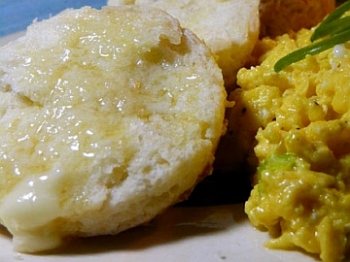
This is the way I saw biscuits being made by my maternal grandma. She didnt mind getting her hands messy to make biscuits properly. And of course, she wouldnt be caught using any old cake pan. To make biscuits, you have to use a biscuit pan. Her biscuit pan was a special square cast iron skillet that was used for nothing else except biscuits. These are some great biscuits for breakfast or supper. They are best eaten warm, and their mild flavor tastes even better when spread with butter, jam or honey.
- 1/2 teaspoon salt
- 1/4 cup heavy cream
- 1 tablespoon baking soda
- 2 cups unbleached all-purpose flour sifted, (preferably white lily)
- 1 tablespoon baking powder (preferably an aluminum-free brand like rumford)
- 3 ounces unsalted butter (3/4 stick), very cold, cut into small cubes
- 1 cup low-fat yogurt cold
- Carbohydrate 365.267325005321 g
- Cholesterol 236.0575 mg
- Fat 87.4256 g
- Fiber 12.9186002140785 g
- Protein 60.8070750000221 g
- Saturated Fat 53.17494 g
- Serving Size 1 1 Dozen (837g)
- Sodium 5067.23900778386 mg
- Sugar 352.348724791243 g
- Trans Fat 6.99335 g
- Calories 2505 calories
Step-by-step
- In large bowl, sift together 1 3/4 cups flour with baking powder, baking soda and salt.
- Using your fingertips, gently rub butter into sifted dry ingredients until mixture looks like coarse crumbs. (Don't let your fingertips touch, and the faster the better, so the fats don't melt.)
- Make a well in the center and pour in cold yogurt.
- Mix with hands just until dough comes together.
- The dough should be very wet and sticky.
- Sprinkle the remaining 1/4 cup flour on a board or counter.
- Dip your hands into the flour, then turn dough onto floured counter and work in only enough flour to make it manageable.
- Pat the dough into a rectangle about 1-inch thick.
- Cut out 2-inch rounds with a floured cutter, being sure to push straight down through the dough, no twisting.
- Place on unlined non-stick baking pan about an inch apart.
- Dough trimmings should be reformed to 1-inch thick, working it as little as possible and continue cutting biscuits until dough is used. (Biscuits from second pass will not be quite as light as those from first.)
- Refrigerate for at least 30 minutes prior to baking.
- Adjust oven rack to middle position and heat to 425 degrees F.
- Brush tops of biscuits with heavy cream and bake in a preheated 425 degree F oven for 10 to 12 minutes or until light golden on top.
Substituting low-fat yogurt for whole milk or buttermilk introduces heavy acidity and moisture that reacts aggressively with chemical leaveners, yielding a distinctively tender crumb but demanding precise temperature control to prevent structural collapse. Achieving optimal height and flakiness in laminated quick breads relies entirely on managing the thermal state of the butter and avoiding common mechanical errors during assembly.
- Keep the butter frozen or near freezing until the exact moment it meets the flour; solid fat melts during baking, creating pockets of steam that force distinct layers apart.
- Cut the cold butter into small cubes and use fingertips minimally to rub the fat into the dry ingredients, preventing body heat from melting the lipids prematurely.
- Press the biscuit cutter straight down through the one-inch thick dough without twisting, because twisting seals the outer edges and prevents uniform rising in the oven.
- Chill the cut rounds in the refrigerator for at least 30 minutes prior to baking to solidify the butter fats fully before they enter the 425 degrees Fahrenheit oven.
- Brush the tops with heavy cream immediately before baking to promote rapid browning through the Maillard reaction.
Precision during the shaping phase prevents the gluten network from overdeveloping into a tough, bread-like chew. Correctly executed technique ensures a tall rise and a fragile, airy interior texture.


