Lucas's Pickled Eggs
This is the recipe I use every year for deer camp. It keeps well & tastes great sliced on a Ritz with the onion slices; with a little salt & pepper; or how my brother eats them, with a splash of hot sauce.
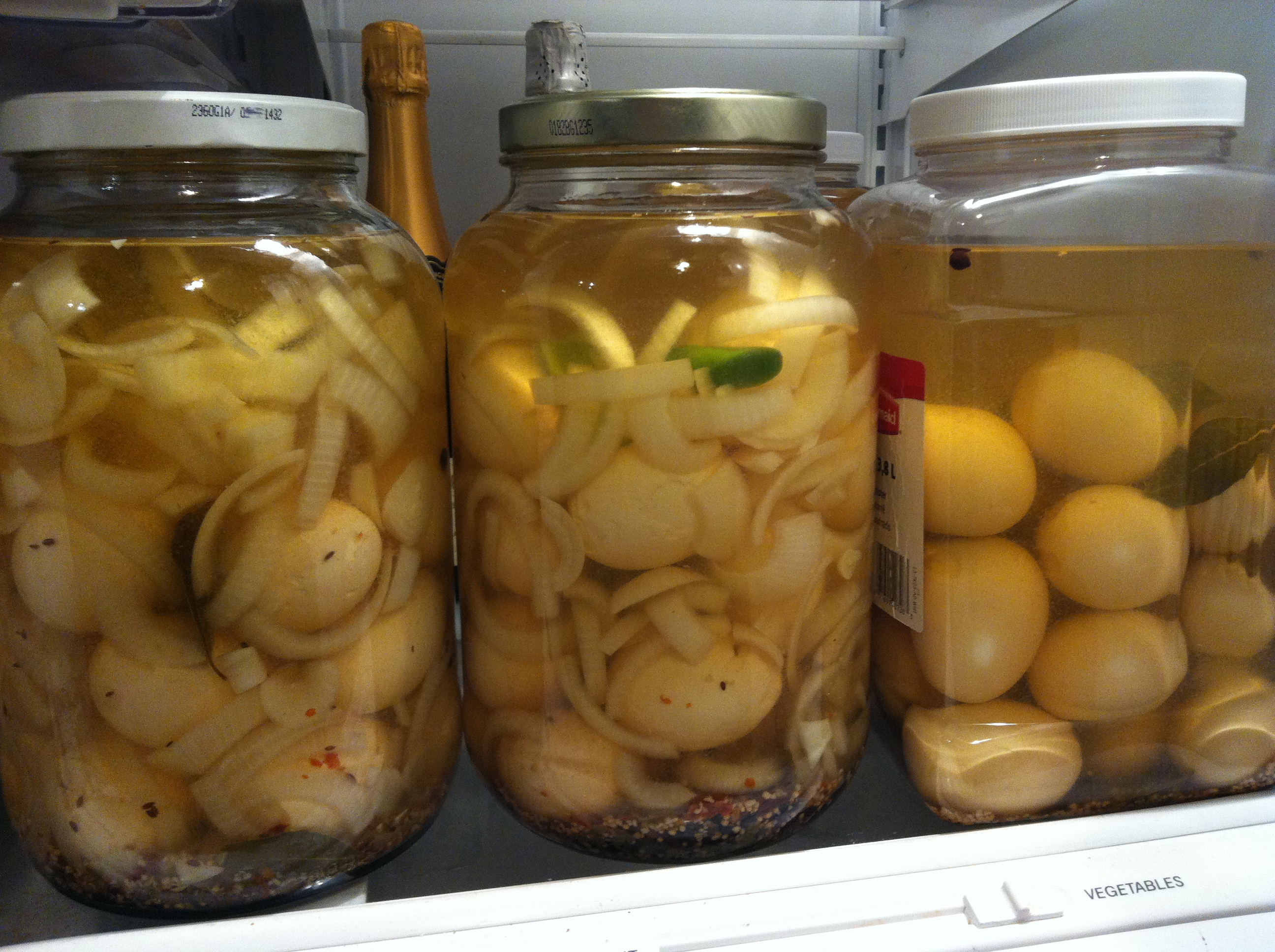
This is the recipe I use every year for deer camp. It keeps well & tastes great sliced on a Ritz with the onion slices; with a little salt & pepper; or how my brother eats them, with a splash of hot sauce.
- 2 dozen large/jumbo eggs hard-boiled
- 4 cups white port wine
- 3 cups water
- 2 cups white vineagar
- 2 tbsp pickling salt (iodized salt works fine too)
- 2 1/2 tsp pickling spice
- 2 tsp whole black peppercorns
- 1 tsp dried minced garlic (or 1 minced clove)
- 1/2 tsp yellow mustard seed
- 1/2 tsp crushed red pepper
- 1/4 tsp dill seed
- 4-5 whole bay leaves
- 2-3 medium-large sliced onions
- Carbohydrate 0.395093720101044 g
- Cholesterol 0 mg
- Fat 0.039885091605864 g
- Fiber 0.162988208331089 g
- Protein 0.0774907748593785 g
- Saturated Fat 0.00729650415476667 g
- Serving Size 1 1 Serving (15g)
- Sodium 0.697304166186127 mg
- Sugar 0.232105511769955 g
- Trans Fat 0.00352532916330556 g
- Calories 2 calories
Step-by-step
- Bring the above mix (minus the sliced onions) to a rolling boil, then reduce heat to a low boil for 5 minutes.
- While the brine mix is cooling is the perfect time to get your onions sliced and eggs shelled.
- Once the brine is cooled, pour the whole mix into a 1-gallon container (sealable glass jar works best, like the big 1-gallon whole-pickle jars) and add the eggs and sliced onions.
- The eggs and onions may not all sit below the level of the brine right when you put them in, but overnight it should all settle to be covered.
- Should sit minimum of 6 weeks.
- Best taste is 6 weeks to 6 months, but since they're pickling, they're edible looooong after that (they just start getting a bit rubbery around 8-9 months).
- Recipe is scalable, so if you don't have 1-gallon jars, make 1/2 batches... don't make 1 batch & try to divide it among multiple containers as the ingredients settle to the bottom of the kettle.
Pickling whole eggs requires precise volume management and adequate vessel sizing to ensure proper liquid-to-solid ratios. Standard quart jars will crowd two dozen eggs and two to three sliced onions, preventing the brine from circulating uniformly. A single one-gallon glass container accommodates the entire volume without crowding, keeping the solid ingredients fully submerged once settling occurs.
The Curing Window
Acidity penetrates cooked albumen slowly. Adequate curing requires a minimum resting period of six weeks at cool temperatures. Chemical osmosis transfers the pickling spice aromatics, vinegar, and aromatics into the protein matrix during this extended soak. Pulling samples too early results in bland centers surrounded by heavily vinegared exteriors. Peak flavor development occurs between six weeks and six months of continuous refrigeration. Beyond nine months, protein denaturation causes the egg whites to develop a distinctly rubbery texture.
- Ensure the brine cools completely to room temperature before combining with eggs to prevent overcooking the outer edges.
- Scale the recipe proportionally if utilizing smaller half-gallon vessels rather than splitting a hot batch across multiple jars.
- Maintain storage temperatures consistently below forty degrees Fahrenheit throughout the entire curing duration.


