Pho Ga
Traditionally, this meal-in-a-bowl noodle soup is made with beef, but the Vietnamese have also perfected a lighter version using chicken. This soup is popular at any time of day or night, and is often enjoyed for breakfast in Vietnam. This recipe I made for my son, who will be in Vietnam teaching English to college students for a while.
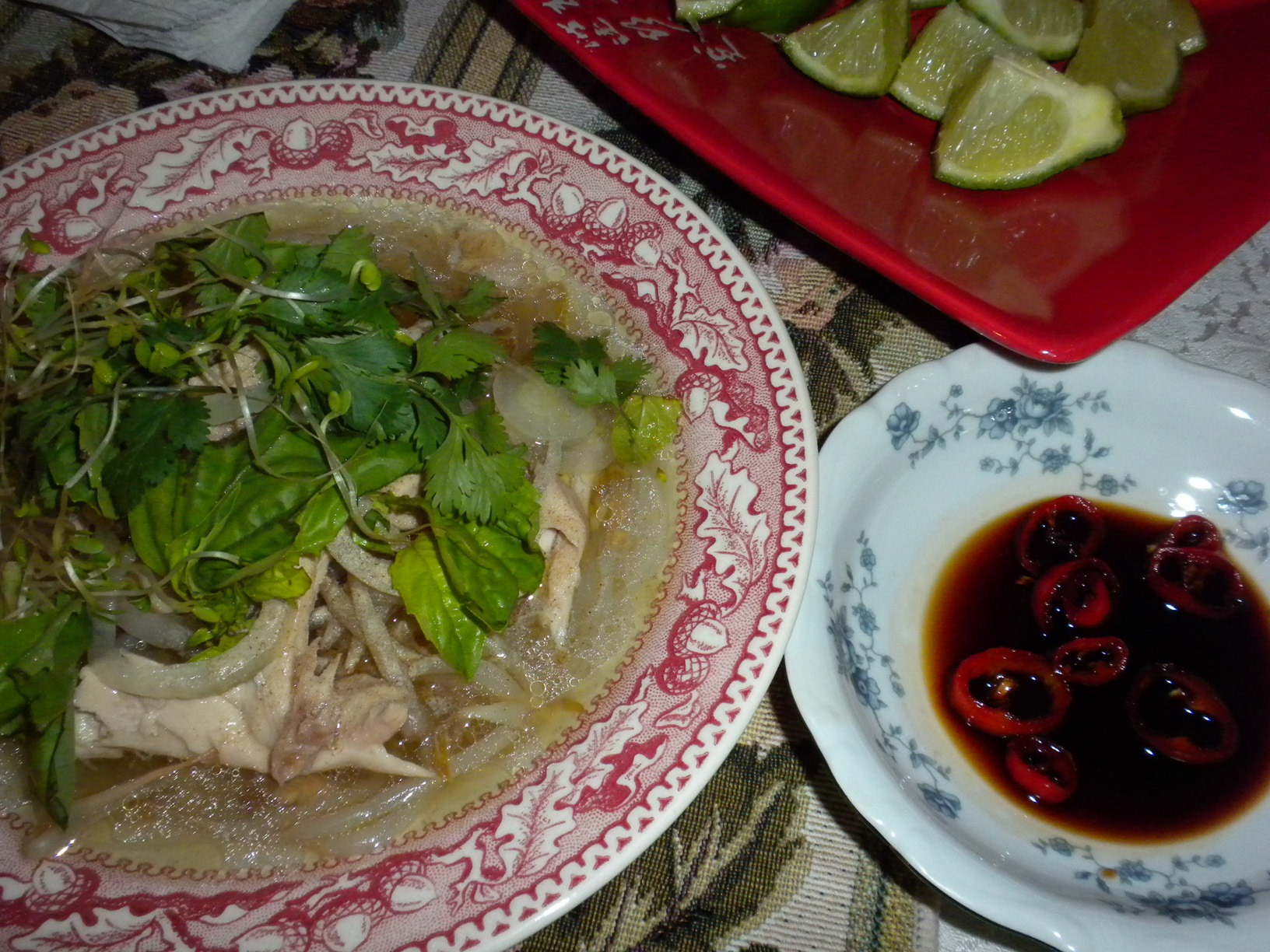
Traditionally, this meal-in-a-bowl noodle soup is made with beef, but the Vietnamese have also perfected a lighter version using chicken. This soup is popular at any time of day or night, and is often enjoyed for breakfast in Vietnam. This recipe I made for my son, who will be in Vietnam teaching English to college students for a while.
- 1 tsp salt
- 2 tablespoons fish sauce
- 1 onion thinly sliced
- 10 oz dried rice stick noodles
- 4 cups bean sprouts seed and tails removed, blanched until cooked
- 1 bunch cilantro (coriander leaves) sliced
- 1 bunch basil leaces
- 2 lime cut into sections, to serve
- 2 finger length chilies deseeded and sliced, placed in a dipping bowl with soy sauce
- broth
- 10 cups chicken stock
- 1 fresh chicken (about 4 -5 lbs.)
- 1 stick cinnamon
- 4 spring onions cut into lengths
- 1 inch fresh ginger root peeled and bruised
- 2 tsp. sugar
- Carbohydrate 31.1408724103581 g
- Cholesterol 9.60000000811537 mg
- Fat 4.01654859514764 g
- Fiber 1.19695969747605 g
- Protein 9.74512143272629 g
- Saturated Fat 1.07295027615509 g
- Serving Size 1 1 Serving (412g)
- Sodium 681.802790386843 mg
- Sugar 29.943912712882 g
- Trans Fat 0.307877344621482 g
- Calories 201 calories
Step-by-step
- Prepare the Broth first by bringing the chicken stock, chicken, cinnamon, spring onions, ginger, sugar, and salt to a boil over high heat in a stock pot. Reduce heat to low and simmer for 45 minutes, skimming off the foam and fat that floats to the surface. Stir in the fish sauce and remove from heat. Remove the chicken and set aside to cool. Strain the solids from the broth using a fine sieve and keep the clear broth warm over very low heat.
- Bring a pot of water to a boil over medium high heat. Add the dried noodles and blanch until soft, about 5 minutes. Remove and rinse with cold water, then drain.
- When the chicken is cool enough to handle, shred the meat along the grain into thin strips.
- Place the noodles into Pho bowls (about the size of a fruit dish), and top with bean sprouts, shredded chicken and onion slices. Pour the hot Broth into each bowl, sprinle with pepper and garnish with cilantro and basil leaves. Serve hot with the lime and bowls of chillies and soy sauce on the side.
Skimming foam and fat from the surface during the initial 45 minutes of simmering determines whether the broth stays clear or turns murky. Whole chicken proteins coagulate rapidly when brought to a boil; removing this scum prevents off-flavors from migrating back into the stock.
Scaling the Batch
Multiplying ingredients for large groups requires careful attention to pot geometry and evaporation rates. A four-to-five-pound bird yields enough meat and bones for ten to fifteen servings when supplemented with ten cups of chicken stock. Doubling this volume further demands a stockpot holding at least twenty quarts to maintain adequate rolling boil mechanics without spilling. Salt and fish sauce do not scale linearly through simple multiplication because water loss changes concentration. Add eighty percent of the initial seasoning ratio first, then taste the broth after twenty minutes of reduction before adjusting upward.
- Cloudy broth usually results from boiling the stock too aggressively instead of maintaining a gentle simmer.
- Rinsing blanched rice noodles under cold water halts starch gelatinization and prevents clumping inside individual serving bowls.
- Bruising the ginger root breaks cell walls, releasing aromatic gingerols into the liquid much faster than slicing alone.


