Chocolate Dipped Strawberries
I learned to make these tasty little treats in a cooking class years ago. These are great to make around Valentines, anniversaries, or any special occasions. The art of tempering the chocolate takes a little time and practice, but so worth every minute in the end!
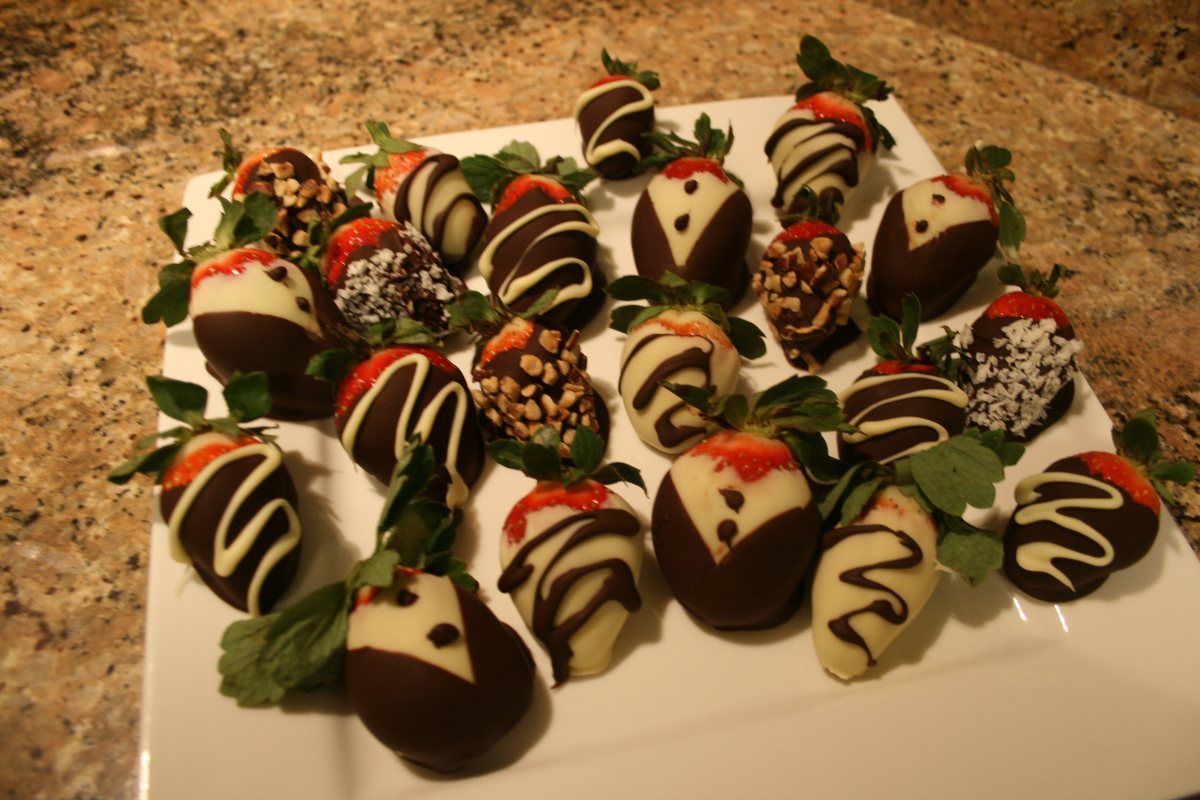
I learned to make these tasty little treats in a cooking class years ago. These are great to make around Valentines, anniversaries, or any special occasions. The art of tempering the chocolate takes a little time and practice, but so worth every minute in the end!
- Carbohydrate 0 g
- Cholesterol 0 mg
- Fat 0 g
- Fiber 0 g
- Protein 0 g
- Saturated Fat 0 g
- Serving Size 1 1 Strawberrie (38g)
- Sodium 0 mg
- Sugar 0 g
- Trans Fat 0 g
- Calories 0 calories
Step-by-step
- Line a baking sheet with parchment paper.
- Wash the strawberries with cool water and then dry completely. Transfer to a paper-towel lined platter.
- Melt 2/3 of the dark chocolate over a double boiler and a candy thermometer. Stir with a rubber spatula and watch the temperature carefully. To temper your dark chocolate, heat to a temperature of between 110-120 deg F. (Don''t let it go over 120 deg F, or you risk yor chocolate separating). Remove bowl from the double boiler and then stir in the remaining 1/3 of the dark chocolate, stirring to melt throughout. Continuing to watch the temperature, cool it to approximately 80-82 deg F. Once the dark chocolate has cooled down to this temperature, place it back onto the double boiler and reheat it back up to between 88-91 deg F. If tempered correctly, the mixture should be smooth and glossy. Dip desired amount of strawberries into the dark chocolate mixture in whichever designs you choose. Lay dipped strawberries out to cool onto parchment paper and refirgerate for 20 minutes to set.
- Melt 2/3 of the white chocolate over a double boiler and a candy thermometer. Stir with a rubber spatula and watch the temperature carefully again. Please note that white chocolate has different tempering instructions. To temper your white chocolate, heat to a temperature of between 105-110 deg F. (Do not let the temperature go above 110 deg F or you could scorch your white chocolate). Remove the bowl from the double boiler and then stir in the remaining 1/3 of the white chocolate, stirring to melt throughout. Continuing to watch the temperature, cool it to approximately 80-82 deg F. Once the white chocolate has cooled down to this temperature, place it back over the double boiler and reheat it back up to between 86-87 deg F. If tempered correctly, the white chocolate mixture should look smooth and glossy. Dip desired amount of strawberries into the white chocolate mixture in whichever design you choose. Lay dipped strawberries out to cool onto parchment paper and refrigerate for 20 minutes to set.
- If you decide to do a design where you are double dipping the chocolates and mixing both white and dark: 1) let your first coat of chocolate set for 20 minutes in the refrigerator 2) Take strawberries out of refrigerator 3) double check the temperature of your bowl of chocolate to make sure it is still tempered 4) If chocolate has cooled off too much, bring back up to the last temperature indicated for tempering (as stated above). Once at that temperature, you are ready to redip your strawberries.
- Double Boiler Method of melting chocolate: This refers to placing your chocolate to be melted into a heatproof bowl that is slightly larger than a small saucepan. Fill the saucepan with about 1 inch of water and set to a medium heat. Place your heatproof bowl on top of your saucepan and let the steam from the saucepan below slowly melt your chocolate in the bowl above. It is imperative that no water gets into the chocolate during this process.
- NOTE: If you prefer to use a milk chocolate, instead of one of the chocolates stated above, follow the tempering directions for white chocolate. Both milk and white chocolate temper at the same temperatures.
Using standard baking chips instead of high-end bars will yield a thick, sluggish coating because commercial chips contain stabilizers designed to prevent melting. Premium couverture chocolate or finely chopped blocks contain a higher percentage of cocoa butter, which naturally lowers viscosity and allows the mixture to run off the fruit in a thin, even layer. Thoroughly drying washed berries with paper towels prevents moisture from seizing the melted cocoa solids, as a single drop of water turns smooth liquid into a grainy paste.
The Double Boiler Setup Without Special Gear
Mounting a stainless steel or glass bowl over a saucepan containing exactly one inch of simmering water creates a gentle, indirect heat source. Steam transfers warmth to the upper vessel without exposing the cocoa butter to direct burner heat that causes scorching. Monitor the process closely with a digital candy thermometer inserted into the center of the mass, ensuring dark varieties reach 110-120 degrees Fahrenheit during the initial melting phase. Keep the simmering water below a rolling boil to stop condensation from creeping up the sides of the bowl.
Achieving the Proper Snap Through Seeding
Stirring the reserved one-third portion of unheated solids into the warm melted batch introduces stable beta-prime fat crystals that force the entire mixture to solidify uniformly. Cool dark chocolate down to 80-82 degrees Fahrenheit before gently warming it back to a working range of 88-91 degrees. White chocolate requires lower thresholds, stopping the initial melt at 105-110 degrees and reheating to 86-87 degrees after seeding. Glossy surfaces and a clean snap upon biting indicate the cocoa butter has crystallized correctly during the twenty-minute refrigeration window.



