Date Nut Pinwheel Cookies
When I worked at a bakery this was one of my favorite cookies. It's a fun Holiday treat and packages well for gift baskets.
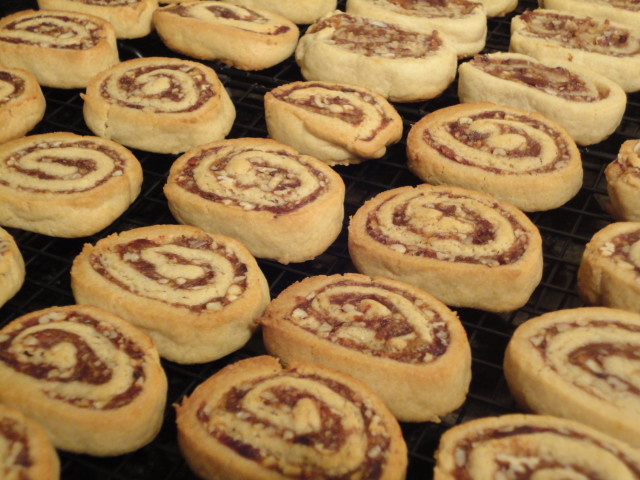
When I worked at a bakery this was one of my favorite cookies. It's a fun Holiday treat and packages well for gift baskets.
- 1 teaspoon vanilla extract
- 1 cup sugar
- 1/2 teaspoon sea salt
- 1/2 teaspoon baking soda
- 2 large eggs
- 1/2 teaspoon cream of tartar
- 1 cup hot water
- 10 ounces dates pitted and chopped
- 1 cup pecans finely chopped, can substitue walnuts
- 1 cup soft butter
- 2 cups firmly packed brown sugar
- 3 1/2 cups unbleached flour
- Carbohydrate 27.4563006669835 g
- Cholesterol 43.8155092592593 mg
- Fat 10.5419225358584 g
- Fiber 1.24268108992135 g
- Protein 2.44427712569195 g
- Saturated Fat 5.23398144438928 g
- Serving Size 1 1 (61g)
- Sodium 1792.13043619214 mg
- Sugar 26.2136195770621 g
- Trans Fat 0.79338324417797 g
- Calories 209 calories
Step-by-step
- Combine dates, sugar, and water in a medium saucepan; cook over medium heat, stirring constantly, about 6 to 8 minutes or until mixture thickens. Remove from heat; stir in chopped walnuts. Let cool completely.
- Cream butter in a large mixing bowl; gradually add brown sugar, beating well. Add eggs; beat well. Stir in vanilla.
- Combine flour, soda, cream of tartar, and salt in a medium mixing bowl; add to creamed mixture, stirring well.
- Divide dough into thirds. Roll each portion into a thin 12 - 15 inch square on separate sheets of parchment. To roll thin and avoid sticking, cover dough with a second sheet of parchment; press out dough to form a square shape and finish with rolling pin over top of second sheet of parchment. Carefully, peel top piece of parchment away from dough; thinly spread the squared dough with one-third of reserved date mixture.
- Lifting up the edge of the lower parchment, gently peel of the long edge of the dough and roll up jelly roll fashion. Use a pastry knife to slide and roll the dough if necessary. You can use the lower piece of parchment to continue to form the jelly roll shape so as not to tear the dough. Use the same procedure with the remaining two portions of dough.
- As formed, wrap rolls in the parchment, and chill overnight. If time is short, you can freeze the dough for a few hours to rapid chill. Remove parchment paper. Cut into 1/4-inch slices, and place 2 inches apart on greased cookie sheet or cookie sheet lined with parchment paper. Bake at 350(F) degrees for 10-12 minutes or until cookie browns slightly around edges. If cookies do not brown, may need to increase oven temperature or increase butter next time made.
- Prepare dough and chill overnight. Store baked cookies in airtight containers.
Attempting to slice soft refrigerator cookie dough immediately yields distorted ovals instead of clean rounds. Chilling the formed logs overnight solidifies the butter sufficiently to maintain structural integrity under a knife blade. Professional kitchens scale pastry recipes by weight for precision, but home bakers dividing this batch into thirds can manage the dough dimensions easily without kitchen scales. Rolling the dough between two sheets of parchment paper eliminates the need for excess dusting flour, which would otherwise toughen the crumb structure.
Scaling and Adjusting Batches
Dividing components proportionally prevents textural alterations when modifying yield quantities. Halving the dairy and dry components maintains the correct hydration ratio for the flour, preventing a crumbly dough that shatters during the rolling phase. Keep mixing times minimal once the flour is incorporated to restrict gluten development, yielding a tender slice rather than a chewy bite.The Critical Chilling Phase
Solid fat management dictates the success of any sliced refrigerator cookie. Freezing the wrapped logs for two hours offers a rapid alternative when overnight chilling is impractical, provided the center reaches firm density before slicing. Slice each log while completely cold using a sharp chef's knife, rotating the cylinder a quarter turn after every few cuts to preserve a circular profile.


