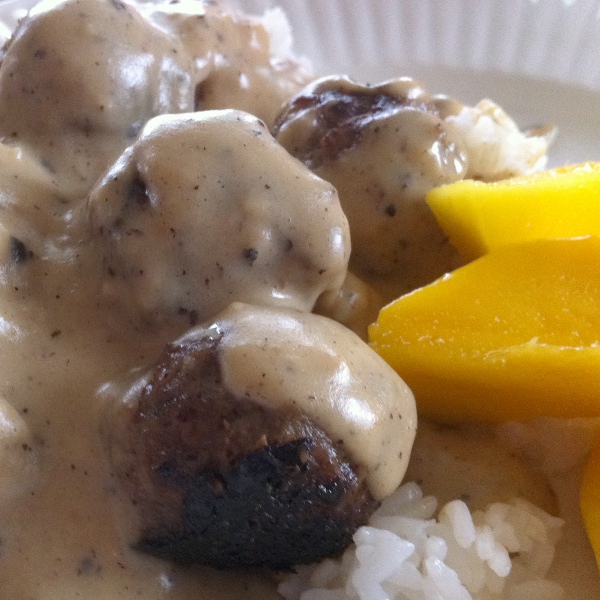
This is a super yummy meal. I usually try and make extra gravy, it's the best.
- 1/4 teaspoon salt
- 1/2 cup milk
- 1 egg
- 1 pound ground beef
- 2 teaspoons sugar
- 1/4 teaspoon nutmeg
- 1/8 teaspoon pepper
- 1 1/4 teaspoons salt
- 1 teaspoon sugar
- 1/2 cup bread crumbs
- sauce
- 1 can mushrooms
- 1/4 teaspoon allspice
- 3 tbs flour
- 2 tbs butter
- 1/4 pound ground pork
- 1/3 cup onions minced
- 1 3/4 cup milk
- Carbohydrate 60.9235648133671 g
- Cholesterol 168.158644716667 mg
- Fat 48.9107662472459 g
- Fiber 4.17713722550435 g
- Protein 38.0098104283684 g
- Saturated Fat 19.082641189873 g
- Serving Size 1 1 Serving (293g)
- Sodium 1387.54817917214 mg
- Sugar 56.7464275878627 g
- Trans Fat 10.7114124137302 g
- Calories 843 calories
Step-by-step
- Saut? onion in 2T butter.
- In large bowl beat egg, add milk and crumbs. Add salt, sugar, allspice, nutmeg, beef, pork and onions. Blend well.
- In skillet heat 2T butter. Form meat mixture into 1/2 - 3/4" balls.
- Drop into skillet and brown will on all sides. Remove when cooked through.
- Into remaining juices stir flour, 1 t sugar, 1/4 t salt, and pepper; add milk slowly. Stir until thickened. Add 1 can mushrooms.
- Serve with rice.
Ground pork provides the necessary fat ratio to keep these small spheres tender, preventing the lean beef from drying out during pan-searing. Incorporating a panade of milk and bread crumbs hydrates the protein strands before cooking, yielding a remarkably soft interior texture rather than a dense sausage consistency. Shape the portions strictly between one-half and three-quarters of an inch wide to ensure the center reaches a safe internal temperature of 160 degrees Fahrenheit by the time the exterior develops a deep, caramelized crust. Butter should foam and subside in a heavy skillet over medium-high heat before adding the formed pieces, signaling that moisture has evaporated and actual browning can occur.
Historical culinary exchange brought spiced minced meat variations to Scandinavia in the eighteenth century, where local cooks adapted the concept using a dual-meat blend of beef and pork seasoned with warm aromatics like allspice and nutmeg. Preserved canned mushrooms supply earthy depth to the pan sauce with minimal prep work, though substituting fresh sliced fungi will require an extra five minutes of sautéing to drive off excess water before the flour thickener is introduced. Whisking cold milk slowly into the browned residual fats and flour roux prevents lumping, creating a smooth emulsion that coats the back of a spoon. Simmering the finished sauce for three minutes eliminates any raw flour taste before the mushrooms and cooked meatballs are returned to the pan.
Historical Roots and Pan-Sauce Mechanics
Historical culinary exchange brought spiced minced meat variations to Scandinavia in the eighteenth century, where local cooks adapted the concept using a dual-meat blend of beef and pork seasoned with warm aromatics like allspice and nutmeg. Preserved canned mushrooms supply earthy depth to the pan sauce with minimal prep work, though substituting fresh sliced fungi will require an extra five minutes of sautéing to drive off excess water before the flour thickener is introduced. Whisking cold milk slowly into the browned residual fats and flour roux prevents lumping, creating a smooth emulsion that coats the back of a spoon. Simmering the finished sauce for three minutes eliminates any raw flour taste before the mushrooms and cooked meatballs are returned to the pan.



