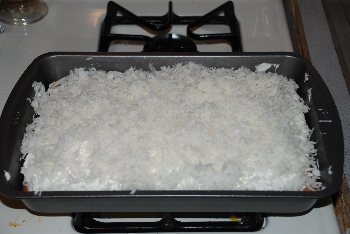
World's Best Coconut Cake!
- Carbohydrate 96.24341875 g
- Cholesterol 0 mg
- Fat 31.37443125 g
- Fiber 4.18031235136092 g
- Protein 5.12909375 g
- Saturated Fat 23.85546 g
- Serving Size 1 1 Serving (221g)
- Sodium 541.889375 mg
- Sugar 92.0631063986391 g
- Trans Fat 0.718145624999998 g
- Calories 673 calories
Step-by-step
- Prepare cake according to instructions on the box. Be sure to get the kind with pudding in the mix already since it will be more moist. However, instead of using water or milk, substitute coconut milk instead.
- Grease a 9" X 13" cake pan, pour the batter into the pan and bake according to directions on the box.
- Once the cake is cooked, take out of the oven and let it cool off for 15 minutes.
- Take the end of a wooden spoon and poke holes in the cake (3 rows of 4 holes is adequate for a 9" X 13" cake pan).
- Mix 1 shot of Creme de Cacao with the can of cream of coconut. You might first need to put the can of cream of coconut in warm water to reliquify, as cream of coconut can congeal at cooler temperatures. Make sure it's well mixed.
- Pour the cream of coconut/Creme de Cacao mixture on the cake, including into the holes.
- Put the cake, still in the pan, uncovered, in the fridge for about 2-3 hours.
- Once the cake has cooled, take out of the refrigerator and cover with vanilla or coconut frosting.
- Cover with shredded coconut to suit taste.
- Optionally, drizzle another shot of Creme de Cacao on top of the coconut.
- Pig out!
Swapping Liquids in Box Mixes
Why substitute coconut milk for the water specified on a commercial box mix? Standard box instructions target a neutral hydration level, but swapping in canned coconut milk introduces high fat content directly into the crumb. Whole coconut milk contains around 20 percent fat, whereas standard cow milk or water lacks that richness. Whisk the batter gently to avoid over-developing the gluten from the wheat flour, which produces toughness. Greasing the 9x13-inch pan thoroughly ensures the edges release cleanly after baking.Managing Temperature and Poking Holes
Allow the baked cake to rest for exactly 15 minutes before inserting any utensils. Poking holes into boiling-hot cake causes the crumb to disintegrate rather than maintain structural channels. Use the round end of a wooden spoon handle to puncture the surface evenly, spacing the holes about two inches apart. Cream of coconut naturally separates and solidifies at room temperature, so submerge the sealed can in warm water for ten minutes to reliquify the contents completely before combining it with the liqueur. Pour the liquid slowly over the surface so the crumb absorbs the mixture evenly without pooling on top.Judging Doneness Without a Probe
Visual and tactile cues remain the most reliable indicators of completion when baking without a thermometer. Press the center of the cake lightly with a fingertip; the sponge should spring back immediately without leaving an indentation. Pull the pan from the oven the moment a wooden toothpick inserted into the thickest part emerges with a few moist crumbs clinging to it, not wet batter. Chill the saturated cake uncovered in the refrigerator for two to three hours to set the internal moisture before applying frosting.


