Dale's Salsa
This recipe has been adjusted over time to have a great, fresh flavor, firm texture and a little bite. It actually is pico de gallo rather than salsa. The secret that makes it so easy is the salsa maker, or chopper. Mine is manual - you just add the ingredients and turn the crank. Food processors can do the same thing. I have made it by hand, but it takes a lot longer.
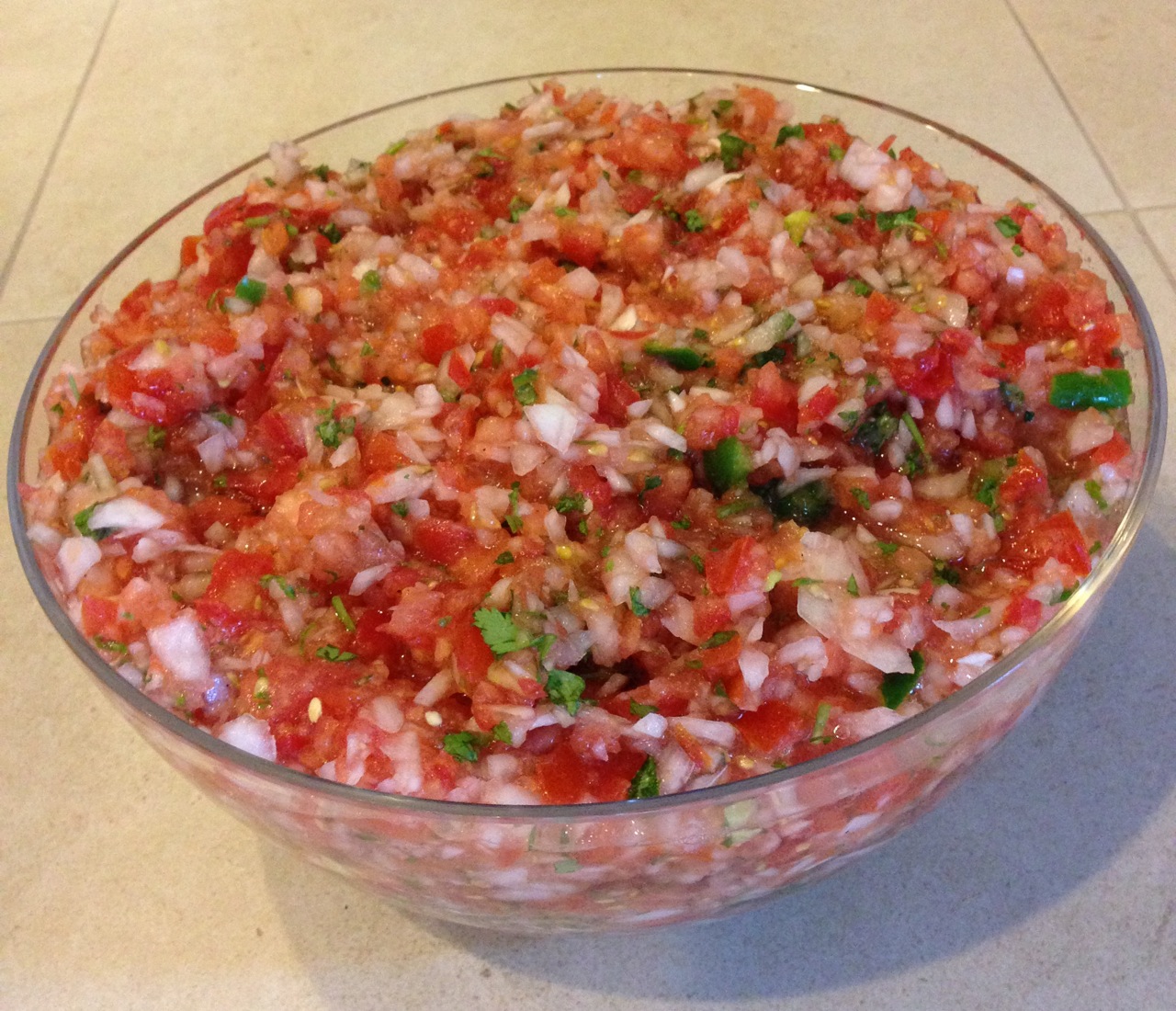
This recipe has been adjusted over time to have a great, fresh flavor, firm texture and a little bite. It actually is pico de gallo rather than salsa. The secret that makes it so easy is the salsa maker, or chopper. Mine is manual - you just add the ingredients and turn the crank. Food processors can do the same thing. I have made it by hand, but it takes a lot longer.
- Carbohydrate 30.0938019792191 g
- Cholesterol 0 mg
- Fat 1.00794019869045 g
- Fiber 7.97386511583362 g
- Protein 4.9032677754051 g
- Saturated Fat 0.160850074580127 g
- Serving Size 1 1 Serving (544g)
- Sodium 25.4555021918471 mg
- Sugar 22.1199368633855 g
- Trans Fat 0.319993446057452 g
- Calories 125 calories
Step-by-step
- Wash all vegetables.
- Cut the the tomato stems out of each tomato and then cut the tomatoes in quarters.
- Peel the onions and then cut them in quarters or eighths.
- Cut the stems off of the cilantro bunch.
- Cut the stems and tips off of the chills, and then cut them in half.
- Cut the limes into small wedges.
- Using a salsa maker or chopper, insert a handful of tomatoes.
- Then add some onions, about half as much as the tomatoes that were added.
- Tear off a small handful of cilantro and add it.
- Add 2 chili halves.
- Squeeze in a wedge of lime and then shake in some garlic salt and pepper.
- Turn on or turn the crank on the chopper.
- Chop the ingredients into small, firm pieces.
- Be careful not to over chop, which will cause the mixture to get mushy.
- Empty the chopped mixture onto a couple of paper towels, fold the edges of the towels over the top and then press lightly to squeeze out some of the juice.
- Leave it in the towels until the next batch is chopped, and then empty it into a bowl.
- Continue making batches the same way until the vegetables are gone.
- For people who want a milder salsa, you can add only 1 chili half to each batch.
- Or you can make two separate batches, one spicy and one mild.
- I think that this salsa is best enjoyed with home made tortilla chips.
- If you are using store-bought chips, regular unflavored ones seem to taste best.
- Enjoy!
Excess moisture is the primary enemy of fresh pico de gallo. Raw tomatoes contain high amounts of water trapped in cellular walls. When those walls rupture completely during processing, free liquid pools at the bottom of the bowl and turns the mixture into a puree. Manual hand-crank choppers or pulse settings on a food processor offer better control than continuous high-speed blades. Pulsing keeps the cell structures intact rather than shearing them into a paste.
Controlling Water Content
Draining the chopped vegetables on absorbent paper towels removes surface liquid before it dilutes the dish. Pressing gently extracts excess juices without crushing the firm flesh of the tomatoes and onions. Leaving the mixture in the towels for five minutes per batch balances the extraction process. Working in small quantities prevents the bottom layers from over-processing while top layers remain coarse.Balancing Heat and Acid
Capsaicin inside serrano chilis dissolves readily in alcohol and fats, but in aqueous vegetable mixtures, mechanical distribution dictates perceived heat. Uniform particle size ensures that the chili oils disperse evenly rather than concentrating in isolated bites. Fresh lime juice provides citric acid that brightens the raw aromatics. Acid interacts with sulfur compounds in the raw onions to soften their sharp bite during resting.Textural Integrity
Firm textures rely on sharp cutting edges and cold ingredients. Chilling tomatoes and onions before processing firms the pectin in cell walls. Dull blades bruise the vegetable tissue and release excess enzymes that degrade texture rapidly. Salt draws out additional moisture through osmosis, so adding garlic salt near the end of the chopping phase prevents premature softening.


