Crunchy Salmon Cakes
I ALWAYS remove the bones and skin. The tiny little bones that run throughout the can of salmon are just way too hard to get to (you won't really bite into them when you cook it, they either dissolve or just don't really crunch when you eat em), but down the length of the can I think towards the middle runs the vertebrae. You can kinda "roll" the salmon off and you will find them. The skin will kinda just slide off, it's very slimy.
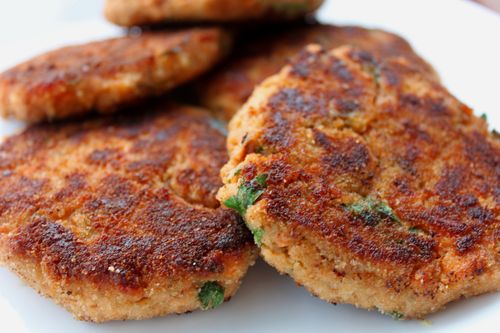
I ALWAYS remove the bones and skin. The tiny little bones that run throughout the can of salmon are just way too hard to get to (you won't really bite into them when you cook it, they either dissolve or just don't really crunch when you eat em), but down the length of the can I think towards the middle runs the vertebrae. You can kinda "roll" the salmon off and you will find them. The skin will kinda just slide off, it's very slimy.
- 2 eggs
- for cakes
- 1 -14.75 oz can of salmon
- 10 -12 crackers crushed (either town house, ritz or some other buttery cracker)
- 1 hefty pinch of red pepper flakes (about the size of a quarter in your palm)
- 1/2 tbl dried parsley
- juice of small lime (or two squirts from bottle)
- 1/2 tbl dill (or size of a nickle in your palm)
- dash of black pepper
- 1/2 tbl dried minced onion
- 1/4 cup panko bread crumbs
- for frying
- 3 tbl canola oil
- 2 tbl butter
- Carbohydrate 5.86935198163445 g
- Cholesterol 11.801041671027 mg
- Fat 11.5196626362162 g
- Fiber 0.373693468800531 g
- Protein 2.14425386311389 g
- Saturated Fat 3.22742600185569 g
- Serving Size 1 1 Serving (58g)
- Sodium 103.937385496732 mg
- Sugar 5.49565851283392 g
- Trans Fat 0.437339010904597 g
- Calories 133 calories
Step-by-step
- Place your Panko in a shallow dish
- Mix all other ingredients for the cakes in a bowl with your hands until they will form a patty. If they are too mushy add a few more crushed crackers, too dry a little more lime juice.
- Place the patties in the panko and coat both sides.
- Get oil and the butter hot in pan (turn down slightly when you put in the patties because you don't want them to burn before they cook)
- After they have cooked on one side take your spatula and carefully lift up one side to see if they are brown underneath, if they are, then flip em'. Cook till both sides are golden brown.
- ENJOY!
Why do these patties hold together without flour? Egg proteins coagulate between 140°F and 158°F, forming a rigid gel network that traps moisture and binds the crushed crackers to the canned fish. Canned salmon provides water-soluble proteins that interact with these starches, creating a cohesive mass when hand-mixed. Dredging the exterior in panko adds coarse starch granules that dehydrate instantly upon contact with hot fat, producing a crisp crust via the Maillard reaction between amino acids and reducing sugars.
Frying Dynamics and Heat Transfer
Combining canola oil and butter achieves two goals. Canola oil has a high smoke point around 400°F, allowing vigorous heat transfer, while milk solids in the butter brown quickly to impart nutty lactones. Heat the pan medium-hot, then lower the flame immediately after dropping the patties. This prevents the exterior from charring before the interior reaches serving temperature. Use a thin metal spatula to test the underside at the four-minute mark; a deep mahogany hue indicates the starch has dehydrated sufficiently for a clean flip.
- If the mixture remains too wet to form spheres, add crushed crackers one tablespoon at a time to absorb free water.
- Store cooked patties in an airtight container for up to three days, reheating them in a dry skillet to recrisp the outer crust.



