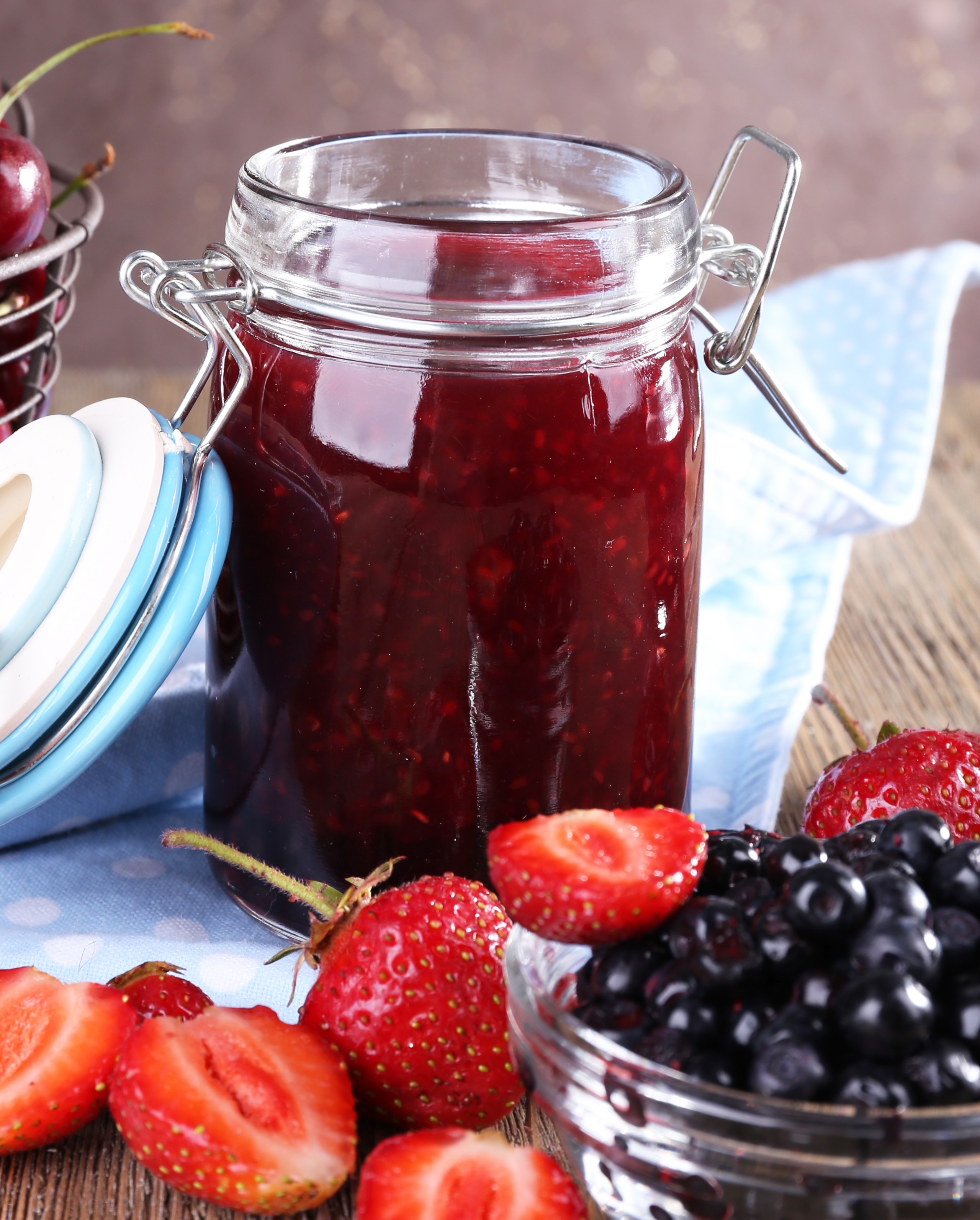
This is always the favorite out of all my jams and jellies that I make.
- Carbohydrate 8.36223142853052 g
- Cholesterol 0 mg
- Fat 0.017109375 g
- Fiber 0.153203283515573 g
- Protein 0.041571875 g
- Saturated Fat 0.0008703125 g
- Serving Size 1 1 Serving (13g)
- Sodium 0.04875 mg
- Sugar 8.20902814501494 g
- Trans Fat 0.005193125 g
- Calories 33 calories
Step-by-step
- Wash 8 half-pint or 4 pint jars. Keep hot until needed. Prepare lids.
- Discard stems and crush enough strawberries to measure 2 cups of crushed berries. Crush enough raspberries to measure 1 cup. Crush enough blackberries to measure 1 cup.
- Add the prepared fruit to a 6 to 8 quart saucepan. Stir in the sugar. Stirring constantly, bring the mixture to a full rolling boil (a boil that does not stop bubbling when stirred) on high heat.
- Stir in pectin quickly. Return the mixture to a full rolling boil and boil exactly 1 minute, stirring constantly. Remove from heat. Skim off any foam with a metal spoon.
- Ladle the jam into one jar at a time, leaving 1/4-inch headspace. Wipe jar rim with a clean, damp cloth. Attach lid. Fill and close remaining jars. Process in a boiling water canner for 10 minutes (15 minutes at 1,000 to 6,000 feet; 20 minutes above 6,000 feet).
The Mechanics of the Rolling Boil
Achieving a proper set in preserves relies on reaching a true rolling boil before the liquid pectin is incorporated. A rolling boil is defined as a violent bubbling action that cannot be suppressed by stirring. This high thermal energy activates the methoxyl groups in commercial liquid pectin, allowing them to form a three-dimensional mesh with sugar and fruit acid. Without this specific energy threshold, the structural bonds fail to develop, resulting in a runny syrup rather than a spreadable jam.
Managing Sugar Ratios and Inversion
Granulated sucrose functions beyond mere sweetness in preserving; it acts as a dehydrating agent that binds water molecules, preventing microbial growth and supporting the gel matrix. The high ratio of seven cups of sugar to four cups of fruit creates an osmotic pressure that draws moisture out of the cellular walls of strawberries, blueberries, and blackberries. Heating this solution breaks sucrose down into glucose and fructose, a process known as inversion, which balances the sweetness and stops crystallization during storage.
Storage and Secondary Uses
Properly canned jars processed in boiling water for ten minutes yield a shelf-stable product that lasts for months in a cool, dark pantry. Once opened, jars require refrigeration and remain optimal for several weeks. Beyond toast and pastries, leftover preserves function well as a glaze for roasted pork or poultry, or as a vibrant acid-balancing swirl in plain Greek yogurt.


