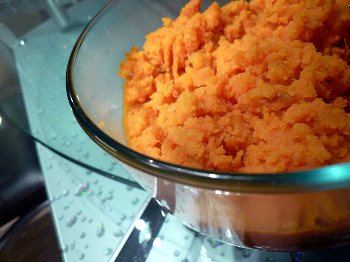
This was Great, a recipe I will make again
- Carbohydrate 15.0605987552782 g
- Cholesterol 10.1766666666667 mg
- Fat 3.92048214764992 g
- Fiber 2.02483441595182 g
- Protein 1.36347371366775 g
- Saturated Fat 2.45332520092668 g
- Serving Size 1 1 Serving (106g)
- Sodium 277.563316540858 mg
- Sugar 13.0357643393264 g
- Trans Fat 0.29114746909985 g
- Calories 99 calories
Step-by-step
- Preheat the oven to 400 degrees F.
- Place sweet potatoes on a baking sheet and roast until easily pierced with a fork, about 1 hour.
- Peel the sweet potatoes while still hot.
- Combine the potatoes, butter, salt, orange juice, maple syrup, and chicken broth in a large bowl.
- Mash with a potato masher until the potatoes are smooth.
- Serve immediately. (This can be prepared a day ahead and reheated).
Whole roasting requires no peeling before cooking, eliminating the hazard of slicing through dense raw tubers. Piercing whole sweet potatoes allows internal steam to escape during baking at 400 degrees F. As internal temperature rises past 140 degrees F, endogenous amylase enzymes convert complex starches into maltose and other simple sugars. This natural enzymatic conversion maximizes inherent sweetness without requiring heavy additions of refined sugar. Baking them whole also retains moisture inside the jacket, creating a naturally steamed interior that mashes more smoothly than boiled cubes, which absorb excess water and turn gluey.
Peeling while hot is essential because steam pressure pushes the skin away from the flesh, allowing the outer layer to slip off cleanly. Combining the hot flesh with warmed chicken broth, melted unsalted butter, and orange juice prevents rapid cooling of the starches, which causes the mixture to stiffen prematurely. Butter supplies fat droplets that coat individual starch granules, reducing friction and yielding a velvety mouthfeel. The small amount of acid from the citrus brightens the dense profile, balancing the sugars from the maple syrup and the caramelized starches.
Preparing this dish up to one day ahead is entirely viable due to the high sugar and moisture content, which resists excessive drying during storage in a sealed container in the refrigerator. Reheating requires gentle indirect heat, such as a covered dish in a 325-degree F oven or low power in a microwave, stirring occasionally to distribute heat evenly. For dietary adjustments, unsalted vegetable stock replaces the chicken broth at a one-to-one ratio without altering the final consistency, and plant-based margarine substitutes for dairy butter identically.


