Country Ham Biscuits
Here is how to make Country Ham Biscuits. I also add a sweet treat to serve on the side!
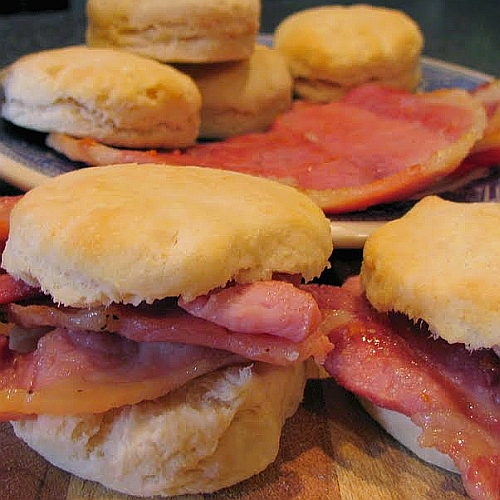
Here is how to make Country Ham Biscuits. I also add a sweet treat to serve on the side!
- Carbohydrate 341.47034652 g
- Cholesterol 134.488984 mg
- Fat 53.39371104 g
- Fiber 12.096000213623 g
- Protein 51.2131046 g
- Saturated Fat 31.716993536 g
- Serving Size 1 1 Serving (667g)
- Sodium 6111.018132 mg
- Sugar 329.374346306377 g
- Trans Fat 5.738098152 g
- Calories 2082 calories
Step-by-step
- Place 2 cups flour in a large mixing bowl.
- Add butter or margarine.
- With a fork or pastry blender, cut butter into flour until the mixture resembles coarse crumbs.
- Gently push the flour mixture to the edges of the bowl, making a well in the center.
- Pour the milk (a little at a time) into the well, and blend the milk into the flour mixture, until it forms a ball.
- Do not over-mix.
- Turn dough onto a lightly floured surface.
- Knead gently 10 to 12 times.
- On a lightly floured surface, pat or roll dough to approximately 1/2-inch thickness.
- Cut with a 2-inch biscuit cutter, butter tops and bottoms, and place on a baking pan.
- Bake in an oven that has been preheated to 450 degrees for 6 to 8 minutes.
- Place about (3) 2-inch squares of country ham in each biscuit and arrange in a nice pattern on a serving platter.
- Enjoy!
Unlike laminated yeast rolls or chemically leavened drop biscuits that rely on heavy stirring for structure, authentic Southern-style biscuits require a delicate hand to maintain the integrity of the fat pockets. Using self-rising flour simplifies the leavening process by pre-blending baking powder and salt into the base, which removes the variable of measuring chemical agents independently. When incorporating the fat, a pastry blender or two table knives utilized in a crisscross motion will yield the necessary coarse crumbs faster than fingertips, which transfer unwanted body heat into the butter and prematurely soften it. Working quickly ensures the solid fat remains intact, creating the steam pockets essential for flaky vertical rise during baking.
Creating the well in the center of the flour mixture before adding the dairy allows for controlled hydration, preventing pockets of dry flour from forming at the base of the mixing bowl. Pouring the milk gradually while folding from the outside in prevents the gluten strands from developing excessively, which is the primary cause of tough, rubbery baked goods. Dough handling should remain minimal, restricted to ten or twelve light kneads on a lightly floured board to bring the mass together without overworking the starch. Rolling or patting the dough to a uniform half-inch thickness guarantees that every piece expands evenly in the oven rather than leaning sideways during the rise.
Baking at a high temperature of 450 degrees Fahrenheit is non-negotiable for achieving a crisp exterior crust while keeping the interior tender and steamy. A standard metal baking sheet works best for heat conduction, whereas dark non-stick pans can over-brown the bottoms before the interior finishes cooking through. Cutting the dough with a sharp 2-inch metal biscuit cutter rather than a twisted glass or dull edge ensures the vertical edges are cleanly severed, allowing the layers to separate fully as the trapped moisture turns to steam. Brushing the tops and bottoms with butter prior to oven placement enhances the Maillard reaction along the crust, producing a rich golden color.
Balancing the intense, curing-salt savoriness of traditional country ham requires a contrasting accompaniment on the serving platter. A sweet brown sugar and butter spread provides this exact counterweight, cutting through the heavy salinity of the cured meat with concentrated molasses notes. When assembling the sandwiches, layering thin, folded ribbons of ham rather than a single thick slab distributes the assertive chew evenly across every bite.



