Eggs en Cocotte with Creamed Mushrooms
From Jacques Pepin~More Fast Food My Way. I think this dish would be great for an elegant breakfast, a wonderful breakfast-in-bed idea, or even as a first course to a fancy dinner. But I have to admit that we enjoyed these eggs simply in the comfort of our cozy home without the frills. They were quite delicious and now my husband is requesting them often.
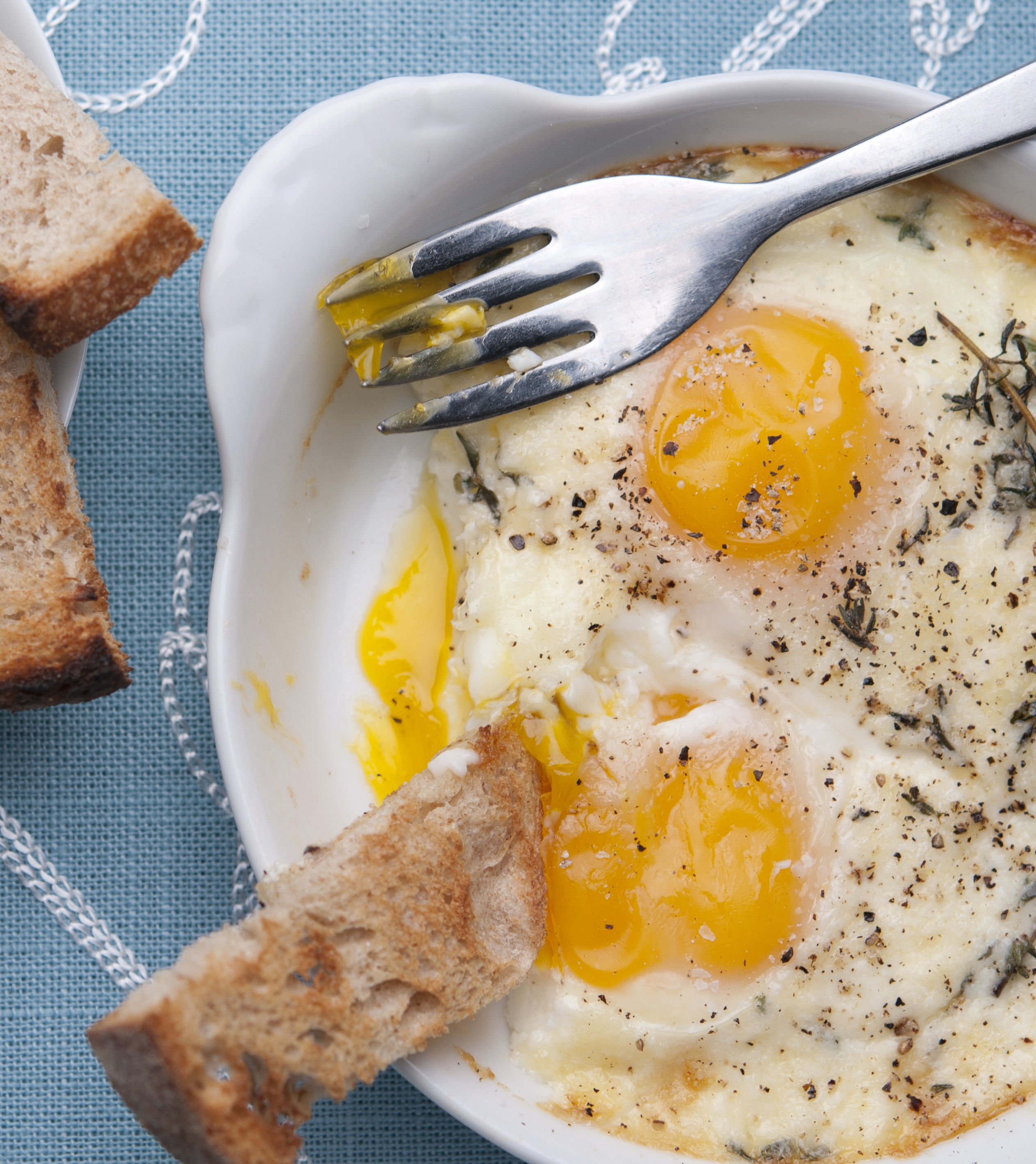
From Jacques Pepin~More Fast Food My Way. I think this dish would be great for an elegant breakfast, a wonderful breakfast-in-bed idea, or even as a first course to a fancy dinner. But I have to admit that we enjoyed these eggs simply in the comfort of our cozy home without the frills. They were quite delicious and now my husband is requesting them often.
- freshly ground black pepper
- 1/2 teaspoon salt
- 1/2 cup heavy cream
- 4 eggs
- 2 tablespoons shallot chopped
- 1 tablespoon good olive oil
- 1.5 cups julienned white mushrooms
- 1 tablespoon cognac/white wine
- 3 tablespoons gruyere cheese grated
- chives chopped
- 2 large slices country bread toasted, buttered and cut in
- Carbohydrate 8.04991989634673 g
- Cholesterol 30.8475000212589 mg
- Fat 11.6906235444424 g
- Fiber 0.282098958333333 g
- Protein 6.8130421866128 g
- Saturated Fat 5.53366291982871 g
- Serving Size 1 1 Serving (181g)
- Sodium 153.334791659433 mg
- Sugar 7.7678209380134 g
- Trans Fat 0.556995416880382 g
- Calories 169 calories
Step-by-step
- You will need to toast the bread. Just do them ahead of time, so that you will have them ready. I chose to sprinkle some Parmesan on them....just because I thought it would look a bit more sophisticated :). Really, though, I do think the Parmesan does add a nice touch to the bread sticks.
- Heat the shallot (or onion) and oil in a small saucepan over high heat. You will notice that the shallot will start to sizzle, stir and cook for another 30 seconds or so.
- You can add the mushrooms, salt and 1/4 teaspoon pepper. Cook the mushrooms, stirring occasionally, for about 2 minutes.
- Add cognac (or wine or chicken stock) and mix well.
- Add the cream and bring it all to a boil. Continue boiling over high heat for 1-1/2 to 2 minutes to reduce.
- Divide the mixture among 4 small (1/2-cup) ramekins or other small molds.
- Sprinkle cheese, salt/pepper and/or chives on top. (The recipe may be prepared ahead to this point.) Or... you can just crack the egg and place the cheese/chives on top of the egg like I did.
- Just before serving time, break an egg into each ramekin and arrange the ramekins (without their lids) in a saucepan that is deep enough so the pan lid fits on top to cover the ramekins while they are cooking.
- Pour enough water around the ramekins in the pan to extend about 1/2 inch up the sides.
- Bring to a boil, cover the pan (not the individual ramekins) and cook for 5 to 7 minutes, or until the eggs are set but still a little runny.
- To serve, sprinkle a little freshly ground black pepper on top of the eggs, if you like.
- Serve with a small espresso spoon on each plate.
While traditional fried eggs rely on direct pan contact to fry whites into opaque ribbons, eggs en cocotte suspend the protein in a gentler thermal environment using steam conduction. Steam maintains a moist ambient heat inside a covered saucepan, surrounding the ramekins with consistent energy that cooks the egg white and yolk at different rates. Because the white contains more water and coagulates at a higher temperature than the yolk, controlling this ambient heat prevents the exterior from turning rubbery before the center reaches a velvety consistency. When you pour water around the ramekins to extend about one-half inch up the sides, you create a water bath that buffers the intense bottom heat of the burner, translating vigorous boiling water into soft, even convection currents.
The Science of Cream Reduction and Emulsification
Heavy cream contains roughly thirty-six to forty percent milk fat suspended in water. Boiling the cream with the sautéed mushrooms for exactly ninety seconds forces excess moisture to evaporate, concentrating the milk solids until they form a dense, glossy emulsion capable of coating a spoon without breaking. If you add the alcohol and fail to boil it sufficiently before introducing the dairy, residual alcohol acids can curdle the protein globules in the heavy cream, splitting the sauce into a greasy film. By letting the mixture reduce rapidly over high heat, water molecules escape as steam, leaving behind a rich mushroom-infused lipid matrix that cushions the delicate egg.
Steaming Dynamics and Timing Precision
Cooking these eggs requires strict attention to the five-to-seven-minute steaming window because eggs continue to cook via residual thermal energy even after removal from the heat source. Trapping steam inside a deep saucepan with a tight-fitting lid creates a micro-oven where the ambient temperature hovers near boiling point. Pull the ramekins when the whites are just set and the yolks still jiggle slightly under a gentle tap, allowing carryover cooking to finish the job on the plate. Pairing the dish with toasted, buttered country bread provides the necessary structural contrast, offering a dry, crisp vehicle to cut through the velvety richness of the creamed mushrooms and soft egg.


