Buttery Spicy BBQ Shrimp
What can I say... It's simple, It's spicy, It's flavorful, It's really, really GOOD!
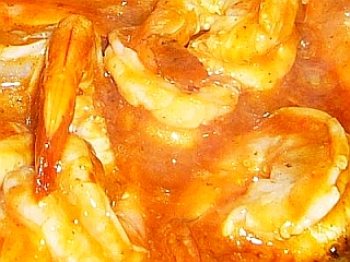
What can I say... It's simple, It's spicy, It's flavorful, It's really, really GOOD!
- 2 tablespoons olive oil
- 1/2 teaspoon cayenne pepper
- salt and fresh ground black pepper to taste
- -- spicy bbq sauce --
- 2 cups barbecue sauce (try trader joe's all natural barbecue sauce)
- 2 teaspoons crushed red peppers
- 1 tablespoon hot pepper sauce (i like louisiana's crystal hot sauce)
- -- bbq shrimp --
- 1 pound shrimp (16-20 count) cleaned, peeled and deveined
- 4 tablespoons unsalted butter softened
- 1/2 cup spicy bbq sauce
- Carbohydrate 51.4110294179262 g
- Cholesterol 248.93 mg
- Fat 15.0182681253484 g
- Fiber 1.14864379278105 g
- Protein 23.6795068750072 g
- Saturated Fat 7.88807925000073 g
- Serving Size 1 1 Serving (270g)
- Sodium 501.062687694671 mg
- Sugar 50.2623856251452 g
- Trans Fat 1.12217675005573 g
- Calories 441 calories
Step-by-step
- For Sauce: Place all ingredients in medium saucepan, mix to combine. Bring to boil over medium-high heat, reduce heat to low and simmer, stirring frequently, for 20 minutes.
- For Shrimp: Heat a large, heavy-bottomed saute pan over medium-high heat for 1 to 2 minutes. Add olive oil, and swirl to coat pan evenly. Add shrimp in a single layer, and cook on one side for 1 to 2 minutes. (Don't crowd; if necessary, use 2 pans. A 12-inch pan will accommodate 1 pound of shrimp.) Reduce heat to medium, turn shrimp, and cook an additional 1 to 2 minutes, or until pinkish in color. Remove shrimp to a plate and drain drippings from pan. Return pan to burner, add butter and heat until lightly browned. Add spicy bbq sauce, whisk to combine. Return shrimp to pan, stirring to coat. Reduce heat to low and cook, stirring frequently, until shrimp are just done (white throughout, moist and tender), about 5 minutes. Take care not to overcook the shrimp. Serve immediately in shallow bowls with hot French bread or garlic bread.
Temperature Control and Pan Mechanics
Preheating a heavy-bottomed saute pan for up to two minutes before introducing oil ensures the metal retains thermal mass, which prevents the shrimp from steaming instead of searing. Crowding the surface drops the pan temperature drastically, so batches remain necessary when scaling up quantities beyond a single pound. Turning the crustaceans at the precise one-minute mark guarantees a pink exterior without rubbery protein coagulation. Once the shrimp are briefly set aside, draining the accumulated drippings prevents excess water from breaking the emulsion when the softened butter hits the hot surface. Brown the butter gently until aromatic notes emerge, keeping a watchful eye because milk solids transition from toasted to burnt in seconds.
Balancing Heat and Commercial Condiments
Commercial barbecue sauces carry high sugar contents that caramelize rapidly, meaning simmering the reduction over low heat for twenty minutes concentrates the chili, vinegar, and tomato solids without scorching the base. Adjusting the ratio of cayenne pepper and crushed red flakes alters the Scoville profile, though commercial hot sauces like Crystal introduce distinct acetic acid notes that pure dried powders cannot replicate. Substituting salted butter for unsalted requires reducing added sodium elsewhere in the reduction to prevent an unpalatable brine. Pescatarian adaptations rely entirely on the base condiment selection, ensuring that regional styles containing Worcestershire sauce or anchovies are filtered out if strict adherence to fish-free boundaries is required.


