Everyday Paleo Pancit
Pancit is a Filipino dish made with meat, noodles, and veggies and seasoned with soy sauce. My husbands grandfather on his moms side was born and raised in the Philippines and passed his cultural and traditions on to his family, especially through the food! It's been years since my husband has had homemade pancit and after talking about the dish yesterday we remembered how great my recent Sausage n Cabbage Noodle dish was and decided to try using the same method for pancit! So we went for it and well, it was good enough to blog about so I hope you all enjoy it as much as we did! Next time I make this for variation I will sub half of the cabbage for grated sweet potato to give it a starchier element.
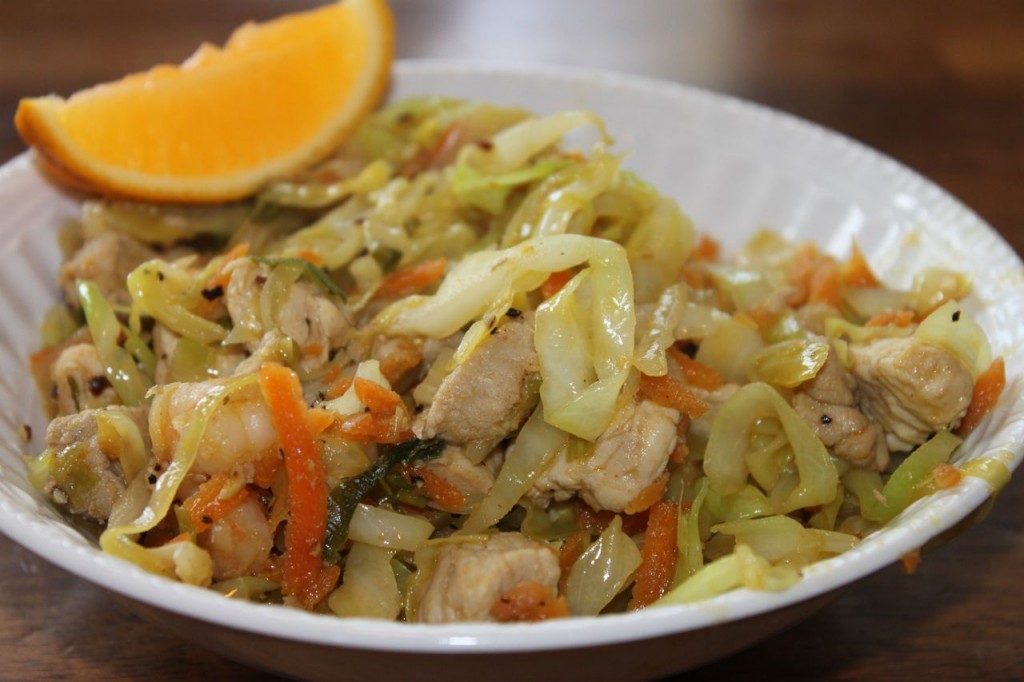
Pancit is a Filipino dish made with meat, noodles, and veggies and seasoned with soy sauce. My husbands grandfather on his moms side was born and raised in the Philippines and passed his cultural and traditions on to his family, especially through the food! It's been years since my husband has had homemade pancit and after talking about the dish yesterday we remembered how great my recent Sausage n Cabbage Noodle dish was and decided to try using the same method for pancit! So we went for it and well, it was good enough to blog about so I hope you all enjoy it as much as we did! Next time I make this for variation I will sub half of the cabbage for grated sweet potato to give it a starchier element.
- 1/4 cup chicken broth
- 2 tablespoons fish sauce
- black pepper to taste
- lemon wedges
- 1 1/2 lbs chicken breasts cut into small bite size pieces
- 1 lb pork loin cut into small bit size pieces
- â½ lb shrimp tails removed and de-veined
- 2 tablespoons coconut oil
- 2 teaspoons crushed garlic
- 4 carrots grated
- 6-8 cups shredded green cabbage
- 1/4 cup coconut aminos or tamari wheat free soy sauce
- 8 green onions diced
- Carbohydrate 13.672933333303 g
- Cholesterol 120.20197805 mg
- Fat 25.0027324694734 g
- Fiber 5.0426664908727 g
- Protein 40.6216023709771 g
- Saturated Fat 10.312667149167 g
- Serving Size 1 1 Serving (384g)
- Sodium 765.837941159203 mg
- Sugar 8.63026684243033 g
- Trans Fat 2.30792617686135 g
- Calories 426 calories
Step-by-step
- In a large wok or skillet heat the coconut oil over medium to medium high heat.
- When the wok or pan is nice and hot, add the chicken, pork, green onions and garlic and saute for about 6-7 minutes or until the meat is done all the way through but still tender.
- Remove the meat from the pan and set aside.
- Add the cabbage and carrots to the wok or pan and cook until the cabbage is tender, about 4 minutes.
- Add the shrimp to the cabbage and saute together until the shrimps turn pink.
- Add the chicken and pork back to the veggies and pour in the coconut aminos or soy sauce, chicken broth, and fish sauce. Season with lots of black pepper.
- Stir well and cook for another minute or two.
- Serve in bowls with a lemon wedge.
- Enjoy!!
The Evolution of Pancit Adaptations
Historical records of pancit point to Chinese traders introducing noodle-making techniques to the Philippines centuries ago, where local cooks continually adapted the dish to incorporate regional produce and available proteins. Substituting shredded cabbage for noodles transforms the structural profile entirely, turning a noodle-heavy banquet dish into a vegetable-forward skillet meal that prioritizes lean meats and shrimp. Cooking shrimp requires precise timing because overcooked crustaceans turn rubbery within seconds; adding them only after the cabbage has begun to soften ensures they reach their signature opaque pink color while retaining a tender bite.Managing Equipment and Storage
A carbon steel or cast iron wok conducts heat efficiently, but standard heavy-bottomed stainless steel skillets serve as viable alternatives provided they are preheated thoroughly over medium-high heat before adding the coconut oil. Leftovers store safely in an airtight container in the refrigerator for up to three days, though the cabbage will continue to release moisture as it sits. Reheat gentle portions in a skillet over medium heat rather than a microwave to evaporate accumulated liquid and restore the texture of the proteins without overcooking the shrimp.


