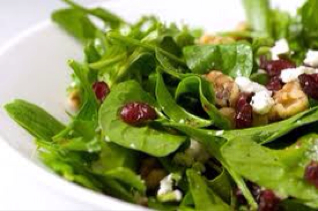
A delicious and beautiful salad.
- Carbohydrate 29.5801138562054 g
- Cholesterol 25.231075559 mg
- Fat 12.9485936825439 g
- Fiber 1.79303977891913 g
- Protein 4.16538544111346 g
- Saturated Fat 5.16305290420981 g
- Serving Size 1 1 Serving (77g)
- Sodium 333.590266200765 mg
- Sugar 27.7870740772863 g
- Trans Fat 0.618050332291078 g
- Calories 241 calories
Step-by-step
- Toss greens, cranberries, cheese and walnuts in large bowl.
- Mix vinegar, honey, mustard and pepper with wire whisk until well blended.
- Gradually add oil, whisking constantly until well blended.
- Pour over salad; toss to coat.
- Serve immediately.
Emulsifying balsamic vinegar and olive oil requires continuous whisking because oil droplets naturally separate from water-based liquids without a surfactant like mustard. Dijon mustard contains mucilage in its seed coats, acting as a structural stabilizer that suspends fat molecules within vinegar when blended. Adding extra virgin olive oil in a slow, steady stream rather than all at once prevents the droplet size from growing too large, which breaks the suspension.
Substitutions demand attention to fat and moisture ratios when modifying recipes for dietary restrictions. Maple syrup serves as a direct one-to-one replacement for honey if vegan guidelines apply, though it brings a thinner viscosity and a distinct mineral note. Plant-based feta alternatives made from coconut oil or almonds melt differently under ambient kitchen temperatures, often requiring immediate serving after dressing to avoid textural breakdown.
Walnuts harbor high oil content that accelerates rancidity when exposed to light and oxygen, making proper storage crucial. Raw walnut pieces toasted in a dry skillet at 350 degrees Fahrenheit for eight minutes develop pyrazines, compounds responsible for the savory, roasted aroma that offsets sweet dried cranberries. Store toasted nuts in an airtight glass jar for up to five days before use, or freeze them for three months to preserve unsaturated fats.
Green salads featuring delicate leaves like endive and radicchio wilt rapidly once salt encounters cellular walls through osmotic pressure. Dress only the portion intended for immediate consumption, holding un-dressed greens and toasted walnuts separately in the refrigerator for up to 24 hours to maintain crisp structural integrity.



