Baked Stuffed Cabbage Rolls
Easy, delicious and fun! Just like Mom used to make. I remember she always used tomato soup, which really makes a yummy difference.
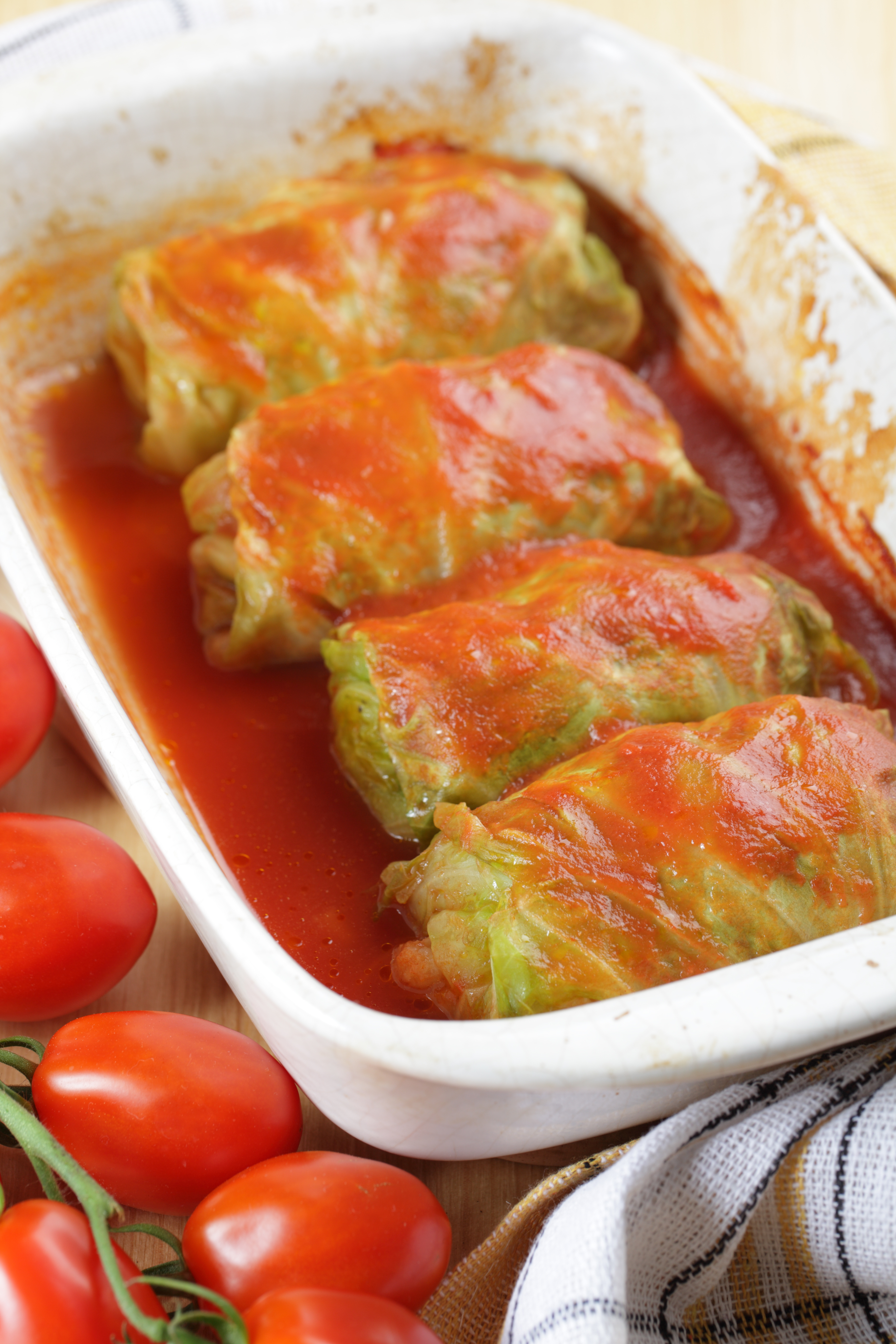
Easy, delicious and fun! Just like Mom used to make. I remember she always used tomato soup, which really makes a yummy difference.
- 2 cloves garlic minced
- salt and pepper to taste
- 1 head cabbage 10 leaves removed, the rest grated
- 2 tbsp olive oil
- 1 large onion chopped
- 1 14.5-oz can diced tomatoes
- 1 tsp crushed red pepper flakes (optional)
- 1 lb very lean ground beef (up to 1.5 lbs)
- 1 cup whole grain rice , cooked
- 1 cup dried bread crumbs (adding more if needed)
- cooking spray
- 1 can condensed tomato soup
- 1 can water
- 1 tbsp honey
- 1 cup reduced fat shredded cheese (see note)
- Carbohydrate 44.7022167280214 g
- Cholesterol 60.99145388 mg
- Fat 13.2291137 g
- Fiber 7.58427211777031 g
- Protein 31.7195580788573 g
- Saturated Fat 4.146804665 g
- Serving Size 1 1 Serving (523g)
- Sodium 664.933522840036 mg
- Sugar 37.1179446102511 g
- Trans Fat 0.915461181080002 g
- Calories 420 calories
Step-by-step
- Bring a large pot of salted water to boil.
- Carefully cut from the stem of the cabbage and peel off 10 large leaves.
- Place in boiling water, stir gently.
- Boil for about 5 minutes.
- Drain in colander and rinse with cold water.
- Gently lay leaves out on paper towels to dry.
- Cut stem from remaining cabbage and discard.
- Cut cabbage in half and grate into a large bowl, discarding any large pieces.
- In a large frying pan over med-high heat, sauté onion and garlic for 5 minutes.
- Add tomato, remaining cabbage, salt, pepper and red pepper if using.
- Cook and stir until liquid is gone and vegetables are soft, about 10 min.
- Remove from heat to cool.
- In a large bowl, add ground beef, rice, cooled tomato mixture and bread crumbs.
- Mix well, adding more bread crumbs if mixture is too moist.
- It should be firm enough to handle.
- Preheat oven to 375.
- Prepare a 13” x 9” baking dish with cooking spray.
- Working one at a time, place a cabbage leaf, stem side towards you, on work surface.
- Form a handful of meat mixture into a small “log”, place in middle of leaf.
- Fold sides in over meat, then stem side forward to make roll.
- Place seam side down in baking dish.
- Repeat with remaining meat mixture and cabbage leaves.
- Wisk together soup, water and honey in a small bowl.
- Pour evenly over cabbage rolls.
- Cover baking dish tightly with foil.
- Bake at 375 for 1 hour.
- Remove foil, bake for another 20 minutes.
Why Blanching Changes Everything
Does parboiling cabbage leaves actually achieve anything structural, or is it an entirely optional step? Submerging raw leaves in boiling water for five minutes breaks down the stubborn pectin networks in the cellular walls, rendering the thick ribs pliable enough to fold without snapping while simultaneously driving out trapped air that would otherwise expand and rupture the packets in the oven. Plunging those softened leaves into ice-cold water stops residual carryover cooking immediately, preventing the delicate outer layers from turning to mush before the filling ever gets mixed.
Managing Moisture in the Filling
Ground beef and cooked rice release divergent levels of liquid during long baking cycles, which threatens to turn a neat casserole into a watery soup unless managed proactively. Cooking down the diced tomatoes and grated raw cabbage until the pan is entirely free of visible moisture removes excess water before it can compromise the structural integrity of the meat logs. Bread crumbs act as a targeted desiccant here, absorbing stray juices from the lean beef and binding the proteins tightly together so the logs hold their shape at 375 degrees.
Balancing Tomato and Honey
Condensed tomato soup delivers intense umami through concentrated glutamates, but its heavy metallic edge requires chemical correction via balancing agents like honey. Whisking one tablespoon of honey into the soup and water mixture introduces simple sugars that neutralize the aggressive acidity of canned tomato solids through sheer sweetness contrast. Covering the 13x9-inch baking dish tightly with foil for the first 60 minutes traps steam to tenderize the exterior leaves, while removing that foil for the final 20 minutes allows surface evaporation to concentrate the sauce into a rich glaze.


