Banana Bread
One of my earliest childhood memories is of my mothers delicious banana bread. Today, I look forward to bananas turning soft and mushy on the counter just so that I have an excuse to make her recipe and relive a little joy of the past. This is a great banana bread that is soft and tender, has loads of banana flavor and crunchy toasted walnuts. My mom used plain yogurt in a lot of her baking, especially in her quick breads. I believe it is the addition of yogurt that makes her banana bread so moist and light.
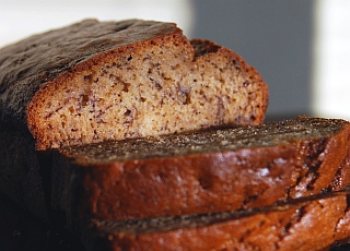
One of my earliest childhood memories is of my mothers delicious banana bread. Today, I look forward to bananas turning soft and mushy on the counter just so that I have an excuse to make her recipe and relive a little joy of the past. This is a great banana bread that is soft and tender, has loads of banana flavor and crunchy toasted walnuts. My mom used plain yogurt in a lot of her baking, especially in her quick breads. I believe it is the addition of yogurt that makes her banana bread so moist and light.
- 1/2 teaspoon salt
- 1 teaspoon vanilla extract
- 3/4 teaspoon baking soda
- 3/4 cup sugar
- 2 cups unbleached all-purpose flour plus more for dusting the pan
- 1 1/4 cups walnuts coarsely chopped
- 1 1/2 cups overripe bananas (3-4 bananas depending on size), mashed well
- 1/4 cup plain yogurt
- 2 large eggs, lightly beaten
- 3 ounces unsalted butter (3/4 stick), melted and cooled
- Carbohydrate 74.1500145833333 g
- Cholesterol 50.453125 mg
- Fat 14.6949214583333 g
- Fiber 2.69091668248177 g
- Protein 8.56531104166667 g
- Saturated Fat 4.40992416666667 g
- Serving Size 1 1 Serving (135g)
- Sodium 94.3129583333333 mg
- Sugar 71.4590979008516 g
- Trans Fat 1.414795375 g
- Calories 452 calories
Step-by-step
- Position oven rack to the lower-middle position and heat oven to 350 degrees F. Grease bottom and sides of a 9- by 5-inch loaf pan; dust with flour, tapping out excess flour.
- Spread walnuts evenly on a baking sheet and toast until fragrant, about 5-10 minutes. Set aside to cool.
- In a large bowl, whisk together the flour, sugar, baking soda, salt, and walnuts. Set aside until needed. In a medium bowl, using a wooden spoon, mix together the mashed bananas, yogurt, eggs, butter, and vanilla. Lightly fold the banana mixture into the dry ingredients with a spatula until just combined and the batter looks thick and chunky. Scrape the batter into the prepared loaf pan. Bake at 350 degrees for 55-60 minutes or until loaf is golden brown and a toothpick inserted in the center comes out clean. Let cool in the pan for 5 minutes, then transfer to a wire rack. Serve warm or at room temperature.
A properly baked quick bread yields a crust that shatters slightly under pressure while encasing a dense, plush crumb heavily saturated with fruit solids. American quick breads evolved out of necessity during the nineteenth century when chemical leaveners like baking soda first replaced commercial yeasts in home pantries. Achieving this specific texture requires understanding how chemical agents react with acidic dairy ingredients. Baking soda needs an acid to trigger its leavening power, which is why plain yogurt works effectively alongside overripe fruit to neutralize the alkali flavor while tenderizing the gluten network.
Dry ingredients must be whisked thoroughly before hydration occurs. Incorporating coarse walnuts directly into the flour mixture coats the nut surfaces and prevents them from sinking to the bottom of the pan during baking. When mixing the wet components into the dry, fold gently using a spatula just until the flour disappears to avoid developing excess gluten that produces a rubbery loaf. Position the oven rack in the lower-middle tier at 350 degrees Fahrenheit to ensure the heat penetrates the dense batter without scorching the top before the center sets.
Leftover portions freeze exceptionally well when wrapped tightly in plastic and aluminum foil for up to two months. Thaw frozen slices overnight in the refrigerator, then warm them in a toaster oven to restore the original crisp crust.


