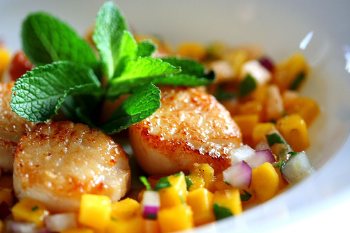
Tropical Fruit Salsa with Seared Scallops
- tropical fruit salsa:
- 3/4 cup mango (1/2 mango) diced
- 3/4 cup papaya (1/2 small papaya) diced
- 1/4 cup red onion diced
- 2 tablespoons fresh mint leaves minced
- 1 pinch chili powder
- 1 tablespoon lime juice
- 1/4 teaspoon orange-ginger flavored salt
- black pepper freshly ground
- scallops:
- 20 large dry-packed scallops
- 1/2 teaspoon kosher or sea salt
- black pepper freshly ground
- 1 tablespoon cooking oil
- Carbohydrate 10.5529875045825 g
- Cholesterol 98.9333333333333 mg
- Fat 6.24714395840508 g
- Fiber 1.91258747710514 g
- Protein 44.0541304168068 g
- Saturated Fat 0.583374895850724 g
- Serving Size 1 1 Serving (267g)
- Sodium 790.233166667222 mg
- Sugar 8.64040002747741 g
- Trans Fat 1.3986023750141 g
- Calories 280 calories
Step-by-step
- Assemble the tropical fruit salsa and set aside.
- Pat the scallops dry with a paper towel and season with the salt. Heat a medium skillet over medium-high heat and add the cooking oil. When the oil is hot but not smoking and add the scallops. Make sure that the scallops do not touch – they should have a finger-width’s space between them. Fry 1-1/2 to 2 minutes each side and remove immediately to prevent overcooking. Timing depends on how thick your scallops are. The scallops should have a golden brown crust and the interior will be medium-rare.
- Serve with Tropical Fruit Salsa.
Adapting Yields and Pan Capacity
Multiplying this seafood recipe requires careful attention to pan capacity rather than simple arithmetic. Crowding the skillet drops the cooking surface temperature rapidly, causing the mollusks to release moisture and steam instead of developing the required crust. Maintain a finger-width gap between each piece by working in multiple batches if your skillet measures less than twelve inches across. Freshly minced mint leaves also degrade quickly under prolonged refrigeration, so mix the fruit component no more than twenty minutes before serving to preserve bright aromatics and prevent the salt from drawing out excessive liquid from the papaya.
Balancing Fruit and Seafood Chemistry
The culinary success of pairing sweet tropical fruits with protein relies on contrast and enzymatic balance. Acid from the lime juice cuts through the natural sweetness of the mango and papaya while lightly firming the delicate proteins in the seafood. Using dry-packed scallops ensures proper browning because they lack the chemical additives common in wet-packed alternatives, allowing heat to rapidly caramelize surface sugars without pooling water in the pan.


