Baked Stuffed Bell Peppers
Stuffed Bell Peppers... We love stuffed bell peppers. I think both my husband and I have great memories of eating stuffed peppers throughout our childhood days. We both liked the way our mothers made them...we added a dollop of sour cream on top. But, this version is a bit different in that it is baked rather than cooked on the stove top(like our mothers used to do), uses turkey instead of beef and has a bit more rice for a lighter version. The stove top method makes the peppers extra soft. The peppers in this recipe have a bit more bite to them.
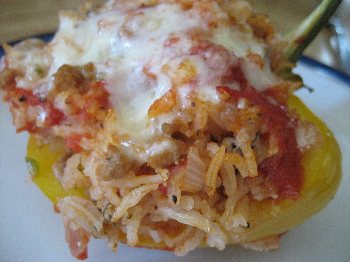
Stuffed Bell Peppers... We love stuffed bell peppers. I think both my husband and I have great memories of eating stuffed peppers throughout our childhood days. We both liked the way our mothers made them...we added a dollop of sour cream on top. But, this version is a bit different in that it is baked rather than cooked on the stove top(like our mothers used to do), uses turkey instead of beef and has a bit more rice for a lighter version. The stove top method makes the peppers extra soft. The peppers in this recipe have a bit more bite to them.
- salt/pepper to taste
- 1 tbsp olive oil
- 0.5 cup water
- 3 bell pepper
- 1 small onion diced
- 3 cloves garlic (up to 4 cloves) minced
- 1 cup rice (used basmati rice for a fluffier filling)
- 10 oz ground turkey
- 1 16-oz can tomatoes diced
- 1 6-oz can tomato sauce
- 0.5 cup jack cheese grated
- 1 taste (i used about 1 tbs drie d)
- Carbohydrate 38.4528 g
- Cholesterol 45.2475 mg
- Fat 9.41795 g
- Fiber 3.45333334803581 g
- Protein 14.5673 g
- Saturated Fat 3.26951333333333 g
- Serving Size 1 1 Serving (281g)
- Sodium 277.586583333333 mg
- Sugar 34.9994666519642 g
- Trans Fat 0.738154999999999 g
- Calories 296 calories
Step-by-step
- You can cook the rice to have a head start. I use1 cup of rice uncooked (the cup that comes with the rice cooker) and get approx. 2 cups cooked rice.
- Wash peppers and cut in half lengthwise. Take out seeds and membranes. Rinse to clean out all the seeds. At this point, if you like your peppers to be softer in the end, blanch them in salted boiling water for about 5-7 minutes. I skipped this step and left them raw.
- Place about 1/3 of the cut up tomatoes on the bottom of your dish. You may add about 1/2 cup-1 cup water and mix with the tomatoes. Place the peppers on top of the sauce.
- Add olive oil to frying pan. Heat on med low and add onion and garlic.
- Saute for about 4-5 minutes or until soft. Lower the heat if you need to so as not to burn. Add turkey, salt ,pepper and dill.
- Cook until turkey is cooked through and no longer pink.
- Add rice and remainder of the diced tomatoes, and 1/2 can of tomato sauce.
- Mix and combine. Turn off heat. Fill bell peppers with rice mixture. Top with a tablespoon or so of the leftover tomato sauce.
- Cover with foil and bake in a 375 preheated oven for about an hour (test and see how soft you want the bell peppers to be and leave them in a bit longer if you wish)... uncover ...bake an additional10-15 minutes. Sprinkle some cheese the last minute or so of the baking time.
Traditional stuffed peppers are frequently simmered in a covered pot on the stovetop, yielding a uniformly soft exterior and a heavily stewed filling. Shifting the cooking method to an oven dry-heat environment changes the structural outcome entirely. Roasting bell peppers at 375 degrees Fahrenheit allows the exterior walls to retain more crispness while concentrating the flavors of the surrounding tomato sauce through gentle reduction. Ground turkey introduces less rendering fat than beef, requiring precise fat management during the initial stovetop saute. Cook the onions and minced garlic over medium-low heat for roughly four to five minutes, ensuring the aromatics soften without browning or turning bitter before the lean poultry enters the pan. Basmati rice works well in the filling because its low starch content prevents the grains from gumming together when mixed with diced tomatoes and tomato sauce. Laying a bed of raw diced tomatoes and water at the bottom of the baking dish serves a dual purpose. It prevents the pepper bottoms from scorching during the long oven phase while generating steam that assists in tenderizing the walls from the outside in. Covering the dish with foil for the first hour traps moisture to cook the pepper walls safely through without drying out the exposed grains of rice on top. Removing the foil for the final ten to fifteen minutes lets excess surface moisture evaporate, concentrating the tomato sugars. Grated jack cheese applied during the final sixty seconds melts rapidly under residual heat without separating its milk solids. Reserve blanching in salted boiling water for five to seven minutes only if a softer, pliable wall is preferred over a firm crunch.


