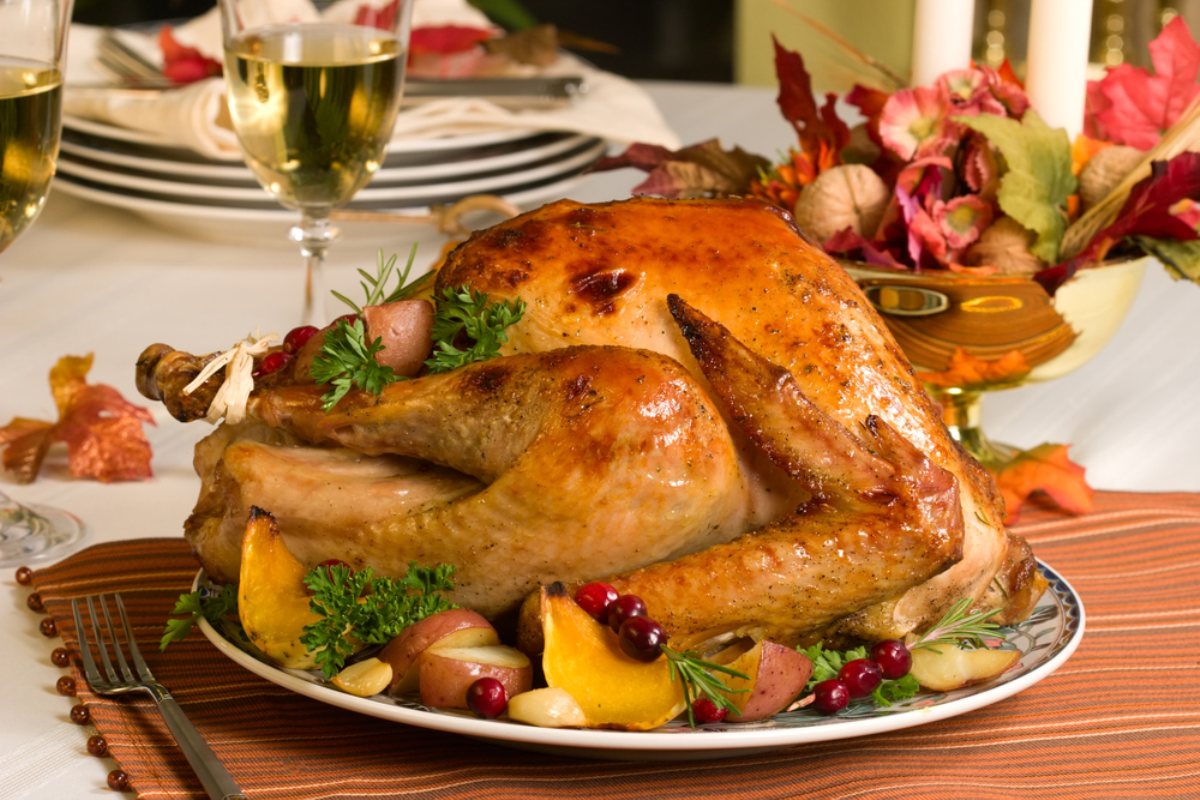
Brined, herb-roasted Thanksgiving turkey for the holiday
- 1 cup brown sugar
- 1/4 cup all-purpose flour
- brine:
- 1 cup salt
- 2 oranges quartered
- 2 lemons quartered
- 6 sprigs thyme
- 4 sprigs rosemary
- 10 pound turkey (up to 12-pound)
- 1 large orange cut into 1/8ths
- 4 tbsp unsalted butter at room temperature
- salt and pepper
- 1 large yellow onion cut into 1/8ths
- 1 stalk celery cut into 1-inch pieces
- 1 large carrot cut into 1-inch pieces
- 2 bay leaves
- 2 sprigs thyme
- 2 sprigs rosemary
- 1/2 bunch sage
- 3 sprigs parsley
- 1 1/2 cups chicken or turkey stock for basting, (up to 2)
- turkey broth:
- 1 tablespoon vegetable oil
- 1 reserved turkey neck and giblets
- 1 large carrot coarsely chopped
- 1 onion coarsely chopped
- 1 large stalk celery coarsely chopped
- 1 small bay leaf
- 3 cups turkey stock chicken stock, or canned low-salt chicken broth
- 3 cups water
- gravy:
- 4 cups turkey broth
- 1 cup dry white wine
- 4 tbsp unsalted butter
- salt and fresh ground pepper
- Carbohydrate 101.784616010506 g
- Cholesterol 537.498400833333 mg
- Fat 41.5733426034471 g
- Fiber 5.25773002974755 g
- Protein 171.943626211369 g
- Saturated Fat 17.8322213230041 g
- Serving Size 1 1 (1350g)
- Sodium 952.228856893117 mg
- Sugar 96.5268859807585 g
- Trans Fat 5.01648145625623 g
- Calories 1499 calories
Step-by-step
- To make the brining solution, dissolve the salt and sugar in 2 gallons of cold water in a nonreactive container (such as a clean bucket or large stockpot, or a clean, heavy-duty, food grade plastic storage bag). Add the oranges, lemons, thyme, and rosemary. Note: if you have a big turkey and need more brine than this, use 1/2 cup salt and 1/2 cup brown sugar for every gallon of water.
- Remove the neck, giblets, and liver from the cavity of the turkey and reserve for the gravy. Rinse the turkey inside and out under cold running water.
- Soak the turkey in the brine, covered and refrigerated, for at least 4 hours and up to 24 hours.
- Preheat the oven to 325 degrees F.
- Remove the turkey from the brine and rinse well under cold running water. Pat dry with paper towels both inside and out. Place turkey, breast side up, in a large, heavy roasting pan. Rub breast side with orange segments and rub on all sides with the butter, stuffing some underneath the skin. Season lightly inside and out with salt and pepper. Stuff the turkey with the onion, remaining orange, celery, carrot, bay leaves, thyme, rosemary, sage and parsley. Loosely tie the drumsticks together with kitchen string. Roast the turkey, uncovered, breast side down for 1 hour.
- Remove from the oven, turn, and baste with 1/2 cup stock. Continue roasting with the breast side up until an instant-read meat thermometer registers 165 degrees F when inserted into the largest section of thigh (avoiding the bone), about 2 3/4 to 3 hours total cooking time. Baste the turkey once every hour with 1/2 to 3/4 cup chicken or turkey stock.
- Remove from the oven and place on a platter. Tent with aluminum foil and let rest for 20 minutes before carving.
- Heat the oil in a large heavy saucepan over medium-high heat. Add the turkey neck, heart, and gizzard to the pan and saute until just beginning to brown, about 1 minute. Add the chopped vegetables and bay leaf to the pan and saute until soft, about 2 minutes. Pour the stock and 3 cups of water into the pan and bring to a boil. Lower the heat to medium-low and simmer until the stock is reduced to 4 cups, about 1 hour, adding the chopped liver to the pan during the last 15 minutes of cooking. Strain the stock into a clean pot or large measuring cup. Pull the meat off the neck, chop the neck meat and giblets, and set aside.
- Pour the reserved turkey pan juices into a glass-measuring cup and skim off the fat.
- Place the roasting pan on 2 stovetop burners over medium heat add the pan juice and 1 cup turkey broth and the white wine to the pan, and deglaze the pan, stirring to scrape any brown bits from the bottom of the pan. Add the remaining 3 cup of broth and bring to a simmer, then transfer to a measuring cup. In a large heavy saucepan, melt the butter over medium high heat. Stir in the flour and cook, stirring constantly, to make a light roux. Add the hot stock, whisking constantly, then simmer until thickened, about 10 minutes.
- Add the reserved neck meat and giblets to the pan and adjust seasoning, to taste, with salt and black pepper. Pour into a gravy boat and serve. Have a great holiday!
- Slice and serve guests with desired sides.
Unlike a quick-roasting chicken or a small cornish game hen that can be tossed into a hot oven without premeditation, a whole holiday turkey demands deliberate thermal management to bridge the moisture gap between lean breast meat and fatty, connective-tissue-laden dark meat. When scaling this dish up for larger birds, use half a cup of salt and half a cup of brown sugar for every single gallon of water required to fully submerge the protein.
- Dissolve salt and brown sugar completely in cold water inside a nonreactive container, such as a food-grade plastic storage bag or clean stockpot, to prevent metallic off-flavors during the mandatory four-to-twenty-four-hour refrigerator soak.
- Pat the skin thoroughly dry with paper towels after rinsing to promote effective lipid rendering and browning reactions during roasting.
- Start the bird breast-side down in a heavy roasting pan for the first hour of the 325 degrees F baking cycle, which encourages rendered fat to baste the delicate white meat from underneath.
- Insert an instant-read meat thermometer directly into the thickest section of the thigh while carefully avoiding the bone to confirm when the internal temperature reaches 165 degrees F.
- Rest the roasted bird tented under aluminum foil for twenty minutes on a platter to allow muscle fibers to relax and reabsorb redistributed moisture before carving.
Deglazing the roasting pan over two stovetop burners with dry white wine and stock lifts the caramelized fond required to build a structured roux-thickened gravy. Whisking continuously while incorporating hot stock prevents the flour mixture from seizing into unwanted lumps.



