Champagne Turkey and Gravy
Very tender and moist champagne-brined turkey roasted to perfection with flavorful gravy
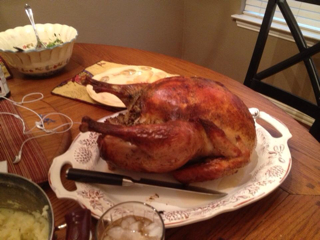
Very tender and moist champagne-brined turkey roasted to perfection with flavorful gravy
- 1 cup salt
- 1/4 cup all purpose flour
- 1 stick butter
- 1 whole turkey can be any size. i usually do about 21 lbs
- 2 bottles champagne any cheap bottle will work
- 1 large cooking bag to brine turkey. can use large pot but i find bag easy clean up
- 2 tablespoons poultry seasoning
- 2 tablespoon ground sage
- 1 extra large can chicken broth
- 1 tablespoon garlic salt
- Carbohydrate 8.34833606725021 g
- Cholesterol 307.22 mg
- Fat 22.0736413395774 g
- Fiber 0.524754502438241 g
- Protein 96.5647316484392 g
- Saturated Fat 10.0947890180768 g
- Serving Size 1 1 Serving (635g)
- Sodium 678.981679618449 mg
- Sugar 7.82358156481197 g
- Trans Fat 2.72798920542989 g
- Calories 759 calories
Step-by-step
- Clean fresh or thawed turkey and remove neck and gizzards from cavity.
- Pat turkey dry with paper towels and rub all seasonings on turkey. Be sure to add some in cavities.
- Put turkey in turkey size oven bag or large pot. Poor 1 bottle champagne into bag and close tight. I put in roasting pan in case it leaks. Soak over night. In refrigerator
- Preheat oven to 350 degrees.
- Remove turkey from bag and brine and put in roaster pan.
- You can stuff with favorite stuffing recipe.
- Add champagne about 1 cup to bottom of roaster.
- Roast uncovered 3 to 4 hours or until internal temperature reaches 180 degrees. If stuffing it takes about 4 to 5 hours.
- About 31/2 hours into roasting rub with butter.
- You can cover parts of bird with aluminum foil if they brown too quickly to keep wings or parts from browning too quickly.
- Put neck and gizzards in saucepan with chicken broth and 1/4 cup champagne and 2 tsp salt to simmer on low while turkey is cooking.
- You can add chicken broth if it evaporates too quickly.
- 30 minutes before turkey is done remove from saucepan reserve liquid .
- Dice meat from neck and gizzards and sauté in 2 tbs butter.
- Remove and set aside.
- Put remaking liquid in saucepan. Should be about 1 1/5 cups
- Take a coffeecup and fill 1/4 with flour fill to top with water.
- Whisk until creamy be sure to mix bottom of cup.
- Bring liquid to low boil.
- Add flour water mixture and add any fat you can get from bottom of turkey roasting pan.
- Simmer on low to it thickens.
- You can put a dash of champagne.
- Great gravy.
- Be sure to continually stir gravy while it is simmering.
- Season to taste.
- Add in meat from neck and gizzards.
The Overnight Brine Mechanism
Submerging a large poultry specimen in an acidic, alcoholic solution alters protein structures significantly before heat ever touches the flesh. Carbonic acid and ethanol present in budget sparkling wine begin denaturing peripheral muscle fibers while the dissolved solute draws moisture deep into the tissue through osmosis. Keeping this immersion strictly contained within a refrigerated environment below 40 degrees Fahrenheit prevents microbial proliferation during the extended twelve-to-twenty-four-hour resting window. Thoroughly drying the skin with paper towels post-brine remains critical because residual surface liquid prevents the Maillard reaction from turning the skin golden and crisp.
Thermal Tracking and Fat Management
Operating an oven at 350 degrees Fahrenheit requires constant monitoring of internal meat density rather than relying solely on arbitrary clock times. Inserting a digital probe into the deepest section of the breast without touching bone guarantees accuracy when verifying that the target of 180 degrees Fahrenheit has been achieved throughout the bird. While the turkey roasts, rendering subcutaneous fat drips into the pan below, providing essential lipids that will later form the base of an emulsion when combined with starches. Shielding delicate extremities like wing tips with aluminum foil midway through the cooking cycle stops them from scorching before the interior finishes cooking.
Constructing the Giblet Emulsion
Simmering the neck and gizzards alongside broth extracts collagen from connective tissues, transforming hard-to-chew scraps into tender morsels destined for reintroduction into the sauce. Whisking all-purpose flour thoroughly with cold water prevents lump formation by hydrating starch granules evenly before they encounter boiling liquid. Pouring this slurry into the simmering broth initiates gelatinization, thickening the pan drippings into a glossy coating that clings to the back of a spoon. Those avoiding dairy or gluten can easily substitute cornstarch for wheat flour or swap out butter for neutral rendered poultry fat without altering the fundamental thickening chemistry.


