Toaster Oven Clementine Chiffon Cake
Small Cravings Satisfied: A Toaster Oven Chiffon Cake with Clementines
Small Cravings Satisfied: A Toaster Oven Chiffon Cake with Clementines
- Carbohydrate 99.191896875 g
- Cholesterol 95.51 mg
- Fat 23.9926237760413 g
- Fiber 2.15857297719767 g
- Protein 12.4824175 g
- Saturated Fat 2.63693781441794 g
- Serving Size 1 1 Serving (255g)
- Sodium 679.048458333333 mg
- Sugar 97.0333238978023 g
- Trans Fat 0.951541437816924 g
- Calories 665 calories
Step-by-step
- Zest both clementines, then peel off the remaining pith, blend the flesh, and strain the juice to remove the pulpy stuff.
- When the eggs are at room temperature, separate the yolks from the whites.
- Sift the flour, sugar, baking powder, and salt together in a large bowl. Add the zest, clementine juice, oil, and vanilla. Dump the egg yolks into the mix, and mix until smooth.
- Using a super-clean electric beater (or by hand, if you really want to feel the burn), beat the egg whites until foamy. Add the cream of tartar, and continue beating until soft peaks form.
- Fold the beaten whites into the other mix, taking care not to deflate its airiness.
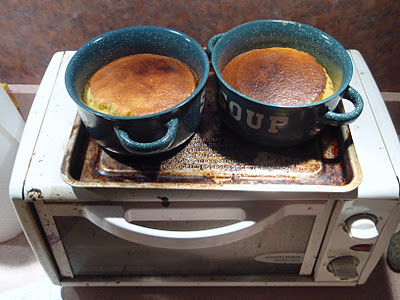
- Divide it into two soup ramekins/whatever cup you plan to use, and get them into the toaster oven at 325 degrees. (Not too hot, because the flame gets so close to the cakes!) It took me about 20-25 minutes to bake.
- Toothpick-test for doneness.
- Drizzle with honey or sprinkle confectioner's sugar. Or eating it with ice cream is pretty good too.
Bakers frequently fail with chiffon cakes by using greased pans, which prevent the aerated batter from climbing the interior walls during baking. Chiffon cakes rely entirely on mechanical leavening achieved by whipping egg whites into stable foams rather than relying solely on chemical agents like baking powder. Cream of tartar acts as an acid that strengthens the protein bonds around the air bubbles, ensuring the foam does not collapse when folded into the dense yolk and flour mixture.
Separating eggs while cold is standard practice because yolks are firm and less likely to break, but allowing those whites to reach 65 degrees Fahrenheit before whipping is critical for maximum volume. Clean equipment is equally non-negotiable since residual fats on bowls or beaters will coat the egg proteins and prevent proper aeration. Whisk the whites until soft peaks curl gently over when the beaters are lifted, indicating enough trapped air to expand under heat without snapping the protein structure.
Folding requires deliberate motion using a wide spatula to slice down the center, sweep across the bottom of the bowl, and gently turn the batter over itself. Vigorous stirring shears the trapped air cells, resulting in a heavy, rubbery crumb instead of the characteristic cloud-like sponge. Castor sugar dissolves rapidly into the liquid ingredients, providing essential moisture and tenderness that heavier granulated sugars often compromise in small-batch baking.
Baking at 325 degrees Fahrenheit prevents the exterior from burning before the center finishes setting in a compact toaster oven cavity where heating elements sit close to the pan. Testing doneness requires inserting a wooden toothpick into the center; it should emerge clean without wet batter clinging to the wood. Cool the baked ramekins upside down if possible, or support them carefully to prevent the delicate internal structure from compressing under its own weight while cooling.


