Acorn Squash with Cranberry Apple Stuffing
Some days I need a little inspiration. I knew that I would be baking squash for our Shabbat dinner tonight. And I knew it would have some delicious dried cranberries in it. I just wasn't entirely sure what form it would all take.
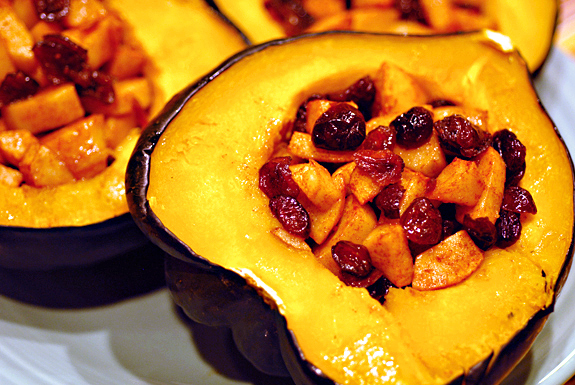
Some days I need a little inspiration. I knew that I would be baking squash for our Shabbat dinner tonight. And I knew it would have some delicious dried cranberries in it. I just wasn't entirely sure what form it would all take.
- Carbohydrate 29.773635 g
- Cholesterol 0 mg
- Fat 0.336585 g
- Fiber 4.04789997434616 g
- Protein 1.75571 g
- Saturated Fat 0.055995 g
- Serving Size 1 1 Recipe (244g)
- Sodium 7.370029625 mg
- Sugar 25.7257350256538 g
- Trans Fat 0.102334 g
- Calories 113 calories
Step-by-step
- Cut squash in half and with a spoon, remove pulp and seeds
- In a 9 x 13 inch baking dish place squash cut-side down
- Pour ¼-inch boiling water into baking dish (or use ¼ inch room temperature apple juice for extra sweetness)
- Place dish in oven and bake squash for 30 minutes at 350°
- In a large bowl, combine apples, cranberries, cinnamon and oil to make stuffing
- Remove squash from the oven after 30 minutes
- Turn halves over and stuff center of each squash half with apple mixture
- Return to oven and bake for 30-35 minutes (or longer) until squash and apples are tender
The Mechanics of Fresh and Preserved Fruits
Balancing fresh produce with dehydrated ingredients changes how moisture behaves inside a roasting cavity. Fresh apples release significant water content when exposed to a 350-degree oven, creating a steam effect that softens the surrounding squash flesh. Dried cranberries act in reverse, reabsorbing ambient juices and plumping up as the dish bakes. Chopping the apples into uniform quarter-inch pieces ensures they soften at the same rate the cranberries swell, preventing pockets of hard fruit. Substituting the quarter-inch of boiling water in the baking dish with apple juice adds residual sugars that caramelize along the edges of the squash skin during the final thirty-minute baking phase.
Adapting Proportions for Different Yields
Scaling this dish requires maintaining the structural ratio of one half-squash per serving, as each cavity holds roughly a half-cup of the apple mixture. Doubling the recipe for eight servings necessitates a second 9x13-inch baking dish to prevent overcrowding, which traps steam and leads to uneven softening. Grapeseed oil provides a neutral medium that carries the cinnamon without masking the natural sweetness of the squash, though coconut oil offers a distinct tropical note that pairs well with dried fruit. Testing for doneness involves piercing the thickest part of the squash neck with a paring knife; no resistance should remain before pulling the dish from the oven.



