Braised Red Wine Beef Short Ribs with Parmesan Polenta
Try this Braised Red Wine Beef Short Ribs with Parmesan Polenta recipe
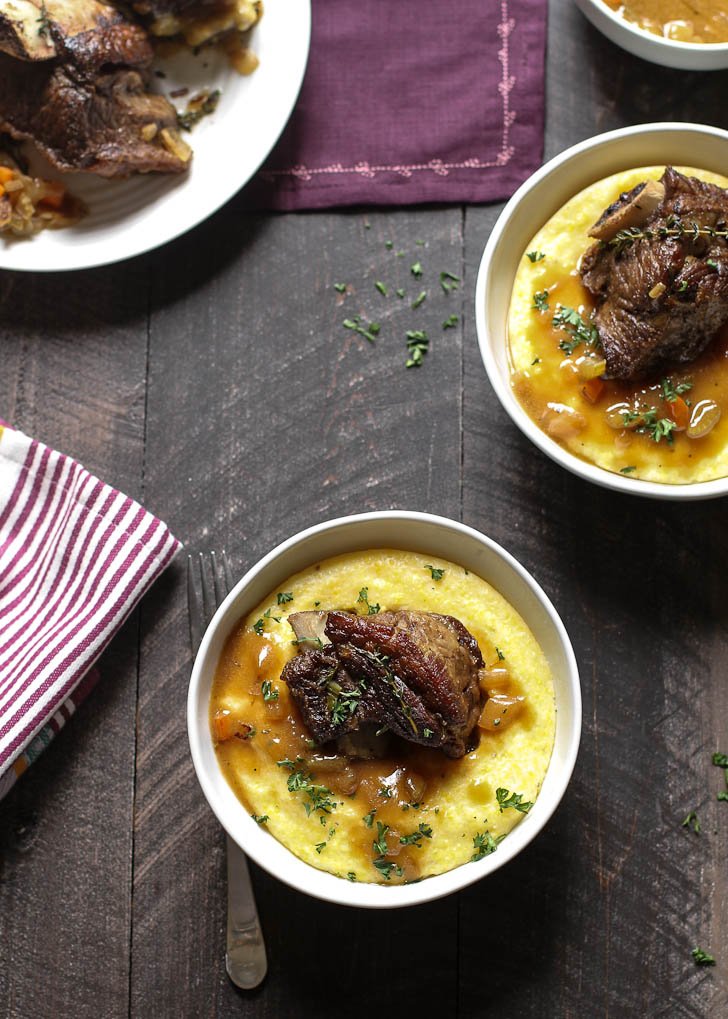
Try this Braised Red Wine Beef Short Ribs with Parmesan Polenta recipe
- Carbohydrate 20.1078696500086 g
- Cholesterol 38.7515625287649 mg
- Fat 20.6211415825972 g
- Fiber 2.51892494133487 g
- Protein 14.019663472791 g
- Saturated Fat 9.09166174913604 g
- Serving Size 1 1 Serving (899g)
- Sodium 752.136147727151 mg
- Sugar 17.5889447086737 g
- Trans Fat 1.58954057692663 g
- Calories 316 calories
Step-by-step
- Preheat oven to 325 degrees F / 163 C.
- Generously season the short ribs on all sides with salt and pepper.
- Heat a large Dutch Oven over medium-high heat. Add oil. When oil begins to shimmer, add short ribs and brown on all sides, about 2 minutes per side. Transfer short ribs to a plate and return pan to heat.
- Add onion, celery and carrots to hot pan. Saute to let the vegetables begin to soften and pick up the browned bits from the bottom of the pan, about 4 minutes. Add red wine and stir, scraping up any more browned bits that remain in the pan. Bring to a simmer and simmer for 2 minutes. Add stock and thyme sprigs. Add short ribs back to the pan. (Note: The short ribs should be mostly covered with liquid, with just the tops uncovered. Add a bit more stock or water if more than half of the short ribs are uncovered.)
- Place the lid on the pan and transfer to the oven. Cook, covered, until the meat of the short ribs easily falls off the bone, 2.5 to 3 hours. Remove from oven and let rest for 20 minutes. Do either of the following two optional steps or jump down to make the polenta.
- Optional Step 1: If you'd like to get a crisp exterior on the short ribs (which is a great complement to the tender, juicy interior, remove short ribs from their cooking liquid and transfer to a sheet pan. Turn on the oven's broiler. Place the sheet pan at least 6 inches under the heat source and broil just until crisp on the top, about 5 minutes (watch them closely so they don't burn).
- Optional Step 2: If you'd like to make a pan sauce, run the cooking liquid through a strainer (discard any solids from the vegetables and meat) and return the liquid to the pan. Simmer until the pan sauce reduces significantly, about 10 minutes. If you'd like a thicker gravy-style sauce, whisk 2 Tbsp of flour with ¼ cup hot water and add that to the simmering pan sauce.
- While the meat rests, make the polenta by bringing milk, water and salt to a boil in a small saucepan. While whisking the liquid, slowly add polenta. Continue whisking until the polenta begins to thicken, about 3 minutes. Reduce heat to a low simmer and continue simmering until the polenta is thick but still creamy, about 20 minutes. Stir in butter and parmesan cheese until fully incorporated.
- Spoon polenta into serving bowls. Top each serving with short ribs and cooking liquid. Enjoy!
Red wine does the structural heavy lifting in this braise, acting as both an acidic tenderizer that breaks down tough connective tissue and a flavor bridge that connects the rich beef stock with the aromatic vegetables. Searing the bone-in cuts over medium-high heat for roughly two minutes per side creates a Maillard reaction that builds a deep foundation of savory depth inside a heavy Dutch oven, which then maintains a stable, even thermal environment when transferred to a 325 degrees F oven for hours of slow cooking. Adapting this dish for dairy-free diets requires swapping the butter and parmesan for olive oil and nutritional yeast, while gluten-free diners can safely enjoy the polenta as written without needing any thickeners for the braising liquid. Fresh thyme sprigs infuse the pot with herbal complexity during the long simmer, whereas dried thyme lacks the bright, volatile oils needed to pierce through heavy fats and requires a three-to-one reduction in quantity if substituted. Resting the meat for twenty minutes before plating allows the contracted muscle fibers to relax and reabsorb their escaping juices, ensuring every bite remains moist even after being exposed to the dry heat of the optional broiler step.



