Couscous Salad
Tender couscous combined with crunchy vegetables and a flavorful vinaigrette, this salad makes for a quick and delicious side dish or light meal.
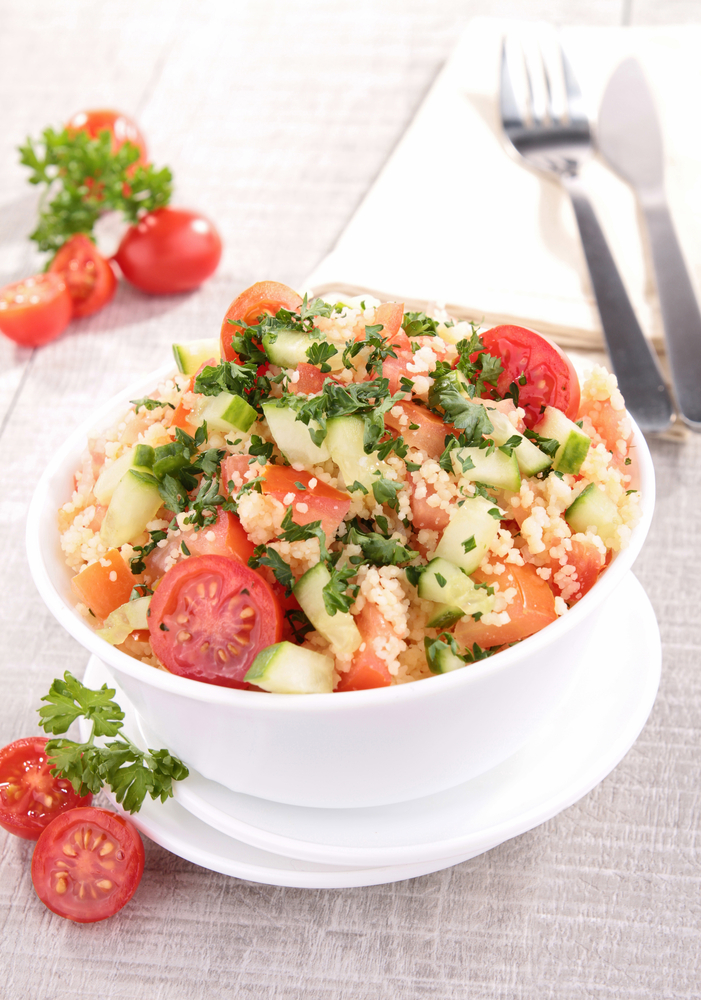
Tender couscous combined with crunchy vegetables and a flavorful vinaigrette, this salad makes for a quick and delicious side dish or light meal.
- 1 teaspoon olive oil
- 2 cups boiling water
- 1 10 oz. box of instant couscous (1 1/4 cups)
- 2 cups halved cherry tomatoes
- 1 cup diced seedless cucumbers or kirbies peeled if the skins are thick
- 1/4 cup sliced scallions
- 1/2 cup canned chick peas drained and rinsed
- 2 tablespoons toasted pine nuts
- 1/2 cup crumbled feta cheese
- 1/2 cup red wine vinegar vinaigrette
- red wine vinegar vinaigrette:
- 2 tablespoons red wine vinegar
- 5 tablespoons extra virgin olive oil
- 1 teaspoon dijon mustard
- 1 teaspoon kosher or sea salt
- 1/2 teaspoon freshly ground black pepper
- Carbohydrate 11.1362280277819 g
- Cholesterol 16.6875 mg
- Fat 17.64723124955 g
- Fiber 2.36755002352595 g
- Protein 5.6887688744862 g
- Saturated Fat 4.35320912493786 g
- Serving Size 1 1 Serving (197g)
- Sodium 898.796018397231 mg
- Sugar 8.76867800425591 g
- Trans Fat 1.29076774998781 g
- Calories 219 calories
Step-by-step
- In a large mixing bowl combine the couscous, boiling water and olive oil. Quickly stir with a fork and cover the bowl with a pot cover or large plate so that the steam stays in the bowl.
- Let sit for 5 minutes and then fluff with a fork to break up the grains.
- Let cool to room temperature or place in the refrigerator to chill.
- While the couscous is chilling, prepare the vegetables.
- Just before you're ready to serve, combine the couscous with all the chopped ingredients. Toss gently to combine.
- Add the vinaigrette and toss again. Serve immediately.
- In a small bowl combine the vinegar with the mustard, salt and pepper. Using a fork, stir until the salt is dissolved and the mustard completely mixed.
- Add the olive oil and whisk with the fork until it has combined with the vinegar.
- Add immediately to the salad. If it sits for a while, re-mix it before adding to the salad because if it has separated back into oil and vinegar the couscous grains may absorb it unevenly.
Managing Moisture and Hydration
Instant couscous is essentially semolina pasta rolled into tiny granules that rely entirely on rapid starch gelatinization during hydration rather than prolonged boiling on a burner. Pouring boiling water directly over the dry grains alongside a teaspoon of olive oil creates a lipid barrier that coats each particle, preventing them from fusing into solid lumps while the covered bowl traps the thermal energy needed for softening. Let the covered bowl sit undisturbed for precisely five minutes, because exceeding this window often results in a sticky, over-hydrated mass that refuses to separate cleanly when fluffed with a fork. Whisking the red wine vinegar, Dijon mustard, and salt thoroughly before adding the olive oil establishes an emulsion, though gravity will eventually separate the phases if the dressing sits too long before hitting the greens and grains.
Staging and Temperature Control
Introducing warm grains to raw vegetables like cherry tomatoes and cucumbers causes premature cellular collapse and watery pooling at the bottom of the mixing bowl. Chill the fluffed couscous to room temperature or lower before tossing it with the vegetables and toasted pine nuts, ensuring the structural integrity of the cucumber remains crisp and the feta cheese does not prematurely melt from residual heat. Fresh vegetables offer high water content that dilutes dressings rapidly, whereas preserved elements like canned chickpeas or brined feta bring concentrated salinity that requires careful adjustment of the final seasoning. Apply the vinaigrette immediately before service rather than hours in advance, since dry semolina acts like a sponge that drinks up all available liquids and leaves the remaining ingredients dry and stripped of their seasoning.


