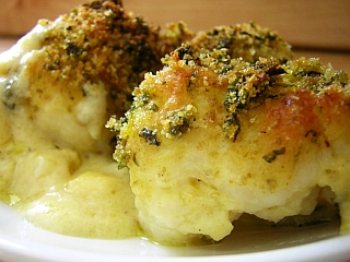
Velvety Cauliflower Indulgence with Creamy Bechamel and Savory Cheese Topping
- 2 tablespoons olive oil
- -- bechamel --
- 1/4 cup (1/2 stick) unsalted butter
- 1/4 cup unbleached all-purpose flour
- 2 cups milk or half-and-half scalded
- 1/4 teaspoon salt (for scalded milk)
- 1 small bay leaf broken in two
- salt and fresh ground white pepper
- 1 pinch nutmeg freshly ground
- -- gratin --
- 2 tablespoons salt (for pre-cooking cauliflower)
- 1 teaspoon white wine vinegar (for pre-cooking cauliflower)
- 1 head cauliflower (about 11/2 pounds)
- 2 cups bechamel sauce
- 1 cup swiss gruyere cheese (about 3 oz) finely grated
- salt and fresh ground white pepper
- -- basil crumb topping --
- 1/2 cup parmesan cheese, or addition gruyere (about 1 oz) finely grated
- 1/2 cup panko (japanese bread crumbs) or dried bread crumb
- 1 tablespoon fresh basil or flat-leaf (italian) parsley chopped
- Carbohydrate 19.507426485373 g
- Cholesterol 20.5220833333333 mg
- Fat 10.0237132745626 g
- Fiber 3.48466400105281 g
- Protein 4.83017351551748 g
- Saturated Fat 5.34501543867022 g
- Serving Size 1 1 Serving (149g)
- Sodium 410.02664438537 mg
- Sugar 16.0227624843202 g
- Trans Fat 0.736131764400888 g
- Calories 182 calories
Step-by-step
- To make Bechamel: In a heavy-bottomed 2-quart saucepan, melt butter over medium-low heat.
- When butter starts to foam, add flour and mix using a wooden spoon to create a smooth, loose paste.
- Cook, stirring constantly, allowing butter and flour to froth together until the mixture turns a light, golden sandy color, about 4 to 5 minutes.
- Remove pan from heat and let stand.
- Meanwhile, combine milk and 1/4 teaspoon salt in a medium saucepan, scald milk (heating it until just below boiling point).
- Return saucepan with roux to medium-low heat.
- Add half of the hot milk to the roux, whisking vigorously to thoroughly blend and prevent lumps, and bring to a boil over medium-high heat.
- When a boil is reached and sauce is smooth, add the remaining milk and bay leaf, reduce heat to low, and simmer, whisking occasionally, until the sauce is smooth and thickened, about 10 to 12 minutes.
- Strain sauce through fine-mesh strainer.
- Season with salt, white pepper and nutmeg to taste, and set aside until ready to use.
- (Makes about 2 cups.)
- To make Gratin: Preheat oven to 375 degrees F.
- Bring 3 quarts of water to a rapid boil with 2 tablespoons of salt and vinegar.
- (The acid in vinegar helps keep cauliflower white.)
- Cut cauliflower into 1 1/2-inch wide florets.
- Boil florets until just tender, about 4 to 5 minutes, drain well without rinsing, pat dry, and season with salt to taste.
- Arrange the cauliflower, florets-side up, in a buttered, medium (about 8-cup) oval gratin dish or baking dish just large enough to hold cauliflour in a single layer.
- If the bechamel sauce is cold, bring it to a simmer on the stove while whisking.
- Gradually stir Gruyere cheese into the hot bechamel and adjust seasoning with salt and pepper, to taste.
- In a small bowl, combine the parmesan, bread crumbs and basil, and mix with olive oil, to coat evenly.
- Spoon bechamel over the cauliflower and sprinkle everything, evenly, with crumb topping.
- Bake in center of oven until gratin is bubbling and lightly browned on top, about 30 to 35 minutes.
- Let rest for 5 to 10 minutes before serving.
- Serve hot, or at room temperature.
The ingredient list omits a crucial detail about the starch-to-fat ratio required for a stable emulsion. Flour and butter must cook together for four to five minutes until the roux smells nutty and loses its raw starch flavor. Adding hot milk to that cooked paste prevents lumps from forming. Scalding the milk denatures the whey proteins slightly, which helps the dairy integrate smoothly into the flour matrix. Vinegar in the boiling water lowers the pH of the cooking liquid. This acid environment prevents the anthocyanin and flavonoid pigments in the cauliflower from oxidizing into unappealing grey tones during the initial boil.
Gruyère contains high moisture and fat levels that break apart if exposed to excessive direct heat. Stir the grated cheese into warm béchamel rather than melting it in a pan. The sauce temperature must stay below a hard simmer to prevent the proteins in the cheese from tightening into rubbery strands. That technique yields a velvety sauce rather than an oily separation. Panko mixed with olive oil provides mechanical crunch atop the soft dairy layer. Olive oil coats the breadcrumbs individually, ensuring they brown evenly at 375 degrees Fahrenheit instead of burning in isolated spots.
Water ruins casseroles. Cauliflower retains massive amounts of moisture inside its dense floret clusters. Boil the pieces for only four to five minutes, then drain them thoroughly and pat the surfaces dry with towels before assembly. Trapped water leaks out during baking, turning the thick cheese sauce into a thin soup. Let the finished casserole rest for ten minutes off the heat. This waiting period allows the internal temperature to drop slightly, giving the starches time to set so individual portions hold their shape on the plate.
The Cheese Melt and Emulsion
Gruyère contains high moisture and fat levels that break apart if exposed to excessive direct heat. Stir the grated cheese into warm béchamel rather than melting it in a pan. The sauce temperature must stay below a hard simmer to prevent the proteins in the cheese from tightening into rubbery strands. That technique yields a velvety sauce rather than an oily separation. Panko mixed with olive oil provides mechanical crunch atop the soft dairy layer. Olive oil coats the breadcrumbs individually, ensuring they brown evenly at 375 degrees Fahrenheit instead of burning in isolated spots.
Common Pitfalls in Gratin Construction
Water ruins casseroles. Cauliflower retains massive amounts of moisture inside its dense floret clusters. Boil the pieces for only four to five minutes, then drain them thoroughly and pat the surfaces dry with towels before assembly. Trapped water leaks out during baking, turning the thick cheese sauce into a thin soup. Let the finished casserole rest for ten minutes off the heat. This waiting period allows the internal temperature to drop slightly, giving the starches time to set so individual portions hold their shape on the plate.


