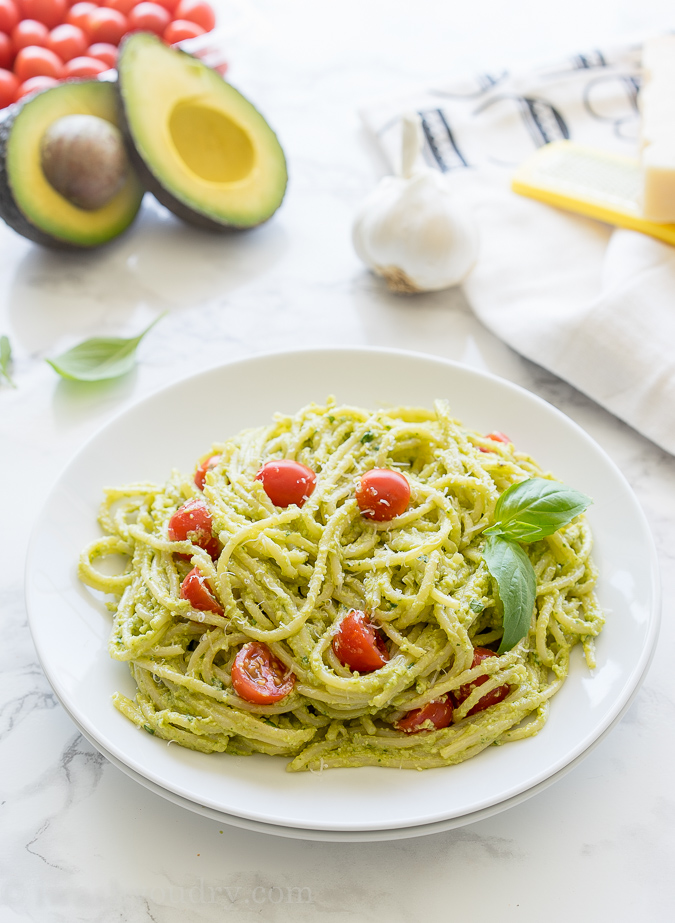
Try this Avocado Pesto Pasta recipe, or contribute your own.
- 1/3 cup olive oil
- 1 cup cherry tomatoes halved
- 3 large cloves garlic
- 2 tbsp lemon juice
- 1/2 cup pine nuts
- 12 oz. spaghetti noodles uncooked
- 2 large california avocados pitted and peeled
- 1 1/2 to 2 cups fresh basil leaves
- 1/4 cup parmesan cheese plus more for garnish
- 1/2 tsp salt (plus more to taste)
- Carbohydrate 15.7226650193848 g
- Cholesterol 5.50000000700806 mg
- Fat 48.0260851053893 g
- Fiber 3.54760008734103 g
- Protein 9.93082001928062 g
- Saturated Fat 5.61527451028964 g
- Serving Size 1 1 recipe (238g)
- Sodium 105.871000125 mg
- Sugar 12.1750649320438 g
- Trans Fat 5.03700051323386 g
- Calories 505 calories
Step-by-step
- Bring a large pot of salted water to a boil and cook noodles until tender. Reserve 1 cup pasta water and drain the rest.
- While pasta is boiling prepare the pesto by adding the avocados, basil, garlic, parmesan cheese, pine nuts, lemon juice and salt in a food processor. Blend the mixture, then slowly stream in the olive oil while still blending. Scrap down sides and pulse again until mixture is combined. Season to taste with more salt if needed.
- Toss the pesto with the hot pasta, add a little pasta water to thin if sauce is too thick. Toss in the tomatoes and enjoy hot with a sprinkle of parmesan cheese.
Swapping the traditional pine nuts for toasted walnuts alters the sauce profile by introducing higher levels of alpha-linolenic acid, shifting the nutty aroma toward a deeper, woodier finish. Standard pesto relies on the friction of a mortar and pestle to rupture basil cell walls, releasing fragrant essential oils. This version utilizes a food processor instead. High-speed metal blades shear the basil leaves quickly, which can generate heat and cause polyphenol oxidase enzymes to turn the bright green puree brown. Acid prevents this discoloration.
The Chemical Mechanics of Emulsion
Avocados contain high concentrations of monounsaturated oleic acid and natural plant emulsifiers. When you combine the pitted fruit with lemon juice and garlic in the food processor, the mechanical action breaks the avocado flesh into microscopic droplets. Slowly streaming in olive oil while the motor runs forces these fat droplets to suspend in the water content of the lemon juice and basil. Starchy pasta water added at the final tossing stage contains gelatinized amylose molecules that bridge the oil and water phases further, locking the emulsion onto the spaghetti strands.
- If the sauce appears too thick, add reserved pasta water two tablespoons at a time until the mixture flows smoothly.
- Ensure the garlic is thoroughly minced during the initial pulse to avoid sharp, pungent pockets of raw allicin in the finished dish.
- Refrigerate any leftover sauce within two hours in an airtight container pressed directly against the surface with plastic wrap to minimize oxygen exposure.



