Slow Cooker Beef Stew
Hearty and savory stew with potatoes, carrots, celery, broth, herbs, and spices.
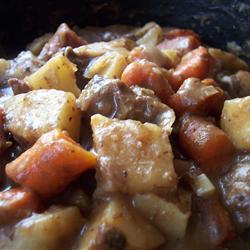
Hearty and savory stew with potatoes, carrots, celery, broth, herbs, and spices.
- 1/2 teaspoon salt
- 1/4 cup all-purpose flour
- 1/2 teaspoon ground black pepper
- 1 bay leaf
- 1 teaspoon paprika
- 1 teaspoon worcestershire sauce
- 1 1/2 cups beef broth
- 2 pounds beef stew meat cut into 1 inch cubes
- 1 clove garlic minced
- 1 onion, chopped
- 3 potatoes, diced
- 4 carrots, sliced
- 1 stalk celery chopped
- Carbohydrate 29.9161713885948 g
- Cholesterol 99.792 mg
- Fat 27.4292775 g
- Fiber 4.64900005898873 g
- Protein 37.2767333333333 g
- Saturated Fat 11.0685675 g
- Serving Size 1 1 Serving (812g)
- Sodium 1769.17605554075 mg
- Sugar 25.2671713296061 g
- Trans Fat 3.44922833333334 g
- Calories 519 calories
Step-by-step
- Place meat in slow cooker.
- In a small bowl mix together the flour, salt, and pepper; pour over meat, and stir to coat meat with flour mixture.
- Stir in the garlic, bay leaf, paprika, Worcestershire sauce, onion, beef broth, potatoes, carrots, and celery.
- Cover, and cook on Low setting for 10 to 12 hours, or on High setting for 4 to 6 hours
Tossing raw beef directly into a slow cooker with flour and vegetables is a standard method that frequently results in raw flour pockets and tough meat if the heat transfer is mismanaged. Coarse chuck cut into one-inch cubes requires extended exposure to moisture and steady heat to alter tough collagen into gelatin. Without proper initial coating, the flour simply clumps when introduced to liquid. Tossing the cubed beef in dry flour, salt, and black pepper directly creates a thin protective layer that absorbs surface moisture and thickens the surrounding broth as starches swell.
The Advantage of Day Two
Allowing the cooked mixture to sit refrigerated for twenty-four hours fundamentally changes the texture and depth of the dish. Starch molecules retrogradely cool and firm up, while salt continues to penetrate muscle fibers that were previously resistant to seasoning. Reheating this preparation on the stovetop over medium-low heat for fifteen minutes redistributes the rendered fats evenly throughout the thickened broth. Fat solidification during refrigeration also allows surface skimming if a lighter consistency is preferred before serving.
Assessing Doneness Visually
Inserting a thermometer into small cubed beef pieces is structurally impractical, so textural cues must guide the cooking process instead. Press a cube against the side of the ceramic insert using the back of a wooden spoon; structural resistance should yield instantly without requiring lateral cutting force. Carrots must offer zero crunch when pierced with the tip of a paring knife, indicating complete cellular wall breakdown. If the potatoes begin to disintegrate into a puree, the liquid has reached maximum starch saturation and requires immediate removal from heat.


