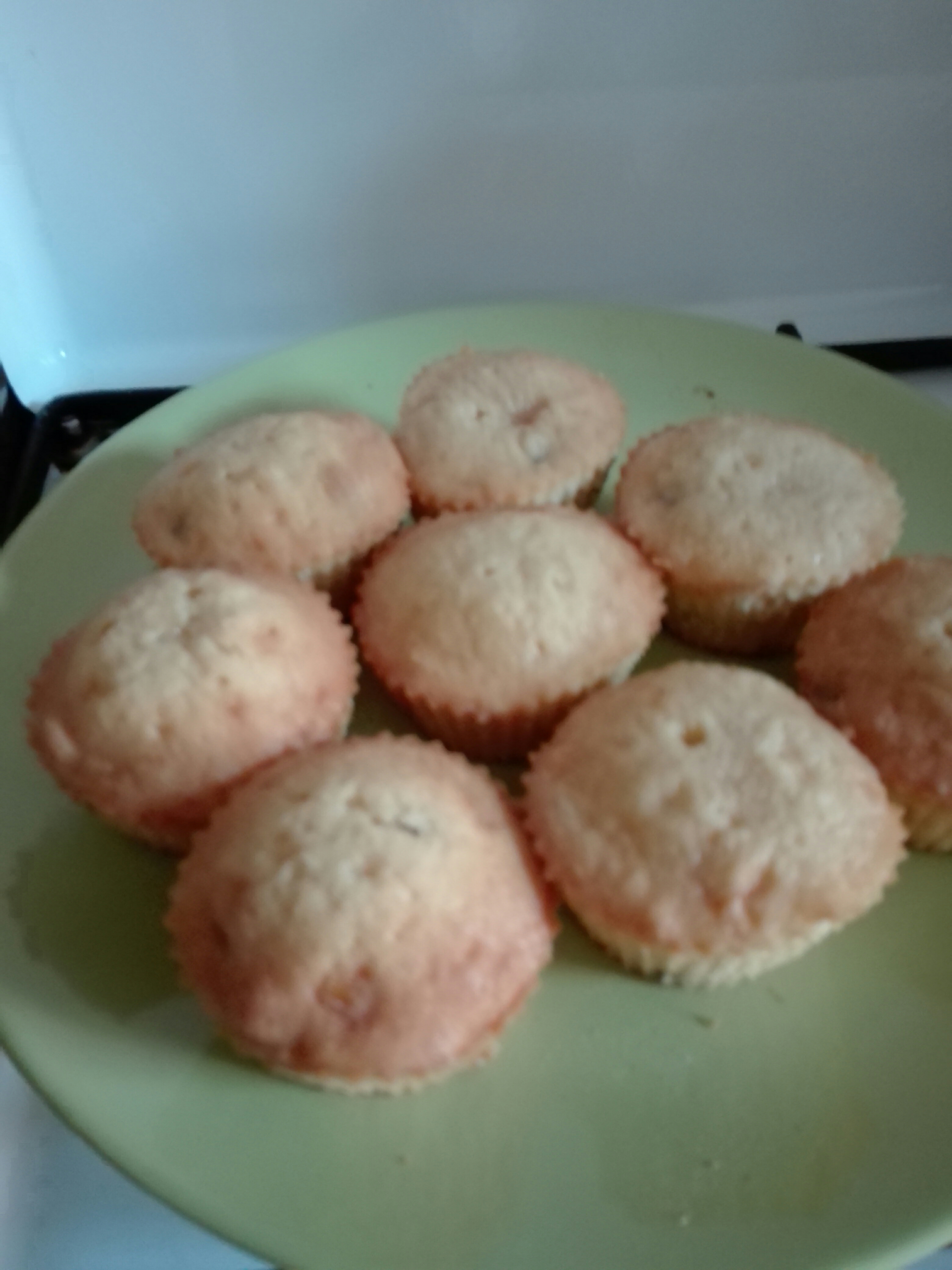
Try this Muffins recipe, or contribute your own.
- Carbohydrate 21.5939849920635 g
- Cholesterol 261.991666660039 mg
- Fat 96.0130599985419 g
- Fiber 0.00441666666666667 g
- Protein 15.8339916611824 g
- Saturated Fat 60.7642766657587 g
- Serving Size 1 1 (563g)
- Sodium 1125.39233315936 mg
- Sugar 21.5895683253968 g
- Trans Fat 6.64667833325878 g
- Calories 994 calories
Step-by-step
- Whip the eggs. Add the sugar and mix it.
- Add the (melted) butter. And mix it.
- Separately mix all the dry inheritance.
- Add the dry ingredients to the mixed eggs and butter.
- Mix until smooth consistency is achieved.
- Put the dough in muffin forms. Fill only 2/3 , off the forms.
- Bake 17 minutes on 160°C (gas mark 3).
- Bake 3 minutes on 180°C (gas mark 4).
Golden domes with tight, tender crumb structures emerge from the oven when physical leavening is managed correctly. Achieving this specific interior requires beating the eggs sufficiently to trap air, which expands inside the batter during the initial baking phase at 160 degrees Celsius. When utilizing fresh eggs rather than aged ones, the albumen possesses a firmer structural integrity that holds trapped air bubbles more reliably throughout the mixing process.
Fat integration dictates how moisture is retained within the baked good over time. Melted butter must cool slightly before incorporation so it does not prematurely coagulate the proteins in the whipped eggs or prematurely activate the leaveners. Incorporating the fat too warm results in a dense, greasy texture rather than the desired light, uniform crumb.
Combining the dry components separately prevents pockets of chemical leaveners from forming, which avoids metallic flavor hotspots. Sifting the 150 grams of flour along with the baking powder and baking soda distributes the agents evenly, ensuring every portion of the batter rises at an identical rate during the 17-minute bake. Over-mixing at this stage develops excessive gluten strands, turning a tender cake-like interior tough and rubbery.
Temperature shifting during baking creates the signature domed top. Baking the filled paper liners for 17 minutes at 160 degrees Celsius sets the internal structure, followed by a final 3-minute burst at 180 degrees Celsius to brown the exterior crust. Storing these finished baked goods in an airtight container at room temperature preserves their moisture for up to forty-eight hours without requiring refrigeration.


