Fall Harvest Roasted Turkey Breast
Fall Harvest Roasted Turkey Breast is a perfect recipe for Thanksgiving if you don't want to cook the whole bird.
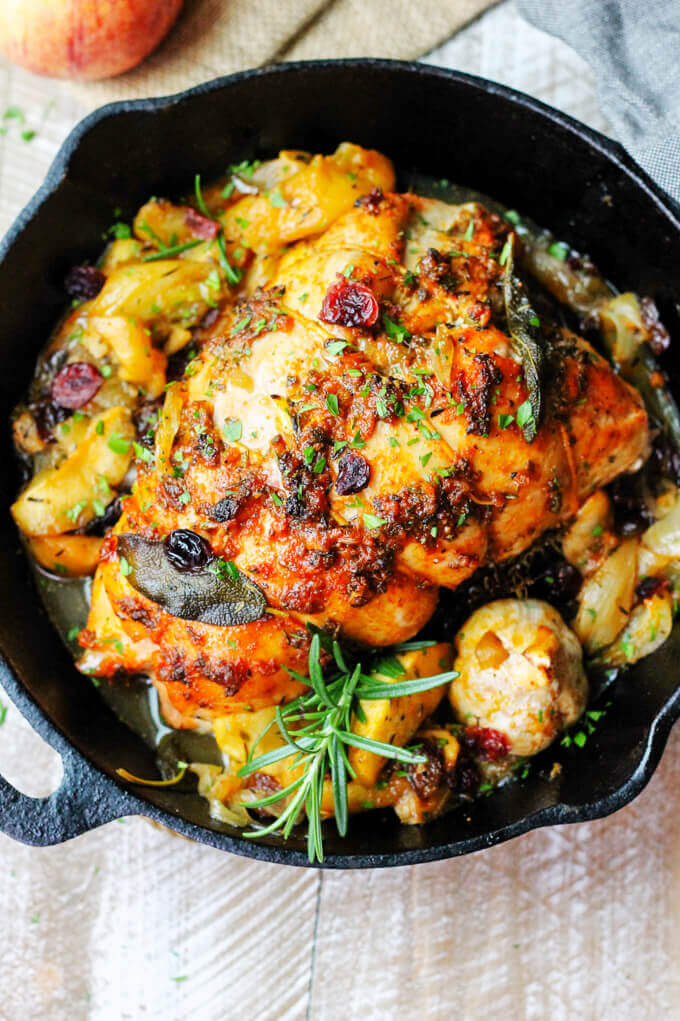
Fall Harvest Roasted Turkey Breast is a perfect recipe for Thanksgiving if you don't want to cook the whole bird.
- 1/2 teaspoon salt
- 1 teaspoon salt
- 1/4 cup dried cranberries
- freshly ground pepper
- 2 tbsp lemon juice
- 2 teaspoon sweet paprika
- 2 tablespoon honey
- juice from half a lemon
- 2 tbsp olive oil (extra virgin)
- 4 strings thyme (fresh)
- 2 lbs turkey breast (up to 3 lbs, boneless, skin-on)
- 2 apples (peeled cored and quartered)
- 1 onion (medium sweet, quartered)
- 3 leaves (fresh)
- 1 string rosemary (fresh)
- 1 whole garlic (bottom cut off)
- 1 teaspoon thyme (dried)
- 2 cups chicken stock (or more)
- 2 teaspoon rosemary (fresh chopped)
- 2 teaspoon thyme (fresh. chopped)
- 2 teaspoon sage (fresh chopped)
- 2 teaspoon mustard seeds (granulated)
- 2 cloves garlic (large minced)
- 3 tablespoon olive oil (extra virgin)
- 2 tablespoon apple cider
- Carbohydrate 6.40716520970811 g
- Cholesterol 0 mg
- Fat 11.3870112499943 g
- Fiber 0.462122922536377 g
- Protein 0.137279375027497 g
- Saturated Fat 1.57266124999904 g
- Serving Size 1 1 Serving (179g)
- Sodium 0.945416666624434 mg
- Sugar 5.94504228717173 g
- Trans Fat 0.328392083330584 g
- Calories 124 calories
Step-by-step
- Add apples, onions, garlic and whole herbs to the cast iron skillet or baking dish; Add olive oil and lemon juice and season everything with salt, pepper, dried theme;
- In a bowl combine the rub ingredients: garlic, fresh herbs, paprika, mustard seeds, salt, pepper, olive oil and lemon juice;
- Rub the paste on the entire breast from both sides and place it on top of the bed of onions and apples;
- Add cranberries and one cup of chicken stock. You will be adding chicken stock as the turkey is cooking to ensure that there is enough liquid to baste the breast. You may use between 2-4 cups of chicken stock;
- Preheat the oven to 450F degrees and roast turkey for 20 minutes;
- Reduce the heat to 325F and roast for approximately another 1hr, or 1hr & 20 mins;
- Baste the breast with the pan juices every 15-20 minutes;
- Start checking the temperature the bird after it's baked in the oven for an hour
- When the internal temperature reaches 150-155F baste it with the cider-honey glaze and cook for another 15-20 minutes, until the internal temperate reaches 165F;
- Remove from the oven and let it rest for about 15 minutes before carving.
Starting poultry at 450 degrees Fahrenheit for the first twenty minutes rapidly sets the skin before dropping the heat to 325 degrees to cook the interior evenly. Boneless turkey breasts dry out easily because white meat lacks intramuscular fat. Establishing a protective bed of quartered sweet onions, peeled apples, and whole garlic cloves underneath the meat keeps the bottom from scorching while releasing moisture into the pan. Pouring chicken stock directly into the skillet creates an essential braising liquid that prevents the drippings from burning during the hour-long roast.
Regular basting every fifteen to twenty minutes deposits gelatin and fat back onto the surface, yielding a moist texture. Monitoring internal temperature with a digital probe inserted into the thickest part prevents overcooking. Apply the apple cider and honey glaze only when the thermometer reads 150 to 155 degrees. Sugars burn quickly under prolonged direct heat, so brushing them on near the end builds color without producing acrid smoke. Pull the meat from the oven when it hits 165 degrees.
Allowing the roasted breast to rest undisturbed for fifteen minutes permits the muscle fibers to relax and reabsorb moisture that would otherwise run out onto the cutting board. Pair this dish with roasted root vegetables, bitter greens like braised kale, or a tart cranberry relish to balance the sweetness of the honey-glazed apples. The cooking juices left in the skillet make a rich pan sauce when reduced with additional stock.
Adjusting this preparation for different gatherings requires careful attention to bird size rather than cooking times. A smaller two-pound breast cooks faster than a three-pound cut, making the digital thermometer mandatory regardless of the weight specified in the recipe. Double the aromatics proportionally if scaling up to a larger cut to maintain the correct ratio of pan moisture.



