Pan-Seared Rib Eye Steak
From my kitchen to yours, discover a delectable culinary journey filled with the irresistible flavors of pan-seared rib eye steak. This flavorful dish is a symphony of tender, juicy meat encased in a crisp, caramelized crust, awaiting your taste buds. The secret lies in the technique of pan-searing, a method that combines the precision of oven-roasting with the convenience of stovetop cooking.
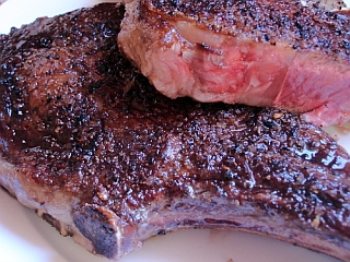
From my kitchen to yours, discover a delectable culinary journey filled with the irresistible flavors of pan-seared rib eye steak. This flavorful dish is a symphony of tender, juicy meat encased in a crisp, caramelized crust, awaiting your taste buds. The secret lies in the technique of pan-searing, a method that combines the precision of oven-roasting with the convenience of stovetop cooking.
- 1 teaspoon dijon mustard
- kosher salt to taste
- 1 tablespoon balsamic vinegar
- salt and fresh ground black pepper to taste
- 2 16-oz rib eye steaks (1 or 2 bone-in or boneless steaks), 1-1/2 inchs thick, at room temperature
- canola oil to coat
- fresh ground black pepper to taste
- -- red wine-mustard pan sauce (optional) --
- 2 medium shallots finely minced
- 1/2 cup dry red wine such as cabernet sauvignon
- 1/2 cup stock (beef, veal, or chicken) preferably homemade (low-sodium canned - optional)
- 3 tablespoons unsalted butter cut into pieces
- 1 teaspoon fresh thyme leaves minced
- Carbohydrate 5.4332649995736 g
- Cholesterol 489.53 mg
- Fat 132.202029999679 g
- Fiber 0.458250000689674 g
- Protein 70.4850749996504 g
- Saturated Fat 74.3384719999802 g
- Serving Size 1 1 Serving (512g)
- Sodium 964.9039999092 mg
- Sugar 4.97501499888393 g
- Trans Fat 11.4790639999855 g
- Calories 1534 calories
Step-by-step
- Pat steak(s) dry with paper towels, and place in a shallow dish. Drizzle with oil; rub oil all over steak(s). Generously season both sides with kosher salt and freshly ground black pepper, to taste (rubbing seasonings into meat with your fingers). Let stand at room temperature for at least 30 minutes, and up to an hour.
- Place a 10- to 12-inch cast iron skillet(s) on an oven rack adjusted to lower-middle position, and heat oven to 500 degrees F. When oven has reached temperature (about 15-20 minutes), remove skillet(s) from oven (do not turn oven off) and quickly transfer to stove top burner(s) over high heat (be careful--skillet and handle will be extremely hot).
- Immediately place steak(s) in middle of hot, dry skillet(s). Sear steak(s) for about 1-2 minute without moving. Flip with tongs and sear second side for another 1-2 minute without moving, or until both sides are well browned and a nice crust has formed. Quickly remove skillet(s) from stove top and place back into oven, and cook until done to your preference. Cook for about 2-3 minutes on each each side for a medium-rare steak(s), or about 3-4 minutes on each side for a medium steak(s). Remember that meat will continue to cook from residual heat when removed from oven, so remove steak(s) from oven when slightly less done than you wish.
- When steak(s) is done to your liking, transfer to a plate(s). Double check doneness by thermometer (rare - 130 to 140 degrees F; medium-rare - 140 to 150 degrees F; medium - 150 to 160 degrees F; medium-well - 160 to 170 degrees F), or by touch. (rare is soft to the touch; medium-rare yields gently to the touch; medium yields only slightly to the touch and is beginning to firm up; medium-well is firm to the touch). Tent steak(s) loosely with foil and let rest for about 5 minutes to allow the meat juices to redistribute and settle before serving. Serve as individual steak(s) or slice just before serving on warmed plate(s).
- After pan-searing, remove meat from pan leaving fond (brown bits in pan leftover from cooking) and residual fat that it was cooked in. Add shallots to pan and cook over low heat , stirring frequently until shallots are translucent.
- Raise heat to high, add wine, stock, and bring to a boil. Using a wooden spoon or spatula, stir mixture, scraping to loosen any flavorful browned bits stuck to pan and incorporate them into sauce. Boil until liquid is reduced by half.
- Reduce heat to medium, add balsamic vinegar, Dijon mjustard, and cook until reaching sauce consistency you desire. It should be thick enough to coat back of a regular spoon.
- Remove from heat, whisk in butter until melted and sauce is thickened, smooth, and glossy. Add fresh thyme, season with salt and pepper to taste. Spoon sauce over cooked steaks and serve immediately.
Preheating a cast iron skillet inside a 500 degrees F oven is the only reliable method for building a deep, mahogany crust on a thick rib eye without overcooking the interior. Anyone attempting this cut in a lightweight aluminum pan or over a standard stovetop flame alone will end up with gray, steamed meat long before the surface develops adequate color. Because high heat causes oil to smoke aggressively at 500 degrees F, select a neutral oil with a high smoke point like canola, and apply a thin, even layer directly to the meat rather than pooling it in the dry skillet.
- Use a heavy 10- to 12-inch cast iron skillet that retains thermal energy effectively when cold meat is introduced.
- Ensure steaks sit at room temperature for 30 to 60 minutes to prevent the exterior from burning before the center warms.
- Whisking three tablespoons of cold butter into the red wine reduction off the heat emulsifies the fats to achieve a glossy, spoon-coating finish.
- Substitute low-sodium chicken or vegetable stock for beef stock if managing sodium intake, keeping in mind that reduction will concentrate salt levels significantly.


