Spinach Egg Breakfast Squares
Adapted from a South Beach Diet recipe. The original was baked in muffin pans, but baking in a large cookie sheet pan is much easier and just as good.
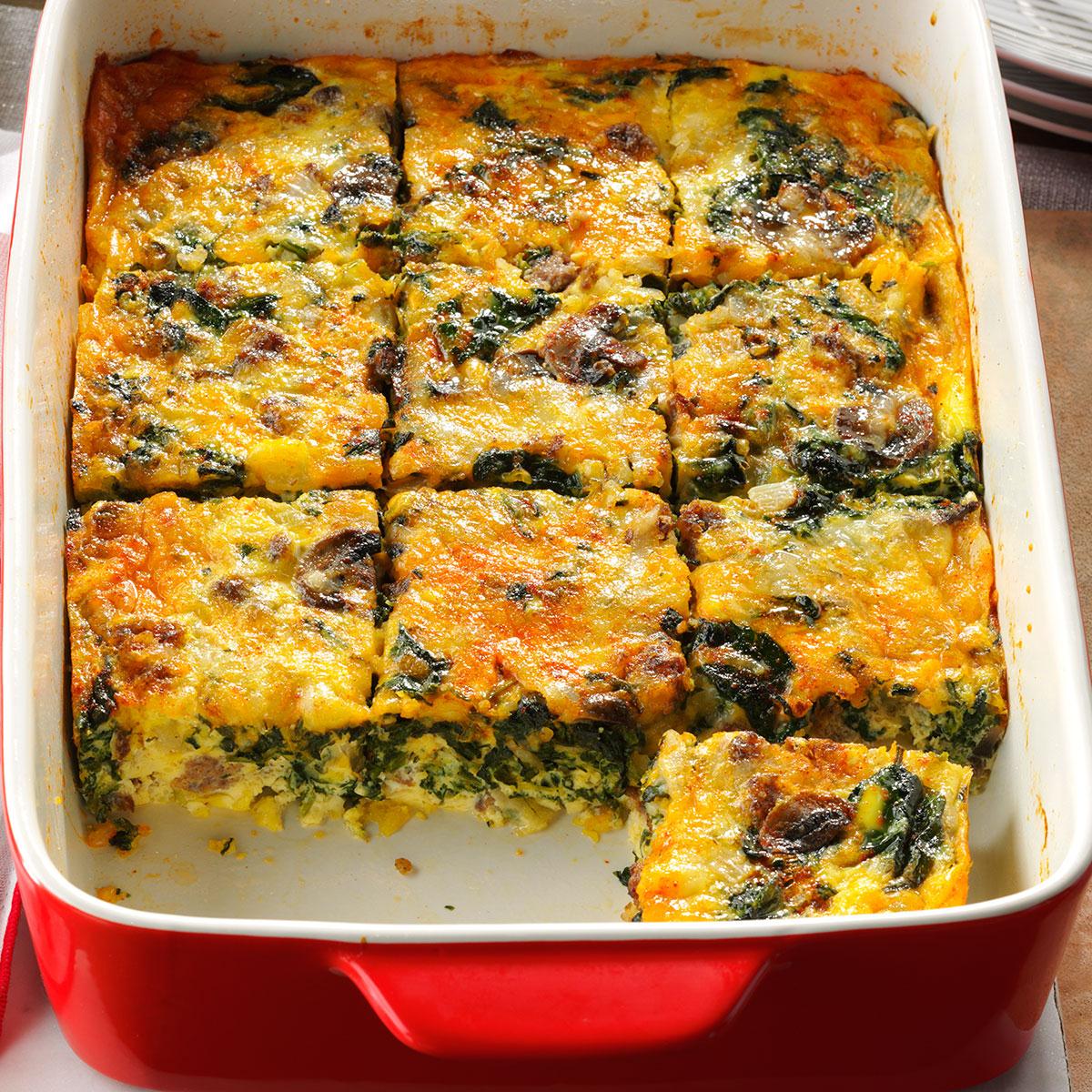
Adapted from a South Beach Diet recipe. The original was baked in muffin pans, but baking in a large cookie sheet pan is much easier and just as good.
- Carbohydrate 12.405184623254 g
- Cholesterol 444.466412333333 mg
- Fat 19.2196797335296 g
- Fiber 2.37511025361797 g
- Protein 19.431031825914 g
- Saturated Fat 7.33939732373185 g
- Serving Size 1 1 Serving (228g)
- Sodium 503.720595989695 mg
- Sugar 10.0300743696361 g
- Trans Fat 2.74243129693024 g
- Calories 295 calories
Step-by-step
- Preheat the oven to 400 degrees F.
- Prepare a large cookie sheet (with sides) with a light coating of cooking oil spray.
- Cook the onion and mushrooms until onion is soft and water has cooked out of mushrooms. Remove from heat.
- Squeeze all the water from the thawed spinach. (I wring it out between paper towels.)
- Add the spinach, bacon and water chestnuts to the mushrooms and onions.
- Beat the eggs in a large bowl and season with salt and pepper. Add cooled spinach/mushroom mixture and blend into the eggs.
- Pour the egg mixture into the cookie sheet and evenly spread into the corners.
- Bake at 400 degrees for 20 minutes or until set and beginning to brown on top.
- Cut into squares to serve.
- Freezes well in as single layer of cut squares in a zip-lock freezer bag. Microwave to reheat.
Removing excess moisture before baking prevents a rubbery or watery egg slab. Thawed frozen spinach acts like a sponge, holding onto significant internal water that must be physically extracted using paper towels or cheesecloth. Similarly, raw mushrooms release a large volume of cellular liquid when heated. Cooking those fungi first evaporates that excess moisture in the pan rather than letting it dilute the egg proteins during the twenty-minute bake at 400 degrees F.
Proteins in eggs coagulate when heated, forming a solid network that traps liquid and fats. Incorporating shredded cheese and cooked bacon introduces dairy fats and sodium ions, which interfere with tight protein bonding. This chemical interruption keeps the baked structure tender rather than tough. Water chestnuts add contrasting crunch, utilizing starch structures that resist softening during the high-heat oven phase.
Baking on a rimmed cookie sheet creates a shallow, uniform depth that cooks evenly without requiring a water bath. Visual cues indicate doneness far better than arbitrary timers alone. Watch for the edges to pull slightly away from the metal and the surface to turn pale golden brown while the center loses its liquid shimmer. Letting the sheet cool slightly allows the starches and coagulated proteins to fully set before slicing into twelve clean portions.
Portioning the squares into single layers inside freezer bags preserves texture for future meals. Reheating works efficiently in a microwave because the trapped water molecules inside the egg matrix vibrate and generate steam quickly. Proper moisture control at the initial sautéing stage ensures the reheated squares retain their structural integrity without becoming soggy.


