Old World Beef Goulash
Beef Goulash I have made on a number of occasions. Is great with sliced bread.
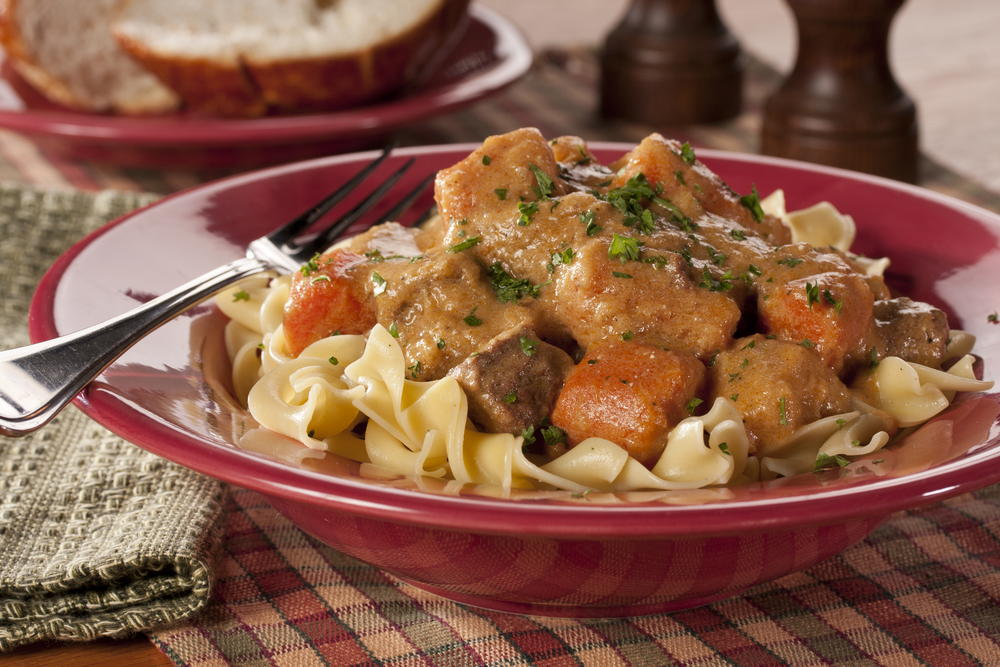
Beef Goulash I have made on a number of occasions. Is great with sliced bread.
- 1/2 cup water
- 1 teaspoon black pepper
- 2 tablespoons red wine vinegar
- 2 teaspoons salt
- 2 tablespoons brown sugar
- 4 cups beef stock
- 3 garlic cloves minced
- 4 tablespoons flour
- 2 5 1/2 oz cans tomato paste
- 2 tablespoons paprika
- 4 tablespoons vegetable oil or bacon drippings
- 1 onion halved and sliced
- 3 lbs boneless beef chuck cut into 1.5 in cubes
- 6 oz bacon diced
- 2 dash chili powder
- Carbohydrate 29.0649236219762 g
- Cholesterol 130.324111575 mg
- Fat 45.1085377972112 g
- Fiber 4.23022379284531 g
- Protein 47.8992489062157 g
- Saturated Fat 17.0776954761689 g
- Serving Size 1 1 Serving (765g)
- Sodium 1585.77272602492 mg
- Sugar 24.8346998291308 g
- Trans Fat 5.43117207242462 g
- Calories 708 calories
Step-by-step
- Heat the vegetable oil or drippings in a large dutch oven or casserole dish.
- Add the onions and sautee over medium-high heat for 5-7 minutes until golden brown.
- Add the vinegar and heat for an additional 2-3 minutes to burn off the sharp flavor.
- Stir in tomato paste, beef stock, garlic, paprika, brown sugar and continue to cook and heat to a simmer.
- Set the pot aside to simmer over medium heat while browning the beef cubes separately in an another pan.
- Preheat the oven to 325 degrees.
- In a frying pan cook the bacon until softened and pale golden in color.
- Pat the beef cubes dry and add in batches to the bacon mixture.
- Add the salt, chili powder, and black pepper to the beef cubes.
- Brown the beef on all sides
- When each batch is browned transfer it to the the dutch oven or casserole dish.
- Add a dash of chili powder, cover and bake for 2 hours or until the meat is very tender.
- Remove the dish from the oven and skim off any extra fat from the surface.
- Whisk together the water and flour until well blended and gently stir into the goulash.
Paprika anchors this hearty dish, originating as a peasant soup in the Hungarian plains before evolving into the rich stew documented across Central Europe. Cooks originally relied on dried red peppers pounded into a coarse powder to preserve harvest yields, imparting both earthy warmth and a deep rust color that defines traditional preparations. Achieving the correct balance of depth requires rendering the bacon fat completely and searing the chuck cubes in small batches without crowding the pan.
Overloading the skillet creates steam rather than a crust, preventing the Maillard reaction necessary to build deep savory notes in the final sauce. Patting the meat dry with paper towels before it hits the hot fat ensures proper surface browning. Once combined with the simmered tomato base, maintaining a steady 325 degrees Fahrenheit in the oven allows the connective tissue in the tough chuck cuts to break down fully over the course of two hours.
Traditional accompaniments often include thick slices of crusty white bread rather than noodles to absorb the paprika-scented pan juices efficiently. Adjusting the thickening slurry requires whisking cold water into four tablespoons of flour to eliminate lumps before stirring it directly into the hot liquid.


