Hamburgers
This recipe was originally from America's Test Kitchen. I'm pinning it here so I can reliably find it.
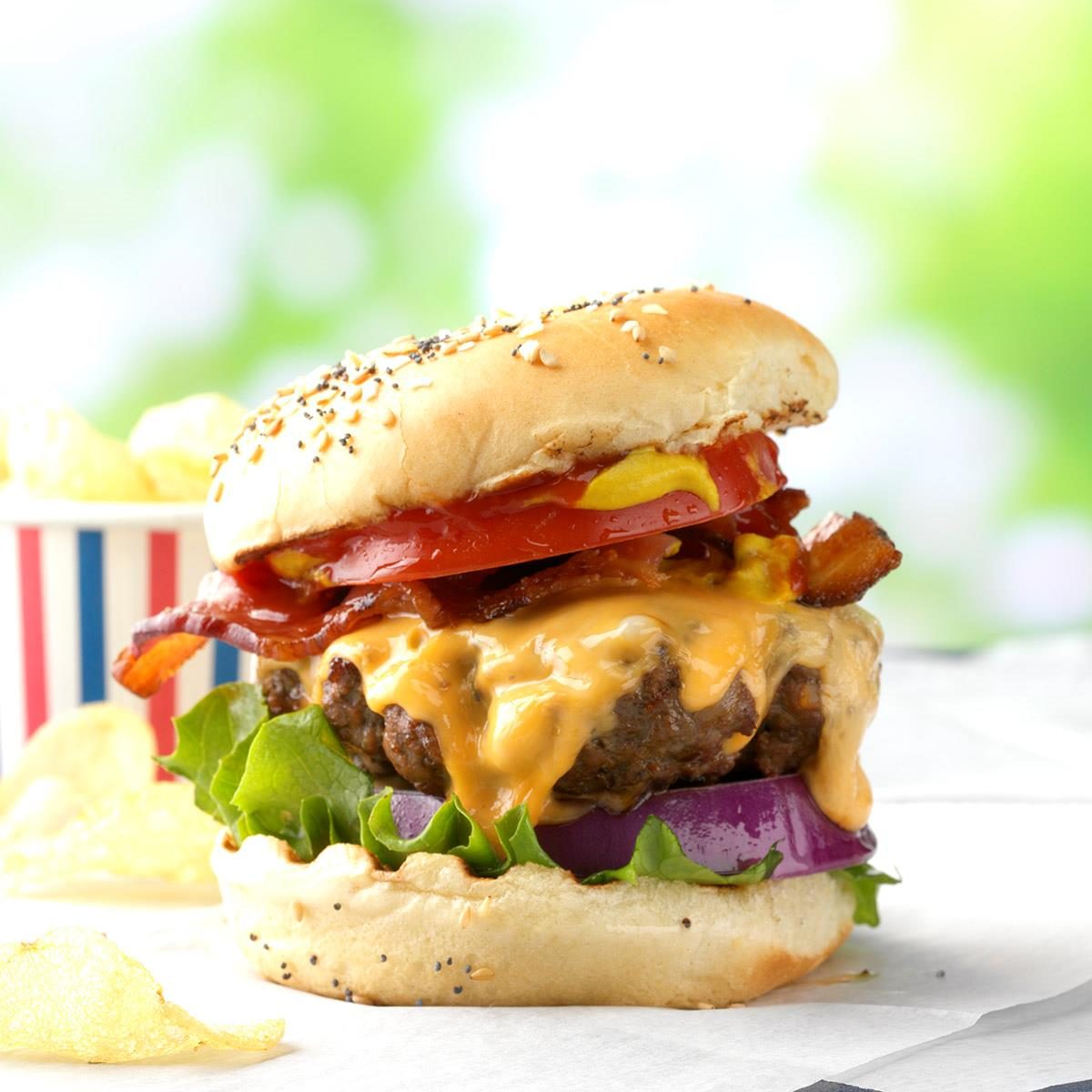
This recipe was originally from America's Test Kitchen. I'm pinning it here so I can reliably find it.
- Carbohydrate 3.90562187496358 g
- Cholesterol 153.182737374919 mg
- Fat 26.5975073909738 g
- Fiber 0.517906254529953 g
- Protein 44.8248630778491 g
- Saturated Fat 10.0777680894475 g
- Serving Size 1 1 Serving (179g)
- Sodium 166.742439899678 mg
- Sugar 3.38771562043363 g
- Trans Fat 4.20221507632196 g
- Calories 446 calories
Step-by-step
- Mash bread and milk in a large bowl with a fork until homogeneous. Stir in salt, pepper, garlic, and steak sauce.
- Add hamburger and mix until combined. Don't overmix.
- Divide meat into 4 portions and form it into a ball. Flatten ball into 3/4 inch thick patties.
- Grill on medium-hot heat for 2-4 minutes. Flip burger. Grill for 3 minutes for medium-well and 4 minutes for well-done.
- If adding cheese, add cheese slices 2 minutes before desired doneness. Cover the burger to melt cheese.
- While burger is grilling, warm/grill the buns.
Overworking the ground meat remains the single most common error committed during patty formation, resulting in a dense, sausage-like texture rather than a tender bite. Incorporating a small amount of panade—a paste of bread cubes and whole milk—retains internal moisture without masking the rich beef flavor of the 80/20 grind. Grilling requires attentive heat management, and understanding how to manipulate your cooking surface ensures optimal rendering of fat.
- Use an instant-read digital thermometer inserted horizontally into the center of the patty to verify doneness accurately, targeting 160 degrees Fahrenheit for medium-well burgers.
- Maintain a medium-hot grill zone that registers roughly 400 degrees Fahrenheit to develop a deep, Maillard-reaction crust without burning the exterior before the center cooks through.
- Substitute regular white bread for whole wheat in the panade mixture at a strict one-to-one ratio if dietary preferences require it, though white bread yields a slightly more neutral binding agent.
- Cover the grill grates with a stainless steel dome or inverted metal bowl during the final two minutes of cooking to trap ambient heat and melt cheese evenly across the surface of the patty.
Synchronizing the grilling process requires warming the buns simultaneously during the final minute of protein cooking so that assembly happens immediately upon removal from the heat source. Controlling these specific variables transforms a basic backyard staple into a consistently juicy sandwich.



