Thanksgiving Stuffing a la Alton
This Thanksgiving stuffing recipe variant features homemade cornbread, dried cranberries, and roasted vegetables.
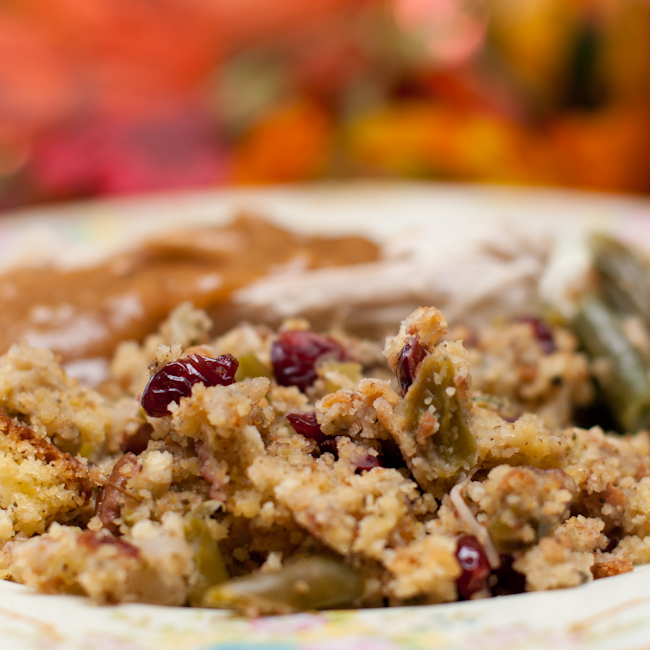
This Thanksgiving stuffing recipe variant features homemade cornbread, dried cranberries, and roasted vegetables.
- Carbohydrate 116.156605844371 g
- Cholesterol 41.972 mg
- Fat 13.5637866910936 g
- Fiber 16.6423563155562 g
- Protein 16.2012912612374 g
- Saturated Fat 2.8738330860897 g
- Serving Size 1 1 Serving (1113g)
- Sodium 1345.643736704 mg
- Sugar 99.514249528815 g
- Trans Fat 1.41456892783987 g
- Calories 626 calories
Step-by-step
- NOTE: You must prepare the cornbread prior to starting this recipe. I usually make this the day before Thanksgiving so it's not taking up precious time/space in my oven. Simply follow the instructions on the back of your favorite cornmeal package, or use my Rosemary Cornbread in a skillet recipe, linked below.
- Preheat oven to 400 degrees.
- In a large mixing bowl, toss the onion, celery, and green pepper with the oil and salt.
- Place the vegetables on a sheet pan and roast for 35 min. During the last 10 min of cooking, spread the cubed cornbread over the vegetables, return to oven, and continue cooking.
- Transfer vegetables from pan to a large microwave-proof bowl and mix with cranberries, pecans, eggs, sage, parsley and black pepper and chicken broth. Stir well in order to break up pieces of bread. Be careful, it's hot!
- Heat the stuffing in the microwave on high power for 6 minutes.
Adding soft, fresh bread directly to a casserole ruins texture by creating a dense, gummy moisture trap instead of a proper crumb. Stale or pre-dried cornbread cubes solve this structural failure by absorbing stock while retaining distinct boundaries. Spreading cubed cornbread across the sheet pan during the final 10 minutes of the 35-minute vegetable roast dehydrates the exterior just enough to accept liquid without dissolving completely.
Controlling moisture requires attention to the protein binder and the hydration medium. Beaten eggs coagulate at 145 degrees Fahrenheit, establishing a firm cellular matrix that locks in the 1.5 cups of chicken broth without turning the mixture into a porridge. Dried rubbed sage and freshly ground black pepper distribute more evenly through the warm vegetable mixture than whole leaves or coarse spices.
Applying high power in the microwave for exactly six minutes steams the interior rapidly, bypassing the crusting and drying effects of conventional secondary oven baking. Using a deep microwave-safe bowl concentrates the steam production, ensuring the heat reaches the center of the dense mixture without overcooking the edges.
Storing leftover portions in an airtight container within the refrigerator for up to three days maintains food safety, while reheating individual portions with a splash of broth restores the original moisture balance.


