Black Bean Burgers
Southwestern style bean burger which uses vital wheat gluten for improved texture
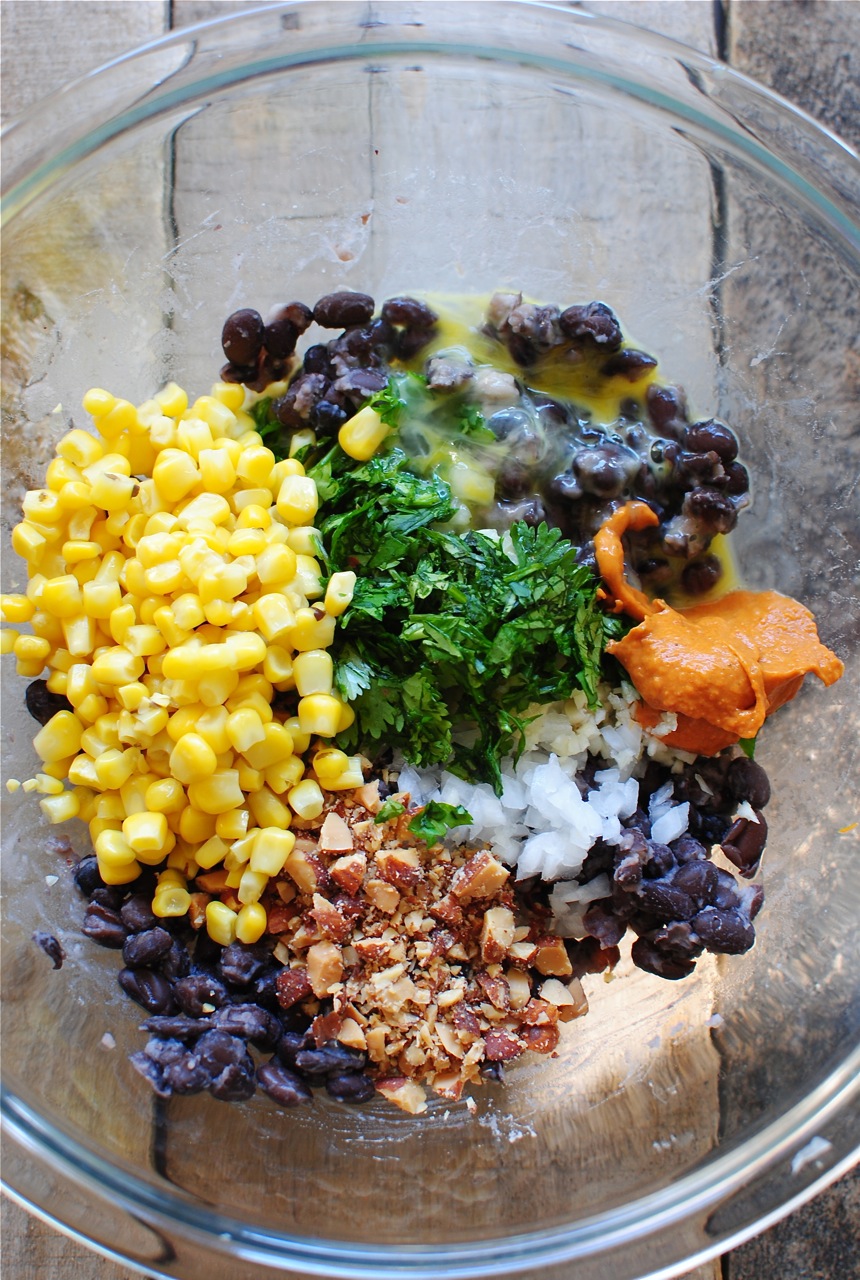
Southwestern style bean burger which uses vital wheat gluten for improved texture
- Carbohydrate 48.6314698975731 g
- Cholesterol 2.1 mg
- Fat 9.39986718778108 g
- Fiber 4.75183340253442 g
- Protein 25.0607129284272 g
- Saturated Fat 1.67869425004061 g
- Serving Size 1 1 Serving (160g)
- Sodium 461.905083335982 mg
- Sugar 43.8796364950387 g
- Trans Fat 4.66076587509327 g
- Calories 374 calories
Step-by-step
- Mash the beans with a fork in a mixing bow. You don't want to puree them; just get them mashed so that no whole beans are left, but you should leave some half beans.
- Add the wheat gluten, bread crumbs, chile powder, cumin, water, and tomato paste (and cilantro if using), but don't mix yet. Use a microplane grater to grate the garlic in. A garlic press or very well minced garlic works, too. Use the large holes on a boz grater to grate in the onion.
- Mix everything together with a fork and then proceed to knead with your hands, until the mixture is firm and uniformly mixed (about a minute).
- Preheat a heavy-bottomed pan over medium heat.
- Divide the burger mixture into six equal pieces. Roll each piece into a firm ball. User your palms to press the ball down on a clean surface to from a patty that is about 1 1/2" thick. Press so that the patty is flat on both sides. Make six patties.
- Pour a think layer of olive oil into the pan. Cook the patties three at time for 5 minutes on each side, gently, but firmly pressing down on them with a spatula. Spray with olive oil before turning over for uniform browning. Once cooked, the patties should be very firm when you press down on them.
- Serve warm on burger buns.
Standard beef patties rely on animal proteins and fats to hold their shape on a hot surface, whereas plant-based alternatives frequently crumble into a disappointing meal upon contact with heat. Achieving structural integrity without animal protein requires deliberate manipulation of starches and proteins so that the mixture behaves cohesively during cooking. When developing plant-based burgers, moisture control remains the primary challenge because excess liquid prevents binding agents from activating properly. By carefully balancing wet elements against dry components like whole wheat bread crumbs, cooks can avoid the common pitfalls of mushy textures.
Vital wheat gluten acts as the foundational structural matrix here, developing stretchy strands when hydrated and kneaded that trap the mashed beans securely inside. Kneading the mass for approximately one minute aligns these gluten proteins, transforming loose ingredients into a firm dough capable of supporting itself under a spatula. Grating the onion on the large holes of a box grater instead of dicing it releases maximum surface moisture while incorporating fine pieces that distribute evenly throughout the mix. Furthermore, grating garlic via a microplane prevents harsh, concentrated pockets of raw aromatics from overpowering the earthy legumes.
Shaping requires rolling the portions into balls before pressing them down on a clean surface to form patties measuring about one and a half inches thick. Cooking three at a time in a heavy-bottomed pan over medium heat ensures the cooking surface maintains its thermal mass, preventing the pan from cooling down and steaming the exterior rather than frying it. Brushing or spraying the top surface with olive oil immediately before flipping guarantees uniform browning and helps conduct heat evenly across the crust. The patties are finished when firm tactile resistance confirms the interior network has set completely.
Adaptability is straightforward for those managing dietary restrictions beyond standard vegetarian preferences. Swapping standard bread crumbs for a certified gluten-free variety alters the texture slightly, though omitting vital wheat gluten entirely will require alternative binders like flaxseed meal to compensate for the lost elasticity. Selecting whole wheat buns rounds out the meal, but any sturdy roll that withstands the considerable protein density of the patty will serve adequately.


