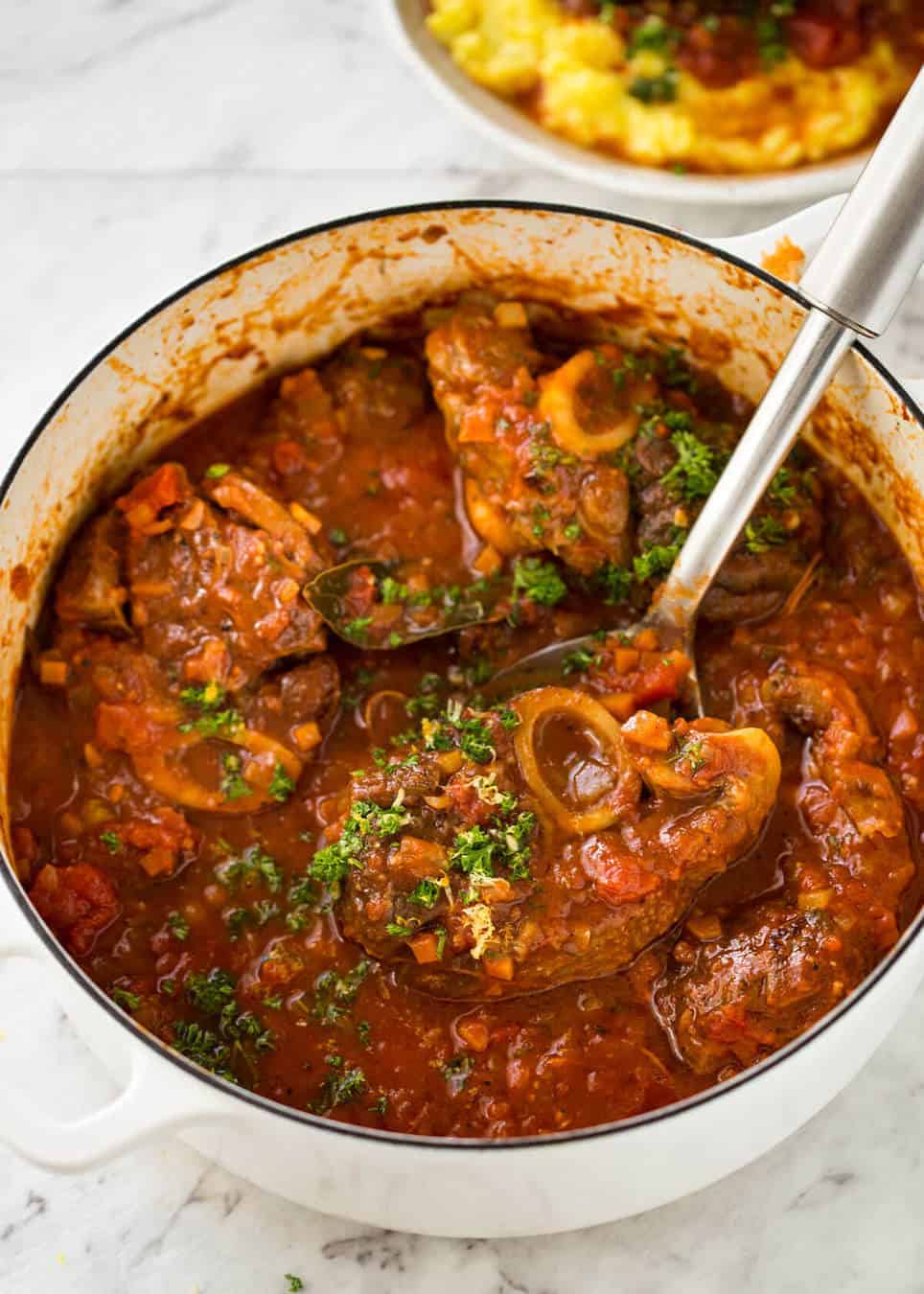
Try this Osso Bucco recipe, or contribute your own.
- oil for frying
- garnish
- 1 bottle red wine (any
- 2 onions chopped, up to 3
- seaonings to taste
- 10 potatoes up to 12
- 3 cloves garlic (depends on
- 10 sl osso bucco meat with bone
- orange peel threads
- 3 carrots peeled and cut to
- 1 celery stalks well-washed
- 2 bay leaves (very important
- 1 cn crushed tomatoes (in israel
- chopped parsley
- Carbohydrate 467.90344 g
- Cholesterol 0 mg
- Fat 4.38872 g
- Fiber 65.8946008858681 g
- Protein 55.49802 g
- Saturated Fat 1.05968 g
- Serving Size 1 1 Serving (3791g)
- Sodium 845.496 mg
- Sugar 402.008839114132 g
- Trans Fat 1.10253 g
- Calories 2608 calories
Step-by-step
- Brown meat in oil in a large skillet. If making a lot do it in batches. Remove from heat and place on a tray. Do not clean skillet.
- In the same skillet (that contains oil + meat juices) saute in order onions, garlic, celery and carrots. Finally add tomatoes and 1/2 bottle wine. Saute for about 15 mins.
- Add seasonings and bay leaves, saute for a few more minutes. It does not have to be thick at this point.
- Put half mixture in large oven pan. Arrange meat on mixture. Pour on top the rest of the mixture. Cover with aluminum foil. Place in pre-heated (medium) oven. Bake for about 11/2 to 2 hours. About 1 hour before end, add peeled potatoes. Check during baking, and add fluids if neccecary (the best choice is wine, however broth can be substituted).
- Remove. If neccecary, place in oven for 15 mins without foil to brown. Meat should be very very tender. Dish can at this stage be cooled and kept at refrigerator for 24 hrs, or kept on a warm plate, or served. Best not to freeze prepared dish (loses flavor).
- Before serving, remove bay leaves. Arrange on tray with vegteables and potatoes around. Garnish with chopped parsley and orange grate (exclude orange grate if intended for children).
Will an entire bottle of red wine turn this meat bitter during a two-hour braise? Half the liquid goes into the skillet during the fifteen-minute vegetable sauté, while the rest waits in reserve. Red wine contains organic acids like malic and tartaric, which denature tough collagen fibers in the shank without requiring harsh mechanical tenderization. Searing the cross-cut veal in batches prevents the pan temperature from dropping below three hundred degrees Fahrenheit, ensuring proper Maillard browning rather than a gray steam bath. Leaving the fond in the skillet incorporates essential amino-acid complexes into the aromatics.
Simmering crushed tomatoes alongside onions, garlic, celery, and carrots creates a balanced acid-sugar matrix that counters the astringency of the tannins. High tannin levels in young red wines can overpower delicate aromatics unless mitigated by the natural glutamates in tomatoes and the sweetness of root vegetables. Layering half this vegetable mixture at the bottom of the roasting pan, setting the meat on top, and blanketing it with the remaining sauce guarantees even heat distribution under aluminum foil.
Collagen transforms into gelatin slowly, typically requiring an internal meat temperature around two hundred degrees Fahrenheit to dissolve completely into the braising liquid. Adding peeled potatoes one hour before the end of the cooking cycle prevents them from dissolving into the sauce while allowing them to absorb the simmering wine and tomato starches. Uncovering the pan for the final fifteen minutes promotes surface evaporation, concentrating the pan juices into a glossy glaze that coats the back of a spoon.
Traditional Milanese versions traditionally omit tomatoes entirely, relying strictly on white wine, broth, gremolata, and marrow bones for flavor. Red wine adaptations offer a heavier, more robust profile that alters the classical Italian flavor architecture entirely. Prepared dishes can be safely refrigerated for up to twenty-four hours to let the flavors meld, though freezing compromises the delicate structure of the braised vegetables.



