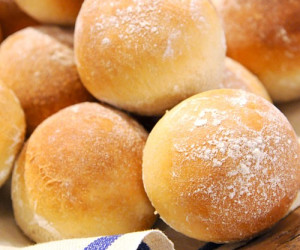
Try this Spanish Hard Rolls (Bolillos) recipe.
- Carbohydrate 468.40145 g
- Cholesterol 0 mg
- Fat 11.0672 g
- Fiber 19.3711880868254 g
- Protein 79.85798125 g
- Saturated Fat 1.6455 g
- Serving Size 1 1 Serving (775g)
- Sodium 26.4839062497037 mg
- Sugar 449.030261913175 g
- Trans Fat 3.59086 g
- Calories 2328 calories
Step-by-step
- In large mixing bowl, combine yeast, salt, and 5 cups flour.
- On low speed, mix until blended.
- Add honey and 2 cups of warm water.
- With flat beater, mix approximately 2-3 minutes until mixture becomes thick.
- Change to dough hook, and continue kneading for approximately 7 minutes, adding remaining flour in 1/2-cup increments during first 4 minutes of kneading.
- Place dough in greased bowl; turn greased side up.
- Cover and let rise in warm place until doubled, about 1 hour.
- Punch down; cover and let rise 15-20 minutes more.
- Divide dough into 16 equal parts.
- Shape each part into oblong, about 5 inches long.
- Pinch ends to form points.
- Place on greased baking sheets.
- Make slash about 3 inches long and 1/2-inch deep the length of the roll.
- Cover and let rise until doubled, 40-60 minutes.
- Preheat the oven to 375 degrees Fahrenheit.
- Mix together cornstarch and 2-1/2 tsp. water; brush gently on rolls.
- Bake until rolls are golden brown, about 35-40 minutes.
- Serve warm.
Bakers frequently err by under-kneading the dough before the initial fermentation phase, which prevents the gluten network from developing the necessary elasticity to trap gas effectively. Bread flour contains a higher protein content than all-purpose flour, supplying the structural foundation required for these substantial rolls. When you switch from the flat beater to the dough hook after two minutes, the machine begins organizing the tangled protein strands into parallel sheets that stretch without tearing.
Judging Doneness Visually
Because bread baking relies on moisture evaporation and starch gelatinization rather than a specific internal target, visual cues remain the most reliable indicator of doneness. You must monitor the exterior color closely, baking the shaped pieces until the crust turns a uniform golden brown across the entire surface. Brushing a mixture of cornstarch and water over the unbaked dough creates a glossy starch film that gelatinizes in the heat of a 375 degree Fahrenheit oven, yielding the characteristic hard, crackling crust. When tapped firmly on the bottom, a fully baked loaf produces a hollow sound that signals the interior moisture has properly escaped.
- If the crust darkens too quickly after twenty minutes of baking, tent the baking sheet loosely with aluminum foil to halt excessive browning.
- Should the dough fail to double in volume during the initial one-hour rise, relocate the bowl to a draft-free zone maintained between 75 and 85 degrees Fahrenheit.


