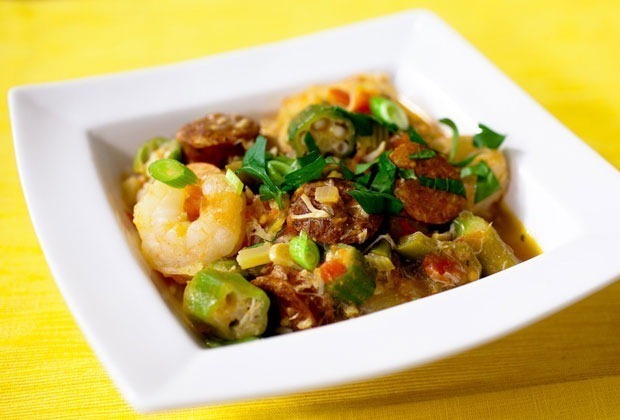
Try this Southern Seafood Gumbo recipe, or contribute your own.
- lemon juice
- 1 green bell pepper chopped
- red pepper flakes to taste
- 2 tb salt
- tabasco sauce to taste
- 1 c all-purpose flour
- 2 garlic minced
- 1/4 ts rosemary
- 2 qt chicken stock
- 1/2 c worcestershire sauce
- 1 pt oysters
- 1 bn green onions chopped
- 4 lb shrimp
- 1 ts brown sugar
- 2 qt water
- 8 stalks celery chopped
- 4 sl crumbled bacon (i use the 1#
- 1/2 c parsley chopped, about
- 1/2 c catsup
- 1 bay leaves (up to 2)
- 1 lg slice ham chopped
- 2 lb cooked crabmeat
- rice cooked
- 1 c cooking oil (or bacon grease
- 2 lb sliced okra
- 1 lg ripe tomato chopped
- 3 lg onions chopped
- 2 c chicken cooked, chopped
- 1/4 ts thyme
- 2 tb shortening
- Carbohydrate 603.302843676763 g
- Cholesterol 4695.8967145 mg
- Fat 510.784179149392 g
- Fiber 65.2035532996796 g
- Protein 925.717901280252 g
- Saturated Fat 97.7566150198418 g
- Serving Size 1 1 Serving (12175g)
- Sodium 25499.3442577419 mg
- Sugar 538.099290377083 g
- Trans Fat 39.9355160281165 g
- Calories 10716 calories
Step-by-step
- Heat oil in heavy iron pot over medium heat.
- Add flour very slowly, stirring constantly with a wooden spoon until roux is medium brown. This will take from 30 to 40 minutes.
- Add celery, onions, green onions, green pepper, garlic, and parsley; cook an additional 45 minutes to an hour, stirring constantly. (You may cut cooking time at this stage, but gumbo won't be as good.)
- Fry okra in 2 tablespoons shortening until brown. Add to gumbo and stir well over low heat for a few minutes. (At this stage the mixture may be cooled, packaged and frozen or refrigerated for later use.)
- Add chicken stock and water, Worcestershire sauce, Tabasco, catsup, tomato, salt, bacon, ham, bay leaves, thyme, rosemary, and red pepper flakes.
- Simmer for 2 1/2 to 3 hours.
- About 30 minutes before serving time, add cooked chicken, crabmeat, and shrimp; simmer for 30 minutes.
- Add oysters during the last 10 minutes of simmering. Add brown sugar.
- Check seasonings and add more if needed. A bit of lemon juice may be added at the very last, if desired.
- Put a generous amount of hot, cooked rice in soup bowls; spoon gumbo over the rice and serve at once.
Swapping lard or bacon grease for neutral cooking oil alters the initial thermal conductivity of the pan, yielding a starch-fat suspension that browns through dextrinization rather than simple scorching. Achieving a medium-brown roux requires maintaining a steady medium heat while whisking continuously for thirty to forty minutes, a duration where starch molecules break down and lose thickening power while developing nutty, toasted aromatic compounds. Introducing the holy trinity of celery, onions, and bell peppers directly into this hot fat halts the cooking process of the flour through moisture release, initiating a lengthy braise that softens the cellular walls of the vegetables. When acidic elements like tomatoes, catsup, and Worcestershire sauce enter the pot alongside chicken stock, the pH shifts downward, tenderizing the heavy load of meats while balancing the rich foundation built by the fats and starches. Managing this complex sequence demands patience, as proteins like shrimp, oysters, and crabmeat toughen rapidly if exposed to sustained high heat before the final thirty minutes of simmering. Shellfish tissues contain delicate muscle fibers that require only gentle thermal manipulation to become opaque and tender without releasing excessive moisture into the stock. Layering the seasonings gradually allows salt to penetrate dense components like ham and chicken while giving volatile compounds in the thyme, rosemary, and red pepper flakes time to diffuse evenly throughout the voluminous liquid.


