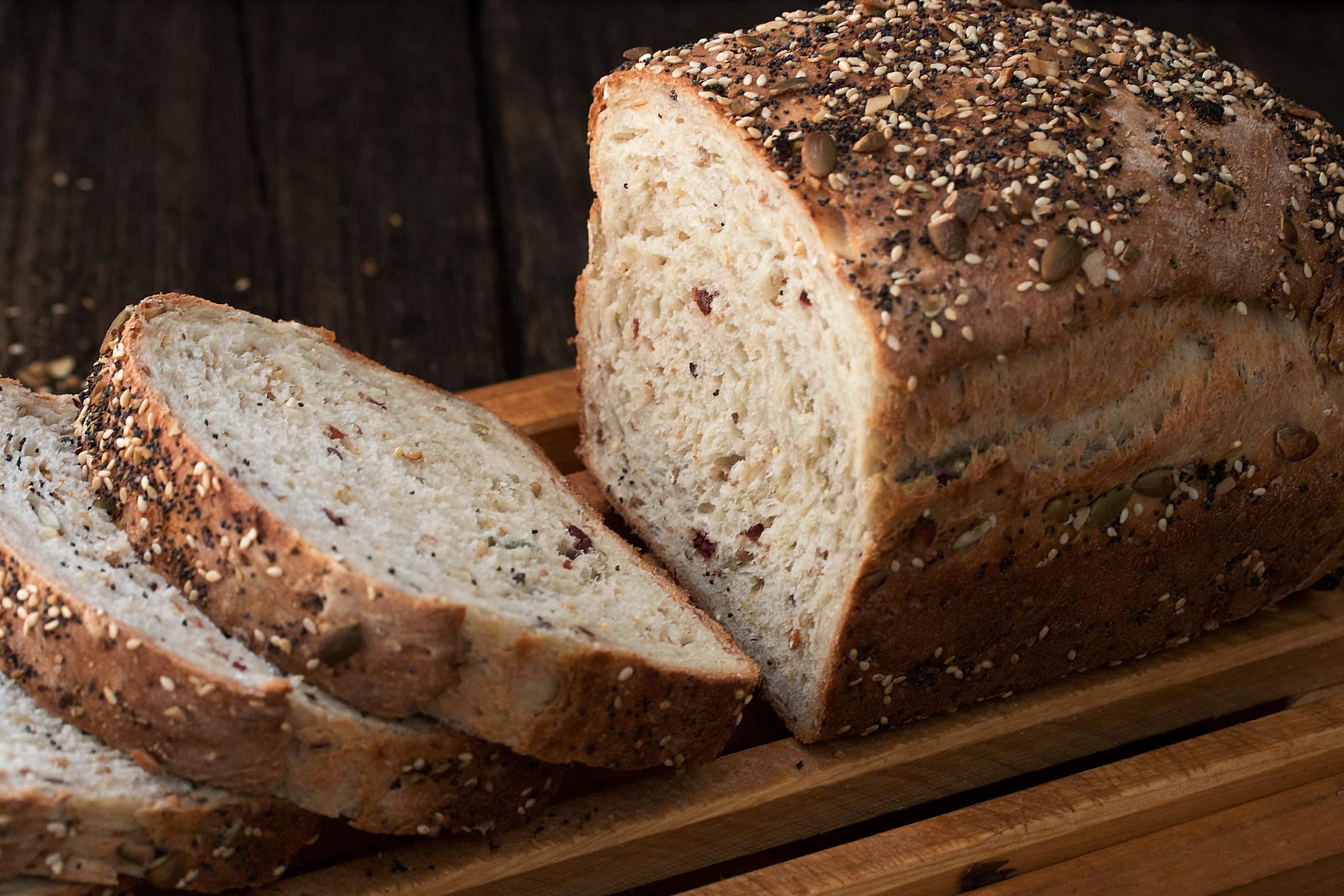
Try this Multigrain Bread recipe, or contribute your own.
- 1 1/4 cups seven grain cereal mix
- 2 1/2 cups boiling water mix with cereal and let sit about 1 hour, or until 100 degrees
- 1/4 cup honey
- 4 tablespoons melted butter, cooled add to cereal mix, and mix on low until combined
- 3 cups all purpose flour
- 1 1/2 cups whole wheat flour combine flours. add to wet mixture 1/2 cup at a time i(in stand mixer). knead 1 1/2 - 2 minutes, until cohesive mass starts to form. cover with plastic and let rest 20 minutes.
- 1 tablespoon salt add and knead 3-4 minutes. if dough does not clear side add up to 3 t flour. knead for 5 minutes.
- Carbohydrate 112.502011954938 g
- Cholesterol 0 mg
- Fat 1.75480017959559 g
- Fiber 8.02742264763206 g
- Protein 15.823710694145 g
- Saturated Fat 0.289350538609506 g
- Serving Size 1 1 Serving (223g)
- Sodium 26.8792760823989 mg
- Sugar 104.474589307306 g
- Trans Fat 0.544530161600578 g
- Calories 524 calories
Step-by-step
- Place dough in greased bowl, turning to grease top.
- Cover with plastic wrap and let rise 45-60 minutes, or until doubled.
- Grease pans - two 9x5 loaf pans, or 3 aluminum foil pans, plus 1 pr 2 little ones.
- Divide dough.
- Press into rectangle to fit pans, roll into tight cylinder.
- Pinch seams together.
- Spray with cooking spray and roll in whole oats.
- Place in pans, seam side down.
- Cover with plastic wrap and let rise until doubled, about 30-40 minutes.
- Dough should spring bake slightly when punched with a knuckle.
- Heat oven to 375(F) degrees.
- Bake 35-45 minutes, or until loaves reach 200(F) degrees inside.
- Remove to wire racks to cool.
Hydration and Temperature Control
Why does the boiling water mixed with the seven-grain cereal require cooling down to precisely 100 degrees before adding yeast or other sensitive elements? Introducing boiling liquids directly to active cultures destroys them, while water that is too cold fails to soften the hard outer hulls of the grains adequately. Monitoring this thermal threshold with an instant-read thermometer ensures the porridge base hydrates the starches completely without compromising structural integrity.
Gluten Development and Rest Periods
Adding flours incrementally prevents the heavy grain mixture from seizing and allows the gluten network to organize under controlled mechanical action. Incorporating the salt only after the initial rest period prevents early dehydration of the protein strands, which otherwise results in a tight, crumbly texture rather than an extensible dough. Kneading requires sustained friction until the mass cleanly clears the sides of the mixing bowl.
Shaping and Thermal Tracking
Rolling the divided dough into tight cylinders eliminates trapped air pockets that cause large, irregular voids inside the baked crumb. Baking concludes reliably when an internal probe inserted into the center of the loaf registers 200 degrees Fahrenheit, signaling that the starches are fully gelatinized and the interior moisture has evaporated sufficiently for a stable structure.



