Almond Pesto Chicken
A bit of a charge from traditional pesto - I usually have this with rice or pasta.
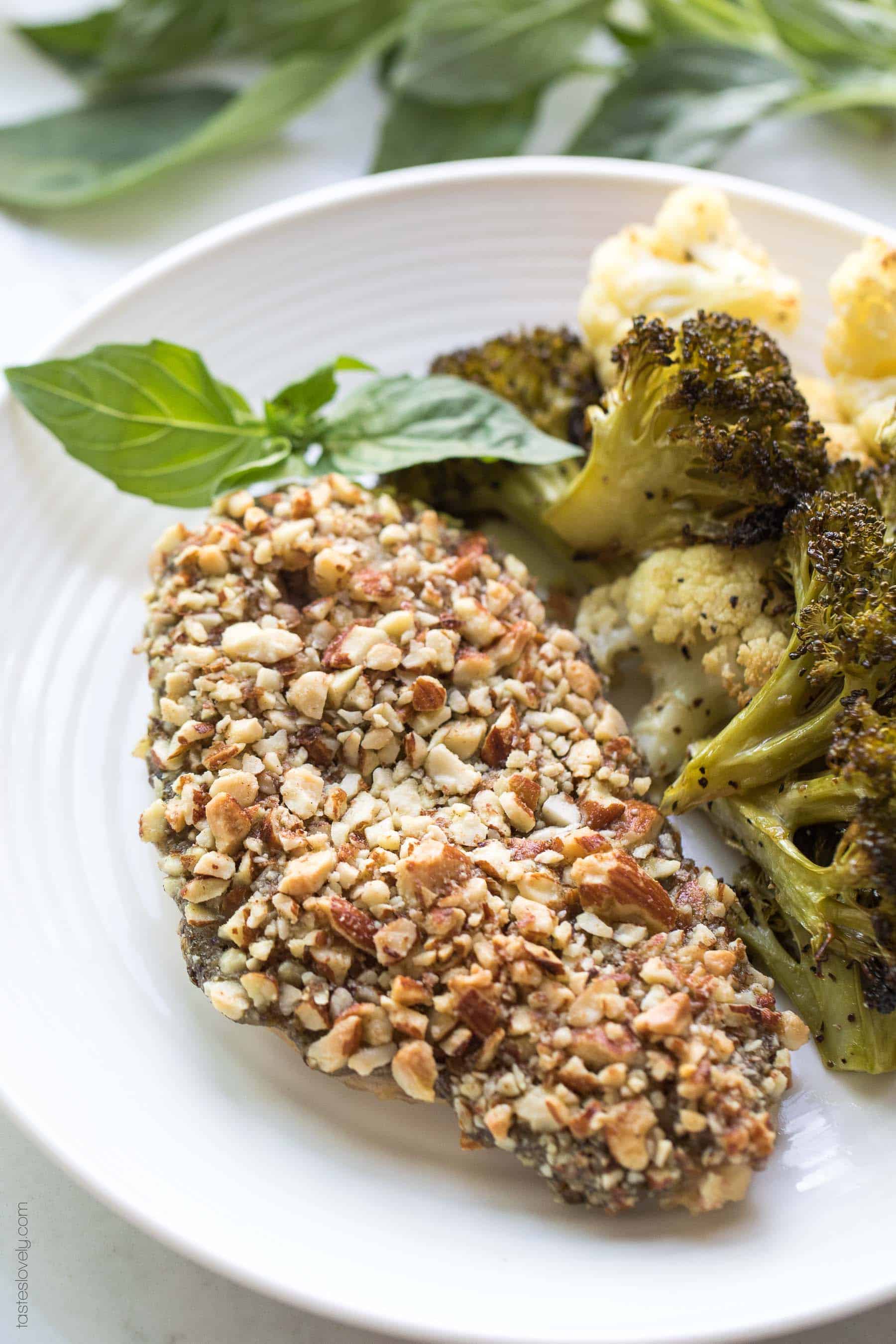
A bit of a charge from traditional pesto - I usually have this with rice or pasta.
- Carbohydrate 4.76359104166667 g
- Cholesterol 126.824632 mg
- Fat 35.0877267604167 g
- Fiber 1.71833753079176 g
- Protein 43.89291839375 g
- Saturated Fat 8.22385318416667 g
- Serving Size 1 1 Serving (303g)
- Sodium 225.886559625 mg
- Sugar 3.04525351087491 g
- Trans Fat 2.18005558208334 g
- Calories 514 calories
Step-by-step
- Chop the garlic. almonds, and 1 cup basil in a food processor.
- Add 1/4 cup oil, the Parmesan, salt, and 1/4 tsp pepper.
- Spoon 1/2 of the pesto over the chicken and broil on a foil-covered pan for 10 minutes.
- Turn chicken, top with remaining pesto. and broil another 8-10 minutes.
- Chop the tomatoes and add the remaining 2 tbs basil, 2 tbs olive oil. 1/8 tsp pepper, and the cider vinegar, and serve over the chicken.
Most home cooks ruin pesto-coated poultry by applying too much direct heat too quickly, causing the garlic and fresh herbs to scorch before the interior reaches a safe temperature. Traditional Italian pestos rely on pine nuts, but substituting almonds introduces a denser cellular structure that behaves differently under a broiler. Almonds contain higher concentrations of structural proteins and less total oil than pine nuts, yielding a coarser paste that adheres well to raw meat surfaces without instantly breaking down into liquid fat.
Technique and Application
Processing garlic, almonds, and basil together creates a cohesive paste only when the mechanical blades of the food processor are used in short pulses. Continuous running friction heats the basil leaves, releasing polyphenol oxidase which oxidizes the bright green chlorophyll into a dull brown pigment. Add the olive oil in a steady stream only after the nuts and herbs are fully broken down to emulsify the fat correctly. When broiling chicken breasts, position the foil-covered pan approximately six inches below the heating element to balance surface browning with internal cooking times.
- Avoid overcrowding the baking pan, as trapped moisture prevents the broiler from rendering the olive oil properly.
- Monitor the garlic closely during the initial ten-minute broil; any pieces protruding above the pesto layer will burn if the heat source is too intense.
- Check internal temperature with an instant-read thermometer inserted into the thickest portion of the meat until it registers 165 degrees Fahrenheit.


