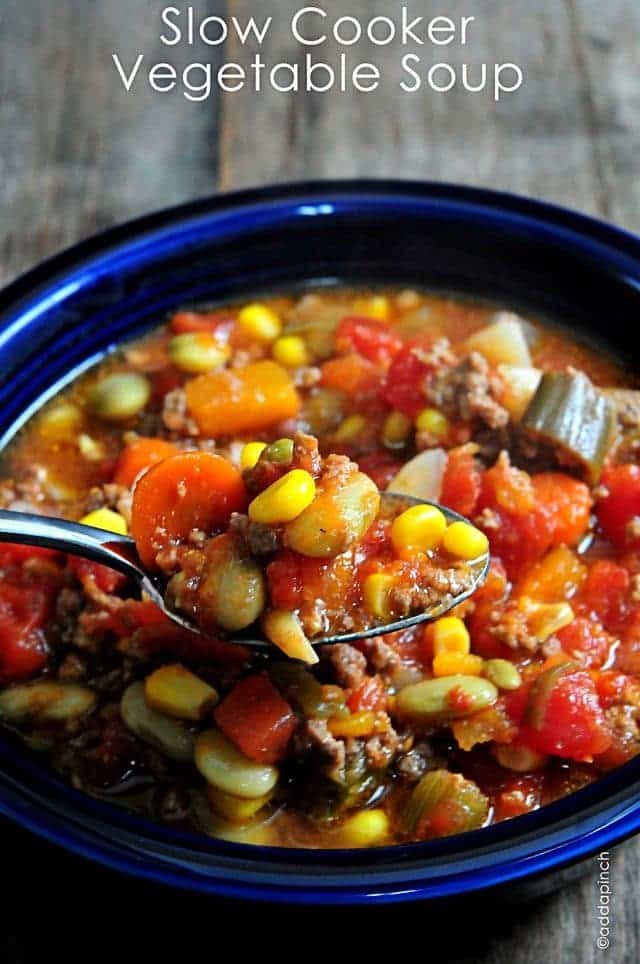
Try this Slow Cooker Vegetable Broth recipe, or contribute your own.
- Carbohydrate 27.0885851527073 g
- Cholesterol 0 mg
- Fat 17.4141065442351 g
- Fiber 10.5468546995152 g
- Protein 3.62422808687331 g
- Saturated Fat 2.07101507807011 g
- Serving Size 1 1 Serving (1380g)
- Sodium 109.854526129831 mg
- Sugar 16.541730453192 g
- Trans Fat 1.57358340865539 g
- Calories 248 calories
Step-by-step
- Heat the oil in a nonstick skillet over medium-high heat. Add the onion and carrot and cook, stirring frequently, until the vegetables begin to brown, 8 to 10 minutes.
- Place in a slow cooker with water, leek tops, celery, turnip, mushroom and seasonings. Simmer on high 6 to 8 hours, or overnight, until vegetables are very soft. Strain off stock and discard vegetables.
- Variation: Instead of using leeks, you can use a combination of 2 or more of the following: loosely packed spinach leaves and stems, lettuce leaves, tomato skins, fresh mushroom stems, or diced parsnips along with some additional chopped celery and carrot to equal 3 cups vegetables.
Operating without a stove leaves room for the slow cooker to do the heavy extraction work over an extended period. Standard slow cookers hold between four and six quarts, meaning this ten-cup liquid volume fits comfortably inside most medium appliances without boiling over. Doubling the recipe requires a minimum six-quart vessel to ensure proper headroom for convection currents. Halving the batch works well in smaller three-quart cookers, provided the solid-to-liquid ratio remains balanced. When scaling up, do not increase the dried mushroom proportion at a linear rate. Dried fungi contain concentrated umami compounds that easily overpower delicate alliums if overdone. Keep the bay leaf count at one for batches up to twelve cups to prevent medicinal bitterness. Strain the finished liquid through a fine-mesh sieve lined with cheesecloth to catch microscopic silt from the leeks and turnips. Store cooled stock in rigid plastic containers with one inch of headspace for liquid expansion during freezing. Frozen broth maintains optimal quality for three months at zero degrees Fahrenheit before degradation begins. Thaw frozen blocks overnight in the refrigerator before using them as a base for soups or grain cooking liquids.


